


 Navistar Logo PNG
Navistar’s logo conveys strength and highlights travel and transportation. The logo’s diversity conveys the corporation’s multifaceted work. Sharp angles and peaks foreshadow leadership.
Navistar’s history reaches back to 1831, when 22-year-old Cyrus McCormick invented a mechanical reaper on his family’s farm in Virginia. The machine replaced the work of many farm laborers and helped push agriculture toward mechanization. McCormick died in 1884, but the company built around his invention remained active.
On August 12, 1902, McCormick Harvesting Machine Company, Deering Harvester Company, and three smaller manufacturers merged to form International Harvester. The new group became the largest U.S. maker of farm machinery, with 85 percent of the domestic market. By 1910, it was among the four largest companies in the United States. It operated plants in Sweden, Germany, Russia, and Australia.
The company expanded beyond agricultural machinery in the early 1900s. Engineer Ed Johnston developed its first gasoline engine in 1904, its first automobile in 1907, and its first truck in 1909. In 1924, International Harvester launched the Farmall tractor, which later became an industry benchmark. During World War II, the company produced military trucks for the U.S. Army, including the M series used by the Marine Corps.
By the late 1970s, International Harvester was under heavy pressure. A 172-day strike in 1979 and 1980 weakened key operations, and the company began selling major divisions to Dresser Industries, Caterpillar, MTD Products, and Tenneco. On January 7, 1986, the International Harvester name was replaced by Navistar International, with the business focused on trucks and diesel engines. Navistar later supplied engines to Ford Motor Company, acquired AmTran, developed IC Bus, and in 2021 became part of TRATON alongside Scania, MAN, and Volkswagen Caminhões e Ônibus.
Meaning and History
The logo reflects the company’s major milestones, highlighting its growth and expansion. Conveys the ambition of a leader. It reflects the company’s direction. It conveys the power of big cars and long-distance trips on intercity highways. The use of road signs, present across all variants of the emblem, connects the company to the transport sector.
What is Navistar?
This is a well-known manufacturer of trucks, buses, and military vehicles under the International brand. It produces durable work machines for tough tasks on North American highways and construction sites. These vehicles are seen on roads worldwide, from iconic long-haul trucks to school buses transporting millions of children daily. Their military vehicles serve the armed forces of various countries, playing an important role in both civilian and military transportation.
1986 – 2001

After International Harvester’s bankruptcy, the new company, Navistar International Corporation, based on the HI truck division, created its logo.
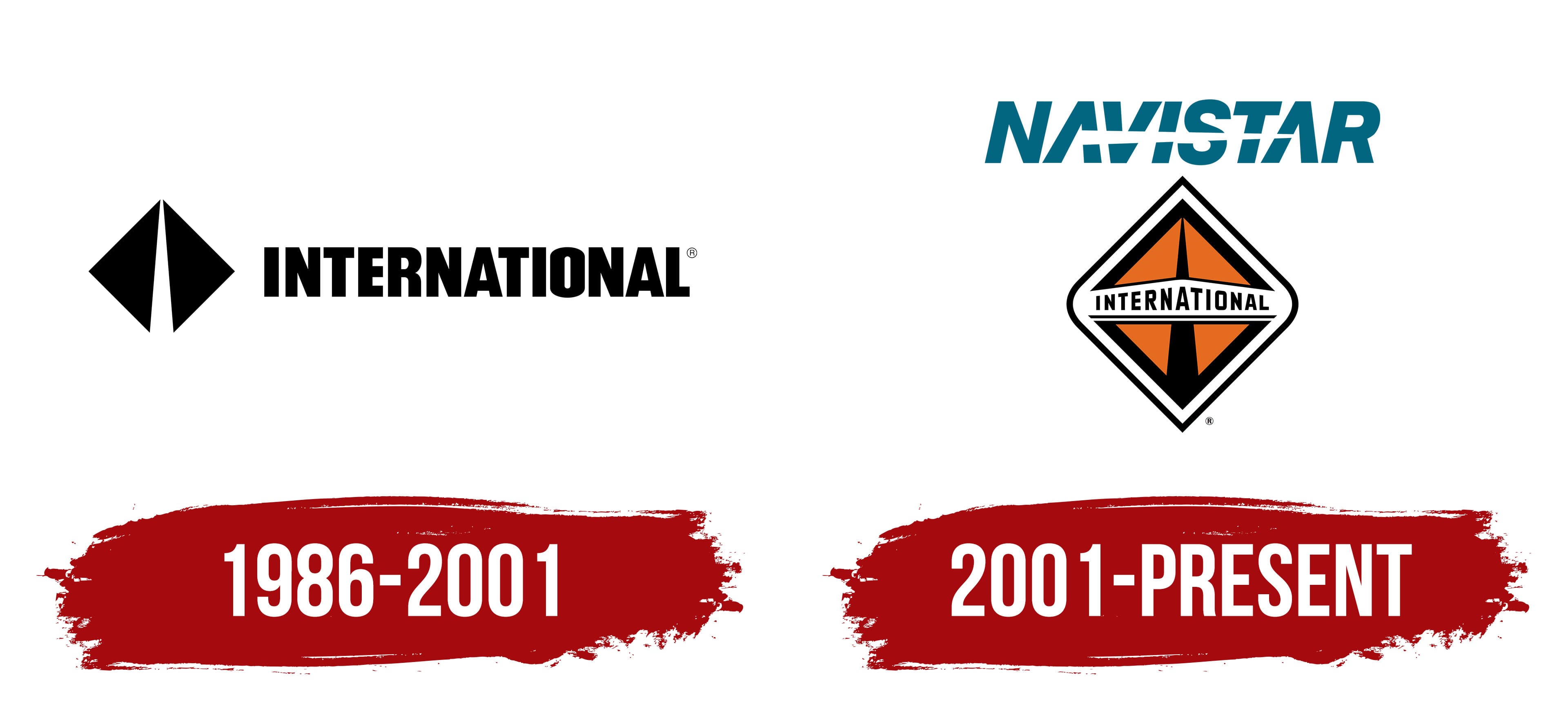
The emblem is represented by the image and the name following it. All elements are in black. The company inherited the idea of minimalism. The logo consists of two triangles connected at their vertices, forming an open rhombus.
The shapes show the subtle relationship between the two firms, the transfer of authority from a company that has completed its journey to a new one. The mirror reflection of the triangles shows that all the traditions, developments, and models will remain, just with different names.
In the center, there is a white road, where the figures are not completely closed. A new road on which the company’s heavyweights will travel.
The triangles also resemble wings beginning to unfold. Navistar planned to climb to the top again. And it succeeded. Having mastered light, medium, and heavy trucks, buses, armored cars, and engines, the fleet was expanded. In the first decade, 600,000 cars and engines were produced annually, and sales expanded to the United States, Canada, Mexico, and Latin America.
For the logo, the name used was not the company name but the trucks’ brand name. It is with their production that it all began.
2001 – today

The new logo has changed, but its concept remains the same. It still consists of an image and a name.
The name is stylized, written in capital letters, and between the two A’s, the word is pierced with a wedge cutting through it. It represents speed and forward motion, demonstrating the power of trucks and pointing to long distances and a roadway converging in the distance.
An image has been placed below the name. It was also redesigned. The two triangles changed color to orange. They were placed in a rhombus with two rounded corners. In the center, the name is written and placed on a white plate from the bumper.
The emblem looks absurd and cluttered, and its color scheme does not match the upper name at all. Therefore, they are most often used separately.
The rhombus represents the “Main Road” sign, indicating that all roads are open to the brand’s cars and intended for driving on the main highways. The road itself is placed between two triangles, with a black center strip.
Due to the sharp upper and lower corners, the whole picture seems to stretch upward, suggesting growth and a desire to surpass the competition and take leading positions in the market.
Placing the word “Navistar” at the head shows the company’s increased scale. International is now just one of its brands.
Font and Colors
The logo is quite motley. It includes blue-green, orange, white, and black colors. They don’t blend much, but they show the corporation’s multifaceted work.
- Blue-green is the color of the sea, indicating the firm’s spread like the sea’s waves, selling products to other continents.
- White: the new life of an old corporation, the start.
- Orange: striving for the sun, climbing into the sky, winning.
- Black: high-powered machinery, long-distance roads, and off-road driving.
The font of the inscription, Afical Neue Black Italic, is transformed by the break, making it unique, just as the company’s history became unique due to Navistar’s separation from the big corporation.