


 John Hancock Logo PNG
The John Hancock logo symbolizes the company’s reliability and reputation in financial and insurance services. The execution highlights solidity, trust, and a serious business approach, grounded in the brand’s historical traditions.
John Hancock was founded in Massachusetts in 1862 by a group of Boston businessmen. It was named after the former state governor and signer of the Declaration of Independence. The company entered a growing US life insurance market during the Civil War era, when demand for financial protection was rising. It later expanded beyond individual policies by offering group insurance to employers, giving the business a larger corporate client base.
By 1954, John Hancock ranked fifth among US insurers, with assets of about $3.8 billion. During the 1960s, the company diversified into real estate and mutual funds. It competed with firms such as Massachusetts Mutual while broadening its services. Its name became closely associated with the John Hancock Center in Chicago, opened in 1969 and for a time one of the tallest buildings in the world.
The high-interest-rate environment of the 1980s pressured insurers with long-term obligations, forcing John Hancock to adjust its investment strategy and broaden its asset mix. In 2000, the company demutualized and completed an initial public offering, changing from a policyholder-owned mutual insurer into a publicly traded corporation and gaining access to new capital.
In 2004, Manulife Financial acquired John Hancock in a major cross-border insurance deal. Manulife retained the John Hancock name for the US market rather than replacing it. At the same time, the business continued to offer insurance, retirement, and investment products under its established identity.
Meaning and History
What is John Hancock?
It is a Boston-based American insurance company providing financial and retirement services. Its name honors one of America’s founding fathers. A unique feature is its wellness program, which allows customers to earn points for physical activity by using fitness trackers. Points can be redeemed for discounts or gifts. The company is part of a major Canadian financial group.
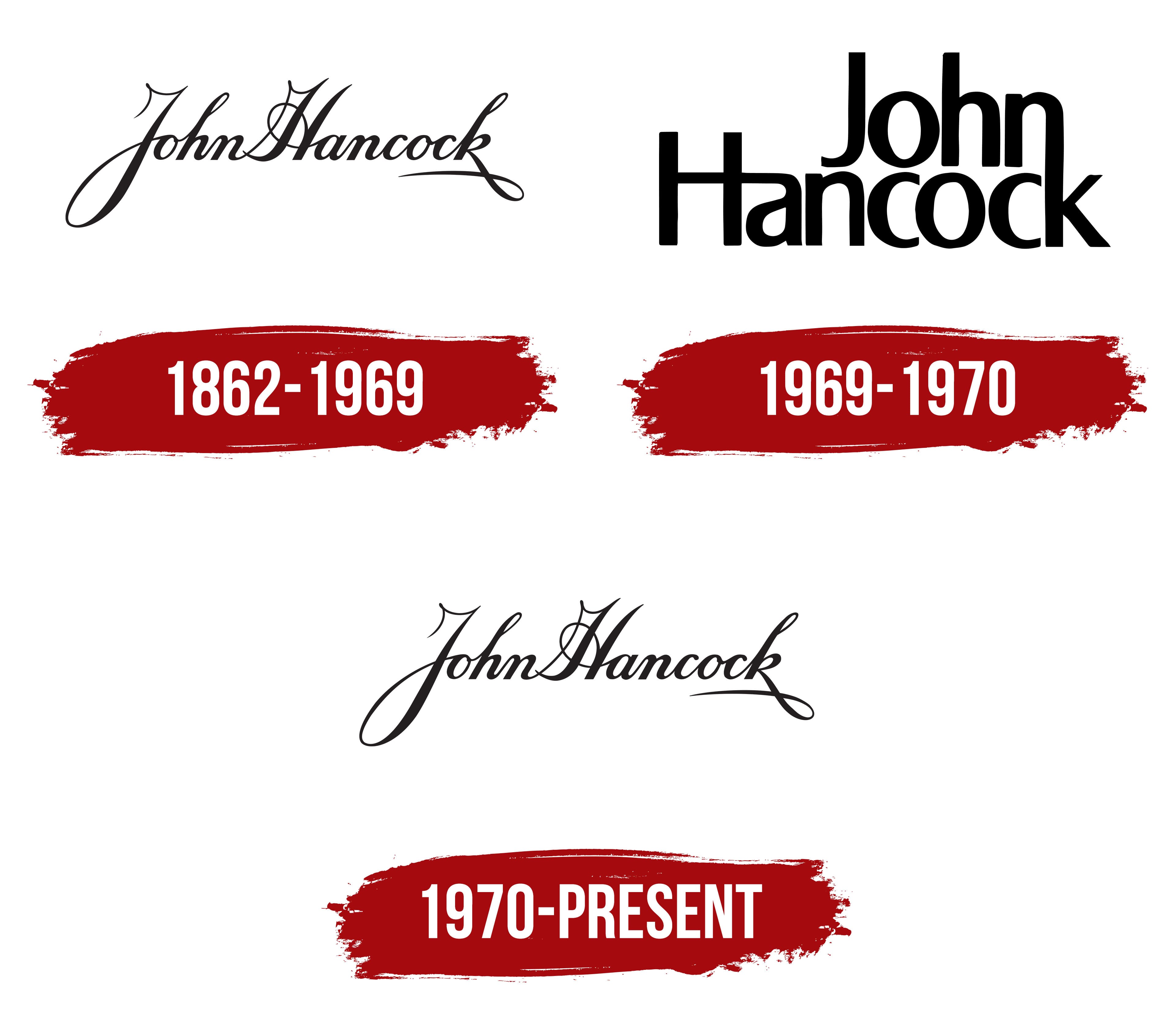
1862 – 1969

The John Hancock Insurance Company logo, introduced in 1862 and still in use today, except for a one-year break (1969-1970), is based on an exact stylization of John Hancock’s autograph, one of the Founding Fathers of the United States and the first person to sign the Declaration of Independence. This choice gives the logo symbolic meaning, embodying personal responsibility, authority, and a reputation for reliability that has been associated with the company throughout its long history. The brief decision to abandon the signature in 1969 was an unsuccessful experiment with a more modern design, after which the company returned to this classic version the following year.
Hancock’s autograph is rendered in the style of historic calligraphy, with characteristic elements: strong contrast in stroke thickness and an elongated uppercase “J” that descends sharply and forms a bold, wide loop. The baseline of the entire inscription is adorned with an elegant flourish typical of 18th-century handwriting. Smooth transitions from thin lines to thicker strokes emphasize the company’s prestige and solidity, while the writing style itself references historical documents, symbolizing stability and continuity of tradition.
Although the official font is not documented, the signature’s typographic characteristics resemble modern calligraphic typefaces, such as Italix Brushpen Sans, Gabor Pro, and Sunlight Script Bold by Typehill. These analogs share softness of form and a harmonious distribution of stroke thickness, creating the impression of a natural handwritten gesture.
The monochrome palette underscores the brand’s conservative, solid character, reinforcing its perception as a stable, authoritative, and professional organization. The black lettering on a white background draws attention to the inscription’s clarity, adding visual discipline and refinement to the mark.
The John Hancock logo is a direct analogy to a seal on a historical document, serving as a metaphor for personal commitment and high trust. The signature has become a visual expression of the company’s principles: consistency, personal responsibility, and continuity.
1969 – 1970

In 1969, John Hancock changed its logo for the first time in over a century, replacing the traditional autograph with a clean, typographic design. The new look was introduced by the New York studio Sandgren & Murtha and lasted only one year before being replaced by the classic version again in 1970.
The updated logo was a two-tier typographic composition. The top line featured the company name in a large sans-serif typeface, similar in form to Indecise SemiCondensed Regular or Newbery Sans Pro Medium. The lettering had horizontal proportions and bold, uniform thickness. The absence of serifs and the geometric precision of the letterforms emphasized the company’s modern, versatile, minimalist identity.
The use of a strict, simple typeface symbolically expressed the company’s desire to move away from associations with an antiquated, patriarchal past. However, the lack of emotional expressiveness in John Hancock’s historical signature elicited mixed reactions from clients and the market.
The experimental logo stood in stark contrast to the company’s traditional identity, shaped over a century. Despite the well-executed typography and professional detailing of the letterforms, the brevity and visual austerity of the new wordmark deprived the brand of an important emotional component: the sense of personal responsibility, reliability, and historical authority.
Its short-lived existence confirmed how deeply the historical signature was embedded in the company’s corporate culture. The 1970 return to the stylized Hancock autograph was an acknowledgment of tradition and a recognition that the powerful symbolism of a personal signature proved emotionally and strategically more compelling than the geometric neutrality of modern typography.
1970 – today

The previous typographic version of the John Hancock Insurance Company logo, introduced in 1969, was withdrawn in 1970. The company returned to the historical John Hancock signature, which has remained unchanged to this day. This version is displayed on the facade of the company’s headquarters and on the John Hancock Tower in Boston. Throughout the 20th century, the company’s classic autograph could also be seen on Fenway Park’s baseball stadium as an illuminated sign, reinforcing its status as an iconic symbol of the brand’s stability and historical authority.
Font and Colors
The John Hancock logo’s typeface is a calligraphic stylization of the actual signature, rendered in cursive with contrasting stroke widths. The letters form soft, flowing lines with elegant flourishes, elongated ascenders and descenders, and intricate swashes typical of 18th-century handwriting. The closest comparable fonts include Geshane Regular, Gold Leaves by Anza Letters, and Petunia Script Bold, all of which share similar glyph shapes and stylistic features.
The logo’s color palette is monochrome, with black lettering on a white background. This color pairing was chosen deliberately to convey the company’s seriousness, authority, and status. Black is traditionally used in the financial sector as it evokes solidity, stability, and professionalism. The absence of additional colors makes the logo visually refined and gives it a timeless quality, ensuring the brand remains relevant and recognizable regardless of changing design trends.