


 Las Vegas Raiders Logo PNG
The Las Vegas Raiders logo conveys the team’s aggressive style and fighting spirit. Its strict, concise design emphasizes confidence, determination, and the club’s uncompromising character regardless of its home city.
The Raiders were founded in Oakland in 1960 as one of the eight original American Football League franchises. Early financial and sporting problems eased after Al Davis arrived as coach and later became a co-owner. His emphasis on speed, physical play and deep passing turned the club into an AFL contender. After the 1970 merger with the NFL, Oakland remained a regular playoff team.
John Madden led the Raiders to their first Super Bowl title after the 1976 season, defeating the Minnesota Vikings. Under Tom Flores, they won again after the 1980 season against the Philadelphia Eagles. A third championship followed after the 1983 campaign, when the team defeated the Washington Redskins 38-9.
Davis had moved the franchise to Los Angeles in 1982 despite opposition from league officials. He won the resulting legal battle, but the club returned to Oakland in 1995. Problems surrounding the aging Coliseum continued for years. After Davis died in 2011, control passed to his son Mark, who made a modern stadium the organization’s main priority.
League owners approved relocation to Las Vegas in 2017. Allegiant Stadium opened in 2020 with about 65,000 seats and cost nearly $2 billion. The move followed the Vegas Golden Knights’ early success in the local sports market. In February 2024, the arena hosted Super Bowl LVIII between the Kansas City Chiefs and San Francisco 49ers, placing the former Oakland franchise’s new home at the center of American football’s championship weekend.
Meaning and History
What is Las Vegas Raiders?
It is an American football club in the NFL’s Western Division, previously based in Oakland and Los Angeles. The team has won three Super Bowls, the most recent of which was won while based in Los Angeles. Known for an aggressive playing style, tough defense, and willingness to sign controversial players who later successfully revived their careers. The team frequently had conflicts with the league over relocation-related lawsuits. After moving to Las Vegas, the club received one of the NFL’s most expensive stadiums.
1960 – 1962

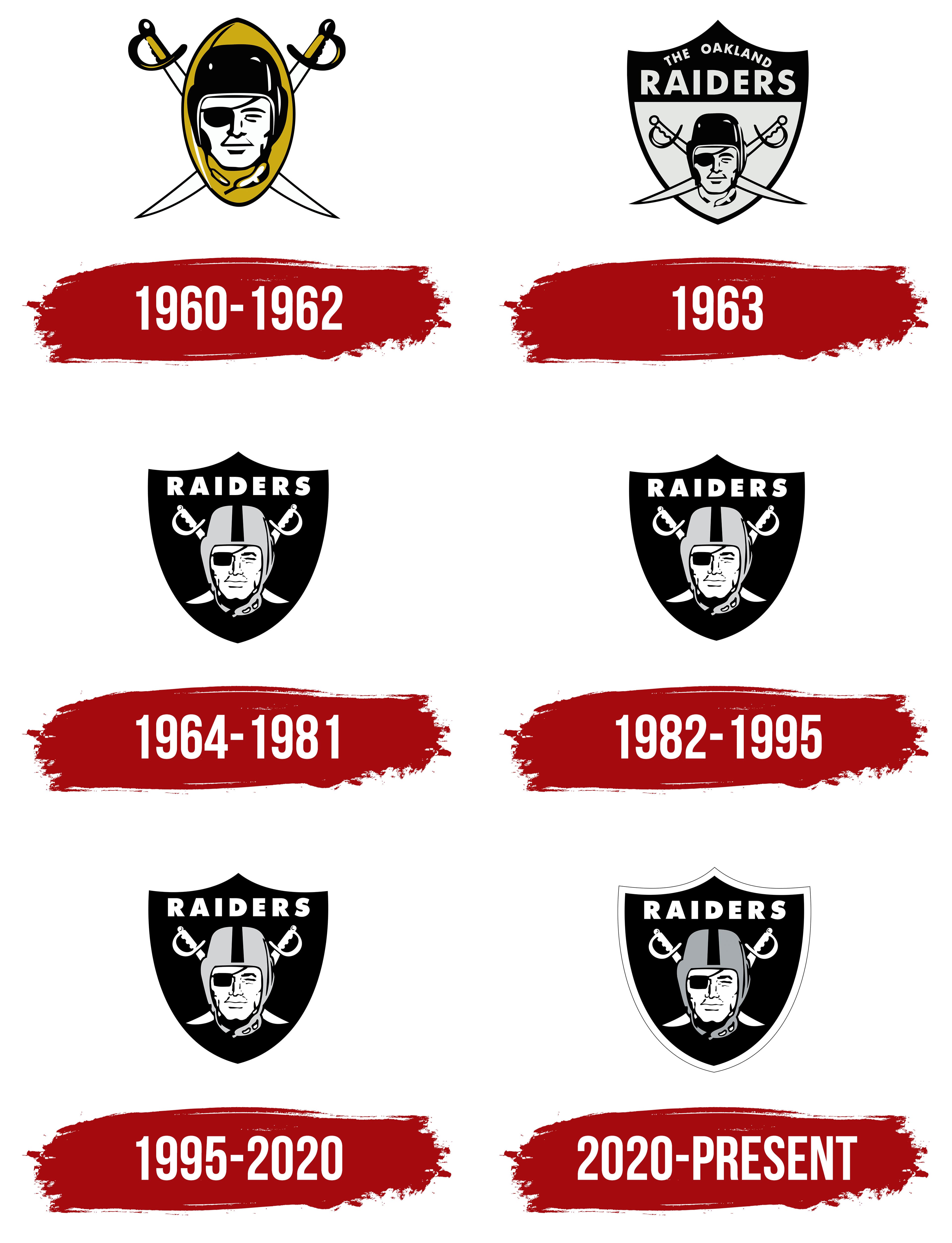
A sense of urgency accompanied the creation of the first Raiders emblem, as the team needed to quickly prepare for its debut in the American Football League. Several specialists were responsible for developing the visual identity, including sports illustrator Tony Morito, invited by Jake Hughet to shape the initial image, and artist Karl Kommaci, who handled adapting the sketch for practical use on uniforms and the club’s printed materials.
The emblem contained no text elements, while the name Raiders appeared separately on the team’s equipment and documentation. The design was inspired by the image of a pirate wearing a football-style leather helmet with an open chin, a key detail being a black eye patch over the left eye, which reinforced the maritime outlaw theme. The character’s face was depicted in a simple graphic style with a clear lean toward the late 1950s cartoon aesthetic, featuring sharp contours and simplified proportions.
The background element was shaped as an elongated golden shield. Behind the pirate were two crossed sabers with black blades and roughly drawn golden hilts, visually stabilizing the composition and resembling the militant symbolism of traditional heraldic emblems.
The emblem’s overall character was marked by simplicity and hand-drawn execution, typical of the era’s visual culture. At the same time, the limited color palette, dominated by gold, black, and white, emphasized practicality and ease of perception.
1963

The Raiders’ emblem, introduced in 1963, served as the foundation of the team’s long-term image, which remained largely unchanged through subsequent club relocations. The redesign coincided with Al Davis’s appointment as head coach and general manager. His decision resulted not only in an updated logo but in a new black-and-silver palette replacing the former gold. Created by local illustrator Karl Kommaci, who had also been involved in designing the first emblem, the new mark adopted fundamentally different proportions and a more refined element structure.
The chosen form was a horizontally stretched shield with curved upper edges and strict symmetry, executed in shades of black and silver-gray, symbolizing strength, aggressiveness, and confidence. The upper part of the shield was occupied by the heavy inscription RAIDERS, set in uppercase geometric grotesque letters with uniform stroke thickness, similar in style to Helvetica Black. Above this massive element, a smaller inscription, THE OAKLAND, was added in small capitals and arranged along a curved arc, visually balancing the logo’s overall shape and adding extra dynamism.
The pirate character played a crucial role in the emblem’s perception, serving as the central figure of the club’s visual identity. His face, stylized in a strict graphic form, retained familiar elements: the leather football helmet and the black eye patch, which enhanced the resemblance to the classic image of a seafaring raider. The portrait lines were improved over the previous version, with bolder, more precise contours that are better suited for printing and smaller formats. A distinctive feature was the crossed sabers behind the figure, harmoniously integrated into the composition and underscoring the emblem’s fighting spirit and historical symbolism.
1964 – 1981

After introducing the updated emblem in 1964, the Raiders finally established a visual style that remained relevant for the next 17 years and became an integral part of the team’s success, particularly the Super Bowl XI victory in 1977. The team moved and became known as the Los Angeles Raiders. The new version was a modified version of the previous one, released just a year earlier. Still, substantial adjustments gave it stability and solidity.
The shield lost the original inscription “THE OAKLAND”. It retained only the word “RAIDERS,” presented in bold uppercase letters set in a heavy geometric grotesque typeface resembling Impact or Helvetica Black. The absence of a city name made the symbol universal and easily adaptable to relocations, a feature that proved useful during the team’s moves.
The shield background turned black, and the white inscription stood out sharply, conveying confidence and strength. The color palette was finally established in a combination of silver, black, and white, creating a distinctive metallic aesthetic and reinforcing associations with aggression and dynamism.
The central pirate figure underwent refinement. The face became more defined, with the chin and cheek lines receiving greater detail, and the expression gained greater confidence. The helmet, painted silver, was complemented by a wide, vertical black stripe running down the center. The stripe referred to the typical helmet design of the time, emphasizing the football connection and strengthening the player’s masculine image, consistent with 1960s aesthetics.
The crossed sabers behind the head were shortened, no longer extending beyond the shield. They acquired symmetrical shapes with enlarged hilts and guards. Their new form contributed to greater visual harmony, creating a balanced composition.
The development and stylistic adjustments were carried out with the participation of Karl Kommaci, who had earlier contributed to the first Raiders design. His modifications ensured the logo’s durability, allowing it to be used in various formats and scales with unchanged recognizability.
1982 – 1995
The Raiders’ move to Los Angeles in 1982 did not result in a redesign of the emblem since the previous version had no geographic reference. For this reason, the mark retained its strong image without adaptation in the team’s new phase. The design remained unchanged: a black shield with a white outline, a large white word “RAIDERS” set in bold geometric grotesque with uniform, dense strokes, and a pirate figure at the center of the emblem.
Although the design was not reworked, the logo took on additional meaning beyond its sports context, becoming part of Los Angeles’ urban culture. It turned into one of the symbols of street fashion and youth subculture, spreading among rap fans after being popularized by the group N.W.A. The classic shield with the pirate became associated with defiance, protest, and street spirit, acquiring iconic status among youth and beyond the football field.
1995 – 2020

After the Raiders returned to Oakland in 1995, the club made no attempts to change the emblem, continuing to use the version developed back in 1964 that had become part of its historical identity. Because the design lacked a city reference, the emblem endured another relocation without visual loss, highlighting its universality and stability.
2020 – today

After the Raiders moved to Las Vegas in 2020, the club preserved the emblem almost unchanged, continuing the strategy established in 1963. This eliminated the need for adaptation, as over the decades, the symbol had achieved widespread recognition and was firmly associated with the team, regardless of location.
The main design elements remained intact. The black shield with a contrasting white outline. The large RAIDERS inscription in bold sans-serif grotesque, similar to Helvetica Black, and the portrait of the pirate in a leather helmet with a vertical black stripe across the top of the head and the signature black eye patch over the left eye. The image’s emotional tone was also preserved: the character’s expression remained confident and restrained.
The shield received an additional white border along its edges, emphasizing its shape and giving the mark a sense of completeness. This frame was complemented by a thin black line, enhancing the contrast and depth. Another change was the use of a slightly darker shade of gray for the helmet, which added richness and depth to the design.
The logo, which has preserved its original structure and strict palette of black, white, and silver, remains a key element of the team’s identity, serving as a symbol of the new Raiders era at Allegiant Stadium in Las Vegas.
Font and Colors

The upper part of the emblem features an inscription in large, evenly spaced capital letters, set against a geometric background. The stroke weight is evenly distributed, giving the letters stability and a sense of solidity. The lettering resembles Extra Bold versions of Futura, known for their concise construction and clean lines.
The color palette is based on three contrasting tones: black, light gray, and white. Black fills the background, creating a solid foundation for all elements. Gray is used for the helmet rendering and details. At the same time, white highlights the inscription and contours, forming visual balance. This combination is associated with strength and toughness, in line with the early 1960s, when it first became linked to the team.