


Modulify has brought website creation and publishing together in version 2.0 and updated its logo. In summer 2026, the service introduced a black radiating emblem and a lowercase serif wordmark. The changes accompany its evolution from a tool for preparing Webflow layouts into a platform that generates, hosts, and launches projects.
Previously, Modulify helped designers build sitemaps, prepare layouts, and design pages, then complete and publish projects in Webflow. According to the company, about 30,000 people had registered for the service. The platform now supports creating websites, web apps, and dashboards, shortening the path from idea to working project.
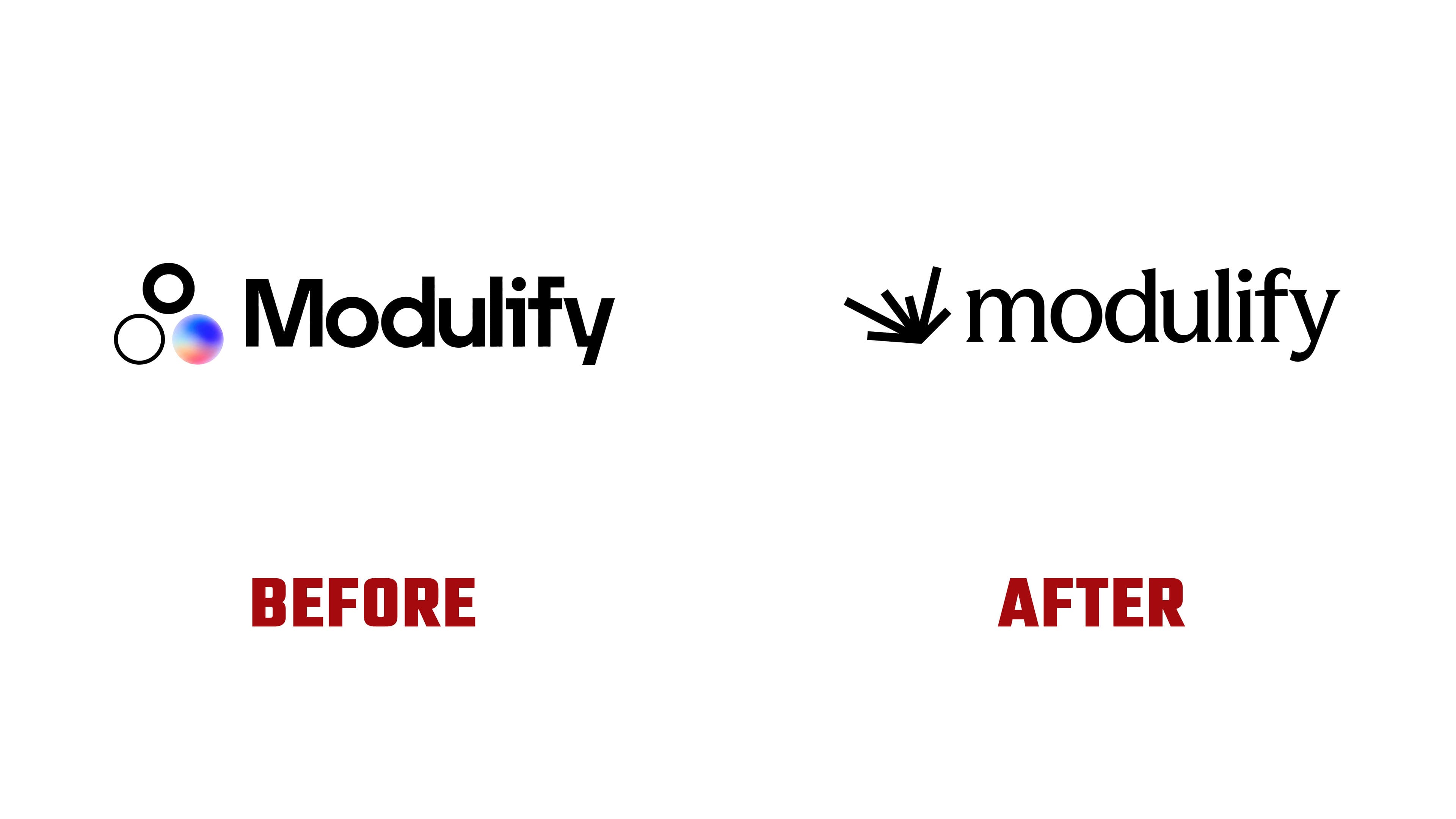
The previous Modulify wordmark began with an uppercase “M” and used a tightly set sans-serif typeface with rounded counters. The new Modulify wordmark is entirely lowercase and uses a serif typeface. Thick main strokes combine with thin connecting strokes. Small serifs appear on the stems of the “m,” while the “d” and “l” rise above neighboring letters. The top of the “f” curves, and the “y” descender ends in a hooked tail.
An asymmetric cluster of rays sits to the left of the name. They converge at the lower right and fan upward and to the left. Two long strokes define the emblem’s reach, with shorter strokes filling the spaces between them. Flat ends preserve its angular contours. The shape resembles a burst of light, contrasting with the wordmark’s smooth curves.

The previous emblem consisted of three circles arranged in a triangle. The upper circle had a thick black outline, while the lower-left circle had a thin one. The lower-right circle featured a blurred spot blending light blue, purple, and pink. In the new version, lines of varying lengths replace the circles and blurred color. Both the symbol and name are now black.
The arrangement remains unchanged, with the emblem on the left and the wordmark on the right. On the website, the logo appears alongside white surfaces and dark text. Color has moved into the surrounding interface, where orange gradients frame the prompt field.
In Modulify 2.0, prompt-based generation replaces assembling pages from prebuilt sections. The service creates the structure, design, and copy, and users request further changes through instructions. Integrations with Figma, Notion, HubSpot, Stripe, and other services connect client content and data during development. The team hosts and publishes the finished project on the platform.