


 Nordstrom Logo PNG
The emblem’s simple, pointed lines reflect completeness. The Nordstrom logo represents everyday goods at affordable prices, without extravagance or pretentiousness. Department stores are a familiar place for relaxed daily shopping.
Nordstrom began with Johan Nordstrom, a 16-year-old Swede who left Alvik in 1887 with five dollars and no English. After years of work in mines, logging camps, and the Klondike gold rush, he returned to Seattle in 1899 with $13,000. There, he reconnected with Carl Wallin, a Swedish shoemaker he had met in Alaska.
In 1901, they opened Wallin & Nordstrom on Fourth Avenue and Pike Street in Seattle. The shop was only about six meters wide and made $12.50 on its first day. By 1905, annual sales reached $80,000, and in 1923, the partners opened a second store in Seattle’s university district.
John Nordstrom retired in 1928 and passed his share to his sons Everett and Elmer. Carl Wallin left a year later, and Lloyd Nordstrom joined in 1933. Despite leather rationing during World War II, the family kept the business running and later built the largest independent shoe chain in the United States. By 1958, Nordstrom had eight stores in Washington and Oregon.
The company moved beyond shoes in 1963 by acquiring Best Apparel and renaming itself Nordstrom Best. It went public in 1971, opened the first Nordstrom Rack in 1972, and became Nordstrom, Inc. in 1973 after sales passed $100 million. Expansion reached Alaska in 1975, Southern California in 1978, the East Coast in 1988, and Nordstrom.com in 1998. HauteLook was bought in 2011, Canada opened in 2014, and then closed in 2023. Nordstrom spent decades competing with Macy’s and Saks Fifth Avenue through fashion retail and service.
Meaning and History
John W. Nordstrom (née Johan Nordström, an immigrant from Sweden) became wealthy during the Klondike Gold Rush, married an American, and began looking for a suitable business. In the end, he chose a shoe store, which he called Wallin & Nordstrom. As co-founders, he brought in a knowledgeable person: the shoe repair shop owner. A dynasty gradually emerged as Nordstrom had five children. Three of them inherited his business: he sold them his shares. Wallin did the same when he decided to retire.
At first, two brothers ran the company. They improved the store and reconstructed its building. In 1933, a third brother joined them, and for about 40 years, the brothers ran the company together, still selling shoes. Over time, the situation changed as department stores underwent transformations, management changes, expansions, and the formation of distribution networks. In addition to footwear, the assortment has been expanded to include other products, allowing customers to dress from head to toe. That is why the stores have reached full cycle status.
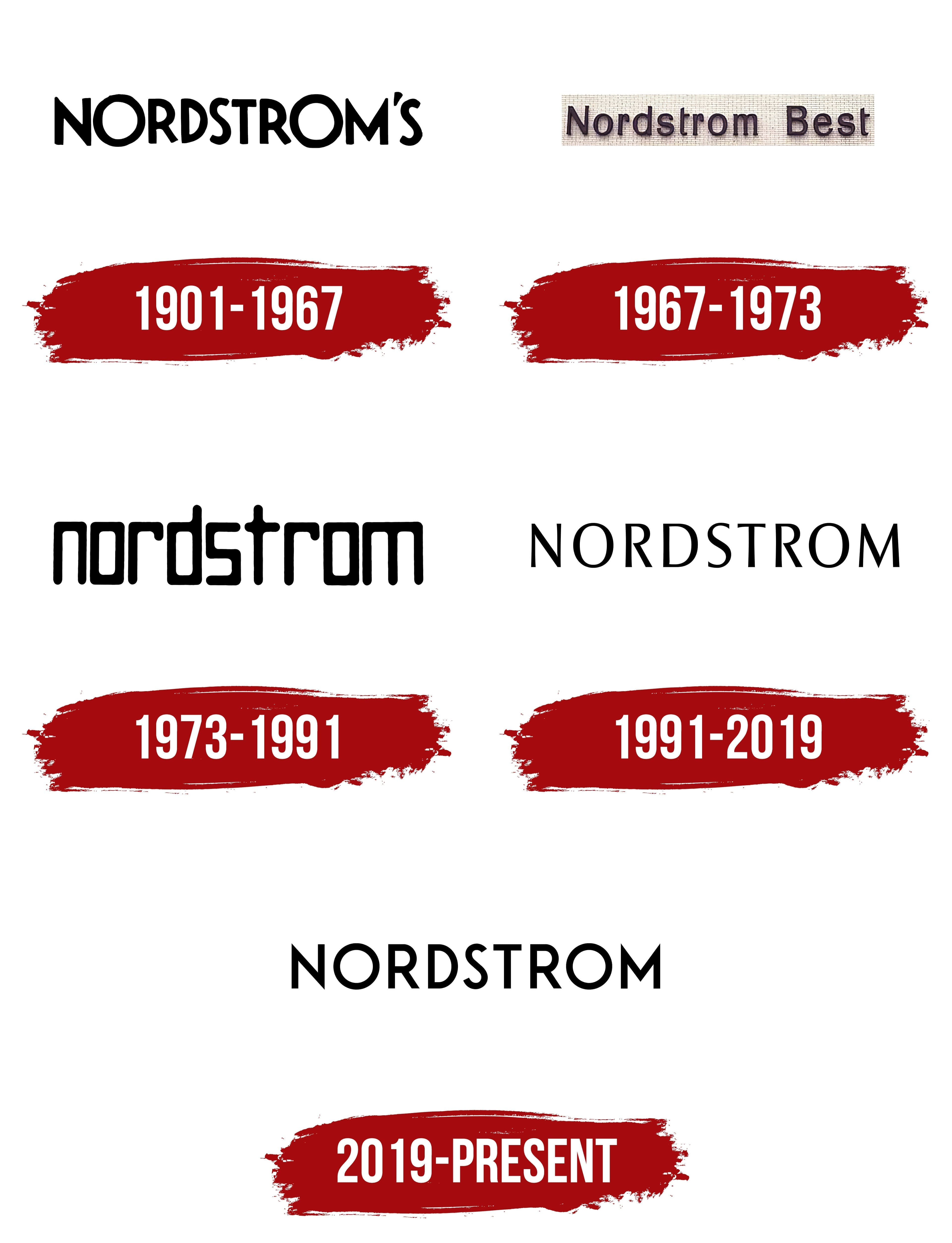
But they were united not only by the products they offered: they also shared a single emblem, which served as a sign and appeared above the entrances of all points of sale. In total, the arsenal includes five types of logos. They are textual, but they converge; they have completely different styles.
1901 – 1967
For the first six decades, the store used an “S” sign with an apostrophe at the end. It meant the brand belonged to the Nordstroms. Three brothers ran the company. The inscription was made of capital letters, chopped and smooth but not quite even. Some parts of the sign were just different sizes. The largest was the “O”: it looked like a large hoop. More massive than the rest, it also looked like an “M” and an “N.” The title had no background; it used only white space.
1967 – 1973

The rebranding prompted the logo change, so the identity at the time was based on the name “Nordstrom Best.” Almost all letters were in lowercase, except for the first. The distance between the symbols increased, while the symbols themselves became more voluminous, with light shadows and gray backgrounds with small dots. Both ts had half of the bar cut off, and the s got a deep bend.
1973 – 1991
Lowercase characters dominated the era’s emblems. The apostrophe and “S” have completely disappeared from the name. The letters were rectangular and harmoniously matched in style and proportion. The symbols had rounded corners. They looked as if they were made one piece at a time, with unnecessary parts removed. For example, “o” was a full-length vowel. In contrast, “n,” “r,” and “d” looked like fragments of it because they were nearly identical. Only “t” and “m” were knocked out: the first letter looked like a cross with an offset crossbar, and the second was perceived as a double “n.”
1991 – 2019
The symbols again have wide inter-letter spacing and a traditional form. After moving to the upper register, “O” became classically oval and “S” wavy. This version of the lettering on the Nordstrom sign is recognized as the most sophisticated and elegant for its smoothly widening and narrowing lines.
2019 – today
The modern logo features tapered lettering at the ends. This is seen in “M,” “N,” and “D.” The other letters have smooth, blunt cuts. The “O” in this version of the identity is not oval or rectangular; it is perfectly round.
Font and Colors
Throughout history, the Nordstrom department store chain’s visual identity has remained textual. It never included any graphic elements. To improve sign readability, brand owners used sans-serif letters so nothing interfered with the name’s immediate perception.
Each emblem has its own individual typeface, unlike the previous ones. One of them is Futura, created by designer Paul Renner in 1927 and inspired by the Bauhaus. The palette also includes Optima Pro Medium by Hermann Zapf.
Although the inscriptions are very diverse, the official palette, by contrast, is conservative. It consists of a monochrome black (letters) and white (background) combination. Gray is also an option.