


 Norfolk Tides Logo PNG
The Norfolk Tides logo represents the baseball club’s connection to the coastal city of Norfolk. The emblem’s graphic style emphasizes the team’s regional identity and its professional, hardworking approach to the game.
Norfolk Tides trace their history to 1961, when professional baseball returned to Virginia’s Tidewater region. The club began as an independent franchise before joining the St. Louis Cardinals system, laying the groundwork for later growth. In 1969, it entered the Triple-A International League as an affiliate of the New York Mets, beginning a partnership that lasted almost four decades.
Playing as the Tidewater Tides, the team won the Governors’ Cup in 1972, 1975, 1982, 1983, and 1985. Norfolk developed players for Major League Baseball, with former members later appearing for clubs including the Chicago White Sox and Philadelphia Phillies. In 1992, an investment group led by Ken Young bought the franchise, began an update, and renamed it the Norfolk Tides.
The club moved to Harbor Park in downtown Norfolk in 1993. Built beside the waterfront, the stadium became the franchise’s permanent home. Its long relationship with the Mets ended after the 2006 season, when the Baltimore Orioles became the new parent organization. The closer regional link changed how prospects moved through Norfolk. It simplified travel between the Triple-A club and Baltimore.
In September 2023, the Tides won their first International League championship in 38 years. They then defeated the Oklahoma City Dodgers in the Triple-A National Championship Game, securing the season title at the highest level of Minor League baseball after a long gap and completing a two-title postseason run.
Meaning and History
What is Norfolk Tides?
It is a Triple-A baseball club based in Virginia that competes in the International League. Over the years, it served as a farm team for the Philadelphia Phillies, New York Mets, and Baltimore Orioles. Previously based in Portsmouth, the club relocated to Norfolk, where it plays at Harbor Park Stadium along the Elizabeth River. Notable former players include Cal Ripken Jr., Dwight Gooden, and Darryl Strawberry.
1993 – 2015

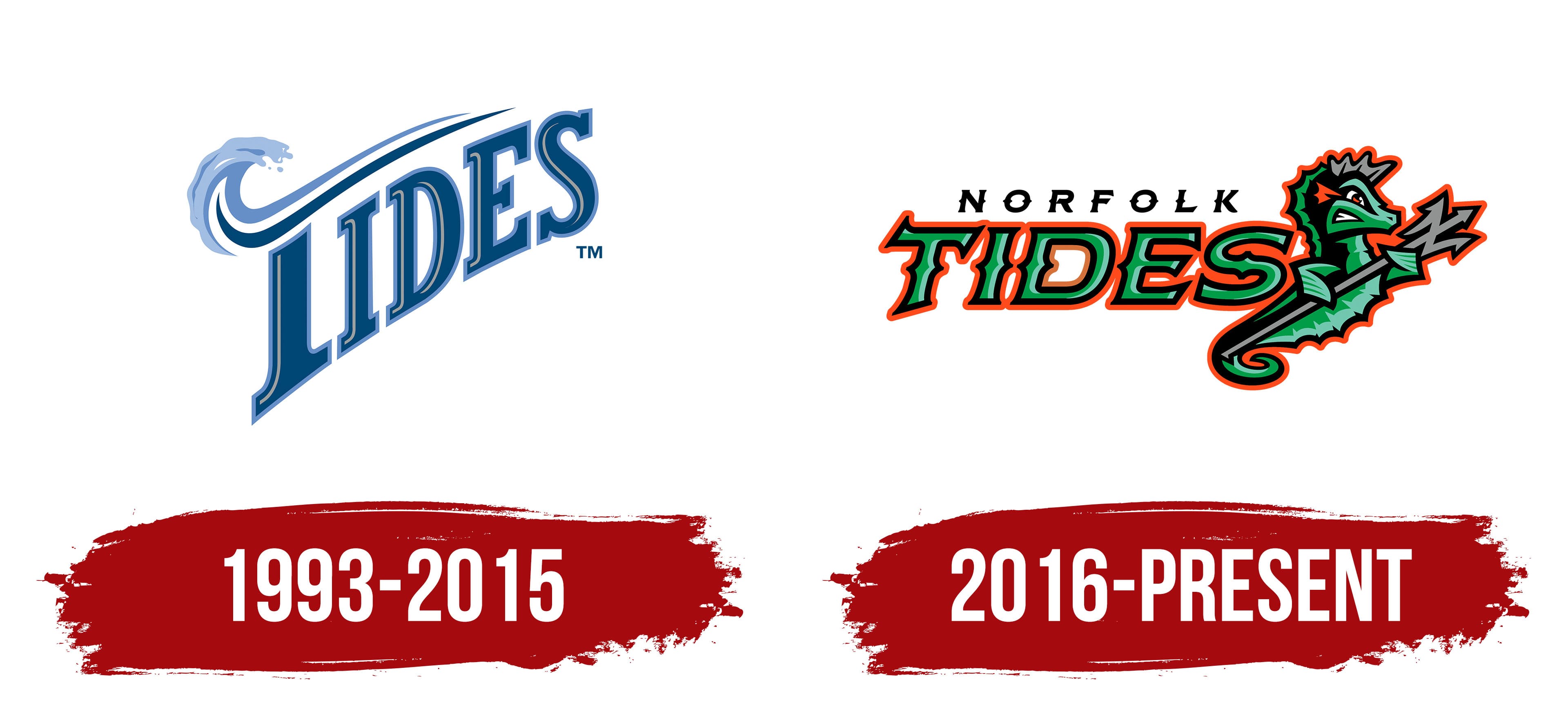
The Norfolk Tides logo became a visual milestone in the team’s history, marking the name change from Tidewater Tides to Norfolk Tides and the opening of the new home stadium, Harbor Park. At the same time, the club adopted a new visual language developed by Sean Michael Edwards Design. The logo is based on a dynamic diagonal “TIDES” wordmark, rendered in custom typography created specifically for the composition.
The main visual motif is a descending wave that smoothly transitions into the upper curve of the first letter. This element, serving as both a metaphor for the ocean tide and a graphic accent, organizes the logo’s composition from left to right and visually emphasizes movement. The wave is executed in a swoosh style, a characteristic symbol of sports brands that connects the team’s identity with its athletic heritage and the spirit of competition. The design has repeatedly drawn comparisons to the Nike logo and the “T” of the Texas Rangers, which in some cases even led to legal cautions over the similarity.
The letterforms have a strong geometric foundation, enhanced by dimensional detailing, shadows, and outlines. The structure features emphasized verticals and precise proportions; serifs are minimal but present as accents on the upper and lower areas of the glyphs, especially on the “I” and “S.” The shape of the “T” sets the diagonal motion for the entire wordmark, reinforcing the aquatic theme through its integration with the wave element.
A double blue gradient transitions from deep marine to lighter aquamarine, with a neutral gray underlayer that creates a pseudo-dimensional effect and separates the letters from the background. The palette improves legibility while reflecting the region’s maritime theme, reinforcing the team’s territorial identity.
The logo served as the team’s primary identifier for over two decades, accompanying it through a period of new athletic achievements and the establishment of Harbor Park as its home stadium.
2016 – today
The official presentation of the Norfolk Tides emblem took place on December 2, 2015. Starting with the 2016 season, the club adopted a new visual style developed by Brandiose, a San Diego-based studio known for its work in baseball branding. The logo’s creation was led by Jason Klein and Casey White, who worked closely with the team’s general manager, Joe Gregory.
At the center of the composition is a stylized seahorse holding a trident. The figure is rendered in a geometric style with sharp outlines and angular lines, emphasizing an aggressive, athletic character. The seahorse’s tail and the trident form a hidden letter “N,” symbolizing the city of Norfolk and referencing maritime myths about Poseidon.
The typography on the emblem is custom-built from scratch, inspired by typefaces from the era of the U.S. Navy. The letters are massive, with a distinct athletic feel, a pronounced slant, serifs, and multilayered outlines that create a sense of depth and motion. The “TIDES” wordmark is especially emphasized, with the letterforms outlined in bright orange. At the same time, the interior is filled with shades of green featuring soft, wave-like gradients that symbolically highlight the team’s connection to the sea.
The color palette is carefully curated with several layers of meaning. Battleship Gray references the region’s naval history and shipbuilding traditions, while Sea Foam and Tidal Green evoke the ocean and Norfolk’s natural surroundings. The team’s orange and Black visually signify its affiliation with the Baltimore Orioles. The combination of colors established a strong regional connection and created a solid visual bridge to the parent club.
Despite initial criticism from traditional fans, the new style gained popularity and proved highly successful commercially, driving a notable increase in the team’s merchandise sales. The logo is integrated into the team’s uniforms: the home kit features green accents and the seahorse on the cap. In contrast, the away kit is adorned with a symbolic letter “N” incorporating an anchor detail.
Font and Colors
The Norfolk Tides logo palette shows a deliberate design approach. It includes two shades of green: the deeper Tidal Green and the lighter, softer Sea Foam. Their combination creates a volumetric effect, emphasizing the emblem’s dynamism and evoking the waves and aquatic environment of the Hampton Roads region. The presence of the vivid Orioles Orange is important, as this color outlines and accents the lettering and symbols, creating a striking contrast and visually linking the team to its main partner, the Baltimore Orioles. The final accents come from the shades Battleship Gray and Black, which provide detail, crisp outlines, and evoke the region’s naval aesthetics and industrial heritage.
The typeface aligns with the brand concept, drawing on historical motifs of naval lettering. The letters have a slant, solid strokes with pronounced weight, and serifs. The glyph structure is carefully refined: the massiveness and dynamism of the letterforms, combined with outlined elements, create a visual rhythm and athletic energy characteristic of baseball’s identity. This typeface reinforces the club’s identity, making the “TIDES” name visually memorable and easily recognizable.