


 Pop Tarts Logo PNG
The Pop-Tarts logo is tied to the rise of ordinary pastries as a beloved treat for millions. The original idea to create a simple and convenient breakfast quickly became a hit thanks to the sweet frosting and rich flavors that families grew to love.
The history of Pop-Tarts began in 1963 when Post introduced a new product called Country Squares. In response, Kellogg’s quickly developed its version, inspired by the pop art movement and the trend for “pop-up” products. This creation was officially launched in 1964 with four flavors: apple-blackcurrant, cinnamon sugar, blueberry, and strawberry. The initial batch of 10,000 boxes sold out almost instantly due to high demand. One key advantage over Post’s Country Squares was that these toaster pastries did not require refrigeration, making them more convenient for consumers.
Introducing frosted versions in 1967 was a major milestone, greatly increasing their appeal. Initially, there were concerns that the frosting would melt in the toaster, but engineers developed a heat-resistant formula to prevent that.
The 1970s saw a rapid expansion of flavors, including vanilla, chocolate, and other dessert-inspired varieties. These treats became a breakfast staple, especially among children and teenagers, cementing their place in American culture.
Advancements in production and packaging technologies improved texture and filling during the 1980s. A nationwide television campaign targeted younger audiences, boosting sales and further embedding these pastries in American households.
The 1990s saw experimentation with seasonal and limited-edition varieties. Kellogg’s also began producing the brand internationally and, in 1994, opened its first dedicated retail store in New York City.
In the early 2000s, Kellogg’s embraced social media marketing, launching campaigns and events that captured attention online. Large-scale installations and creative promotions helped maintain relevance with younger consumers.
The 2010s saw flavor innovation, new formats like organic options, and collaborations with popular brands and personalities. In 2016, Kellogg’s opened a café in New York City that served desserts and drinks inspired by the brand, generating widespread media coverage and boosting visibility.
As of 2023, these toaster pastries remain among the most popular breakfast and snack products in the United States. With a lineup of around 30 flavors, ranging from classic options to creative new varieties, the brand continues to innovate with marketing campaigns and product launches.
From its origins as a simple breakfast option, the product has become a cultural icon. By blending traditional favorites with creative production and marketing strategies, it continues to appeal to a wide range of consumers.
Meaning and History
What is Pop-Tarts?
This is a crispy pastry with a tender fruit filling, sweet glaze, and sprinkles. The product combines convenience and flavor, turning breakfast into a delightful experience. The treat is available in various flavors from classics like strawberry and cinnamon with brown sugar to unique options like S’mores or “Birthday Cake.” It can be enjoyed straight from the package or slightly warmed in a toaster for a warm and aromatic treat. The foil packaging and vibrant design have become a recognizable symbol that connects people across generations, while the variety of flavors ensures there’s something for everyone.
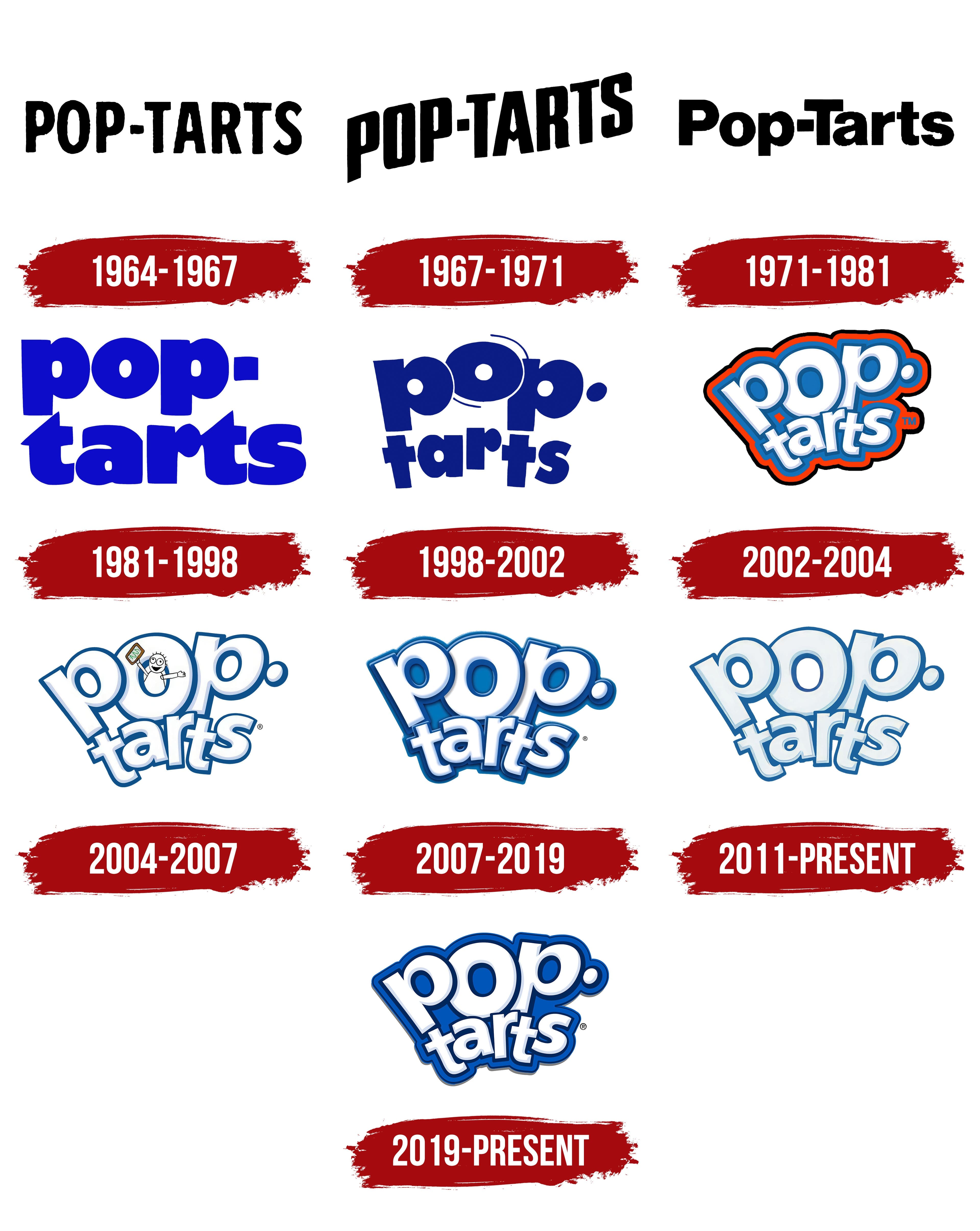
1964 – 1967
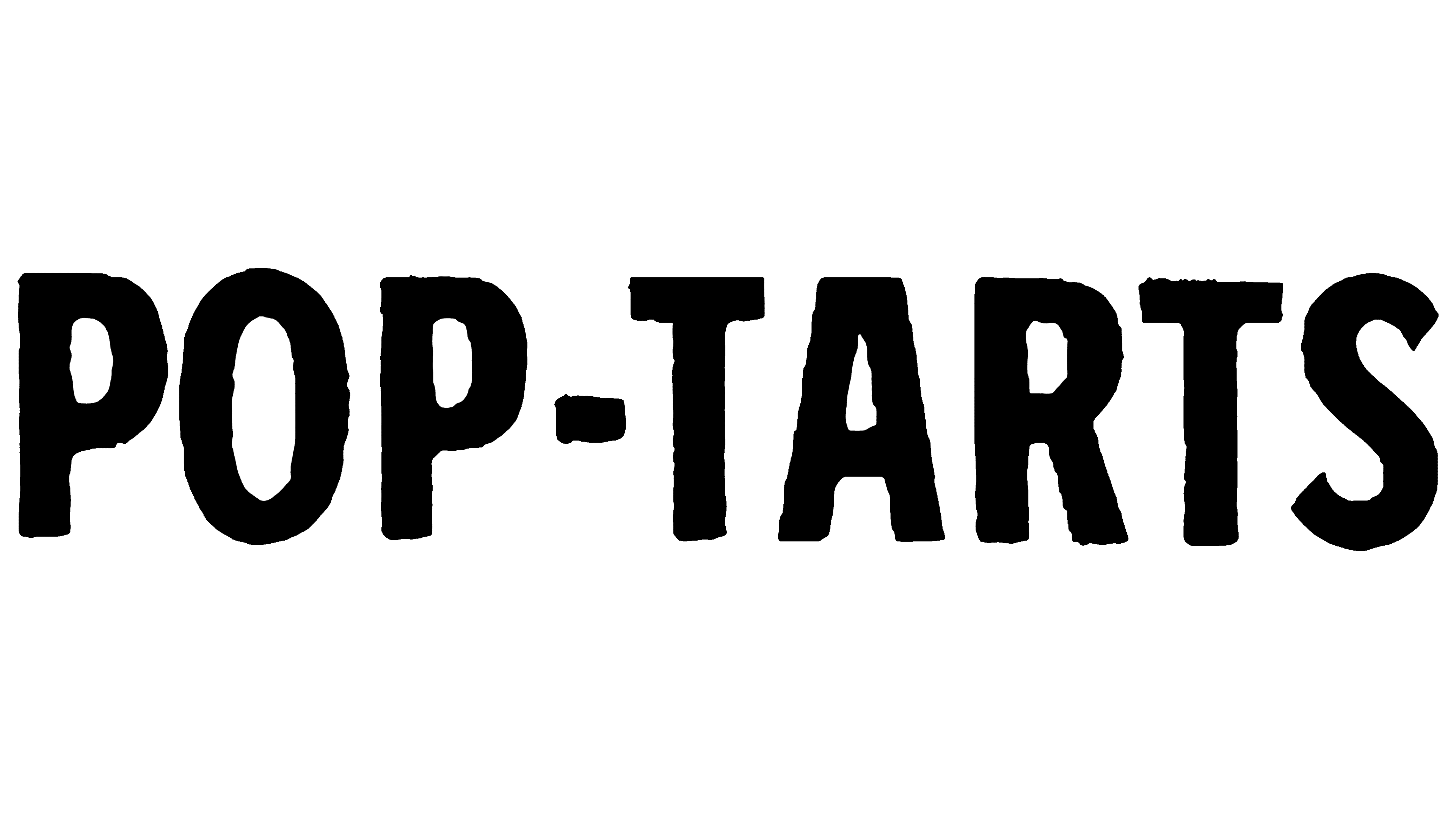
The first Pop-Tarts logo didn’t look fancy or cute. Everything was simple: black text, bold font, and all capital letters. It gave the impression of a strict, industrial design without unnecessary lines or hints of softness, straightforward and rough.
The font is straight, sans-serif, and laconic. Black is used as a universal solution, but is not associated with the joy or sweetness expected from a delicacy. This was unexpected for food because designers often added colorful details or softness to the design. However, the logo most likely had different color schemes on the packaging.
The name “Pop-Tarts” is a play on words inspired by the “pop art” popular in the 1960s. ” Pop is associated with brightness and fashion, and “tarts” emphasizes the connection with baking. Despite the strict logo, the name adds lightness and humor to the brand, creating an interesting contrast.
The first flavors of the product included strawberry, blueberry, brown cinnamon sugar, and apple combinations. The packaging and logo did not emphasize the theme of sweetness. Perhaps the idea was to stand out through simplicity when others used bright, catchy details. Minimalism was aimed at practical buyers who did not need embellishments.
1967 – 1971
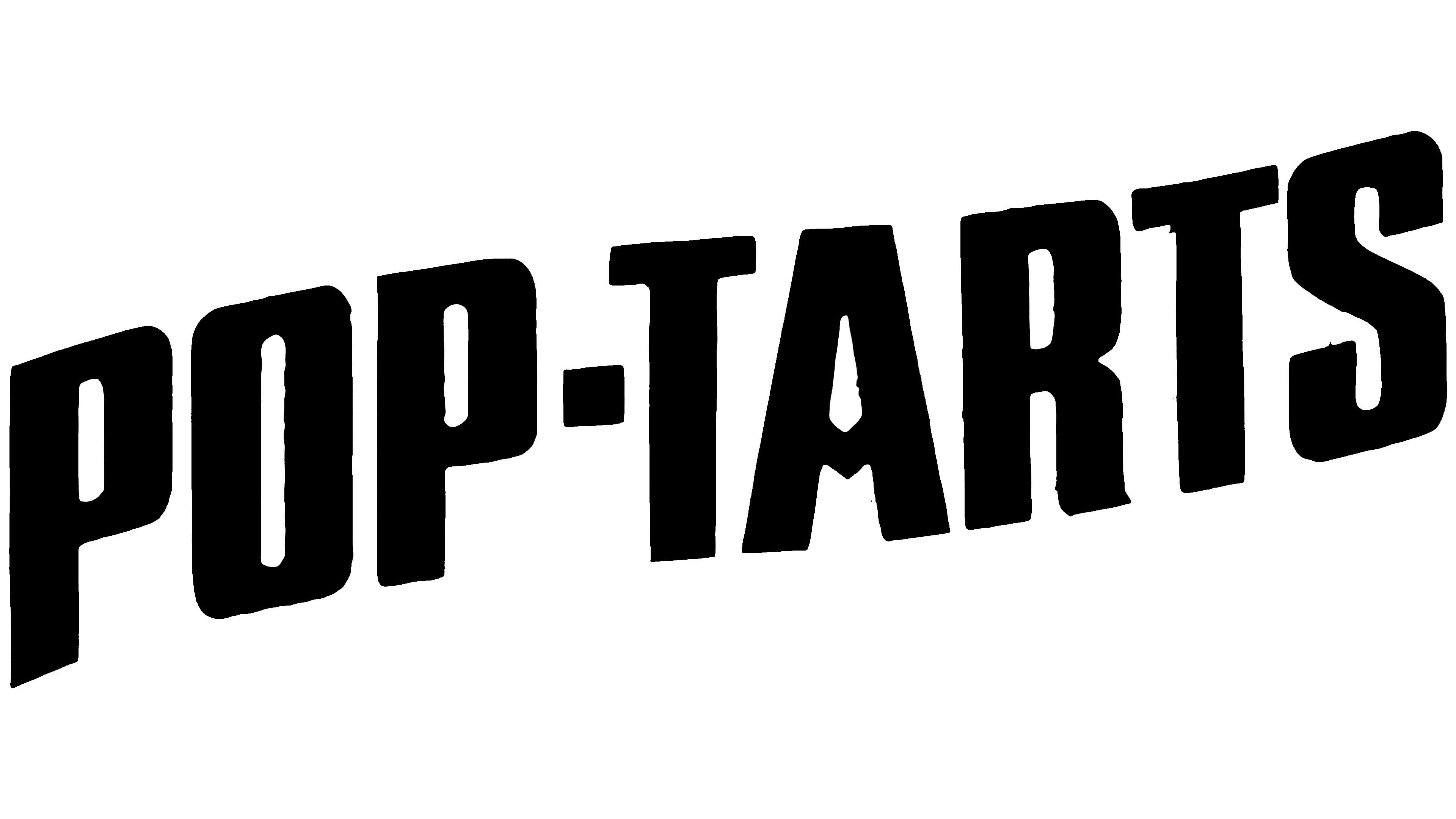
The logo has been updated, as has the product itself, which, for the first time, received a glaze that can withstand heat in a toaster. The design is dynamic. While the original logo looked restrained, the new design aims to create a sense of dynamism.
The main thing that stands out is the diagonal arrangement of the text. The letter “P” is at the bottom, and the “S” rises upwards, forming a slope that leads the eye throughout the lettering. The text has a slight wave.
The font became massive and angular, with sharp lines. There are no serifs, and the letters look bold, emphasizing the brand’s desire to attract a young audience. The inscription is made in capital letters.
Black is again the basis of the design, but thanks to the new arrangement of the letters and their shape, the inscription looks less strict. The logo no longer seems utilitarian; it reflects that the brand is part of an active, modern life.
1971 – 1981
The 1971 Pop-Tarts logo looked more restrained than previous versions. The diagonal slope and “wave” were abandoned, making the inscription even. Now, the text is located strictly horizontally, without unnecessary tricks.
The inscription is bold, with the letters slightly rounded but not completely. The font is the same, sans serif. The combination of uppercase letters at the beginning of words (“P” and “T”) with small lowercase letters between them makes the text less difficult to read. The color is black again, versatile and practical.
The design change reflects the brand’s movement towards a more mature and understandable style. In the early 70s, Pop-Tarts was already a well-known product with a foothold in the market, and its logo became a symbol of stability.
The product’s name is playful and simple, inspired by the popular culture of the time.
1981 – 1998
The 1981 logo is a complete departure from the previous restraint. Now, it is bright and alive, and it screams with fun. A rich blue color is used for the first time in the brand’s history. Only echoes of the strict black style of the past remained, and the logo became visually closer to the audience, lighter, more childlike, and carefree.
The inscription “pop-tarts” is split across two lines: the upper part, “pop,” is slightly larger and wider than the lower part, where it reads “tarts.” The location gives the text a sense of airiness and lightness. The font is three-dimensional, reminiscent of inflatable forms or pillows. It is all-rounded and soft and has remained massive.
The blue color looks rich and positive. It is great for a product associated with childhood, breakfasts, and sweet moments of joy.
The design is reminiscent of the bold, cheerful, and daring style of the 1980s. The logo fits into an era when the culture of bright colors, unusual shapes, and an easy approach came to the fore.
The logo conveys the feeling that Pop-Tarts are not an ordinary snack but a source of fun and vivid emotions at any moment.
1998 – 2002
The 1998 Pop-Tarts logo has become playful and lively, retaining the brand’s familiar look. This time, the text style received additional elements that made it mobile. The lettering is arranged on two levels: the word “pop” at the top and “tarts” at the bottom, both of which look large and cheerful. The letters became even more rounded, as if soft and airy, enhancing the “bubble” effect characteristic of the era’s visual culture.
In the word “pop,” the letter “o” has been redesigned. Now, it is framed by two arc-shaped lines, creating the impression of rotation or pulsation, which is associated with energy and dynamics.
The color has become a rich, deep blue, darker than previous versions, while retaining its brightness. A shade of blue conveys fun and modernity while remaining visually pleasing.
The font is slightly asymmetrical, especially in the word “tarts.” The letters are tilted, creating the illusion of play. The feeling that the logo breathes, moves, and never stands still. The brand’s mood, associated with joy and sweet pleasure, is reflected in it.
2002 – 2004
The updated logo is built on brightness and layering to convey fun and lightness. The words “pop” and “tarts” are set in a rounded, playful font that evokes associations with childlike carelessness. There is practically no letter spacing, adding a sense of density and integrity to the text. The letters’ slight inclination and smooth curves enhance playfulness as if the text “jumps” joyfully.
The entire inscription follows an arcuate line, making the letters appear more compact. The logo’s color palette enhances the overall impression. The inside of the letters is white, contrasting with a rich blue contour decorated with a gradient that fades to blue. The blue background around the letters gives an overall sense of airiness and lightness. The outer red stroke adds energy. A black line follows the red line, completing the composition.
2004 – 2007
The updated version of the logo retains the previous design’s main features but with several changes. The basic style of the logo remained the same: the words “pop” and “tarts” are located on two levels, retaining the slope and arc-shaped arrangement. However, the color palette has become simpler.
The font retained rounded and soft lines. The letters remained large and bold, but the blue filling inside and red outer outlines were removed. The letters received a white-and-blue outline, creating a three-dimensional effect.
The addition was a new symbol, a character in the letter “o” of the word “pop.” Drawn in a caricature style, the hero smiles and holds a piece of Pop-Tarts. This makes the logo more engaging by reinforcing the connection between the image and the product.
The design has become more asymmetrical, thanks to the uneven arrangement of the letters and their inclination, creating an impression of fun and lightness
2007 – 2019
Another design change, new changes that made it simpler. The slight inclination of the letters disappeared, but the arched arrangement of the inscription remained. The main task was to ensure the text’s readability when placed on the packaging.
The blue background, returned in this version, enhances the logo’s overall volume and contrast. It creates a foundation that allows the text to visually stand out against any background. The character previously located in the letter “o” has been removed. His small size made it difficult to see the packaging, and details, such as the product in his hand, were lost. Thus, the character is no longer used, and the logo has become more versatile for application on various surfaces.
The inscription still consists of two parts, “pop” and “tarts,” placed on two levels. A rounded and bold font with soft lines creates a feeling of friendliness. The letters have a three-dimensional effect due to the white central color and dark blue outer outline.
The letter “o” in the word “pop” has a slightly higher volume that stands out from the other letters. It creates the impression of a bulge and adds visual depth to the logo.
2011 – today
This option is primarily used in the Canadian market, as it is tailored to local consumer preferences.
The main composition includes two words, “pop” and “tarts,” on two levels. The letters are large, rounded, and bold. Letter spacing is minimal, and the text seems dense and cohesive.
The word “pop” is visually distinguished by its height. It dominates the overall design, setting the tone for the entire composition. The letters’ inclination and arcuate arrangement form a feeling of liveliness.
The inner contour of the letters is light blue, adding volume. The shade evokes associations with cleanliness. The outer outline is rich blue, contrasting and making the text stand out against any background. Expressive strokes add depth and dimension to the image, enhancing the three-dimensional effect.
2019 – today
The current “Pop-Tarts” logo retains the main features of previous versions but differs by enhancing certain elements. First, this applies to the background, which has darkened and become more saturated. It adds contrast and allows the letters to stand out brighter. The outline of the text has changed – now it is made in a rich dark blue shade, almost black, increasing the visual emphasis on the three-dimensional nature of the letters and their volume.
The word “pop” occupies the top position and is more emphasized. “Tarts” completes the composition, acting as a complement. The letters are rendered in a rounded, bold style.
Thanks to multi-layered strokes, the letters have a three-dimensional structure. Updates to the design have enhanced the visual experience.