


 Scat Pack Logo PNG
The Scat Pack logo adds a special halo of power to the technique and conveys the desire for victory and leadership. The emblem symbolizes a complete set and the highest level of technical equipment, leaving rivals far behind.
By 1968, Dodge had a marketing problem. Cars such as the Charger R/T, Coronet R/T, Dart GTS, and Super Bee all had strong identities, but nothing connected them. While Ford pushed Mustang and Chevrolet built around Camaro, Dodge’s performance cars felt disconnected from one another.
The answer came from the Ross Roy advertising agency, which created the “Scat Pack” name to unite the company’s high-performance models. The term came from jazz “scat” improvisation and likely echoed Frank Sinatra’s Rat Pack. To qualify, a car had to run the quarter mile in under 14.99 seconds. Models received bee-stripe graphics and special emblems, while marketing materials called the lineup “the hive.”
The campaign spread across magazines, dealerships, and television. In 1969, the Charger Daytona joined the Scat Pack lineup, featuring a tall rear wing and a NASCAR focus. In 1970, the Challenger entered the group, and Chrysler launched the official Scat Pack Club. Members received newsletters, Direct Connection parts catalogs, decals, patches, and a racing guide for $3 per year. Plymouth answered with its own “Rapid Transit System,” featuring cars such as the Road Runner and Superbird.
The original era faded by 1973 as insurance costs climbed and emissions rules weakened the muscle car market. The Scat Pack name disappeared for decades before returning in 2014 with updated Charger and Challenger models. Dodge positioned the 6.4-liter 392 Hemi as a more accessible performance option below expensive SRT trims. Later versions included the Scat Pack Widebody, and in 2023, the badge became part of the final special editions before production of the Charger and Challenger ended.
Meaning and History
Chrysler Corporation introduced a tuning package for its passenger cars to boost sales. Customers received powerful dream cars at the muscle-car level for an additional surcharge. To distinguish them from the rest, the manufacturer added a bee image and unique stripes to the radiator grille. Customers could remove the tuning at any time at no cost. Still, it quickly gained popularity, enabling the manufacturer to sell 96,100 Dodge Chargers and more than 17,000 Dodge Charger R/Ts in just a year.
However, the Scat Pack tunes and re-equips cars with additional technical features to enhance their capabilities. The package includes cabin features such as carbon-like elements, leather seats, a heated steering wheel, all-season tires, wide-body fenders, 20-inch aluminum wheels, a powerful engine, adaptive damping suspension, an exhaust with a heat sink, a special cold air intake system, power mirrors with manual folding, and much more.
Advertising agency Ross Roy helped launch the campaign and suggested the name “Scat Pack.” At first, it was a marketing term meant to emphasize power and boost the reputation of the ferocious Dodge series. Only cars that could dash a quarter mile in 14 seconds from the start earned that label.
The name comes from a play on words. “Scat” is a verb meaning “to leave,” “to move quickly,” “to leave instantly.” “Pack” comes from the famous Rat Pack and aims to unite buyers and instill a sense of unity. This fact confirms the presence of a fan community for such sports cars. The club is called “The Hive” and is also associated with a bee, whose image is featured on the grilles of powerful cars. To that end, Chrysler has gone to great lengths to showcase the coolness, potential, and eccentricity of its vehicle lineup. Later, the badge began appearing as a patch on jackets and cases.
The brand previously emphasized involvement with the hive and the swarm of bees, capable of rapid flight, through slogans paired with images of bees in advertising. The mottos were: “The cars with the Bumblebee stripes” and “Run with the Pack.” Moreover, the manufacturers literally visualized their statements: they stuffed cars with improved units and applied wide and narrow stripes to the rear of the vehicles.
The marketing campaign promoting the Scat Pack series continued until 1971. Then it resumed in 2013 at the SEMA show. And in 2014, three tuning models were introduced for the Dart, Challenger, and Charger. Currently, the enhancement package is only available for the last two.
Font and Colors
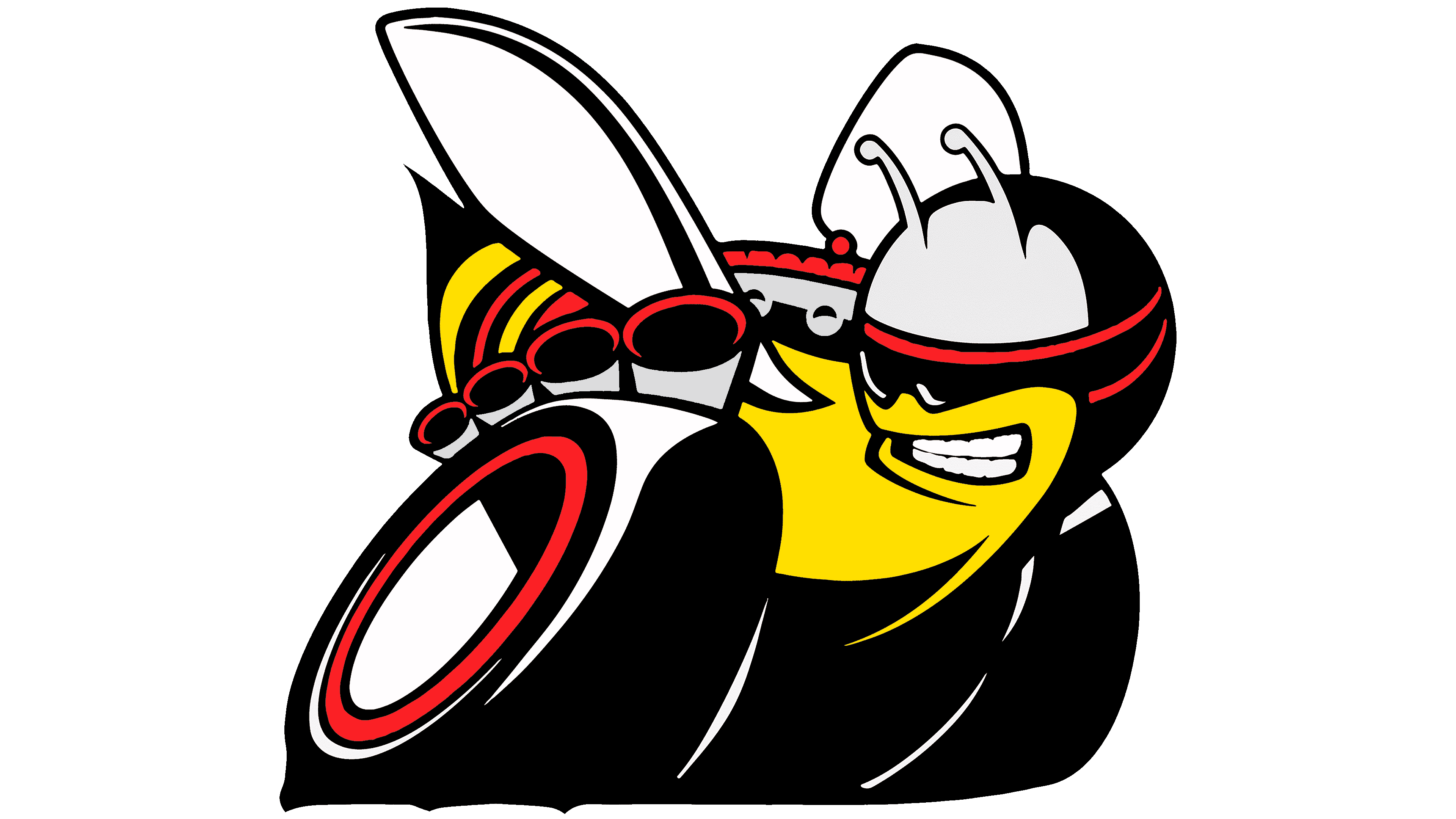
Chrysler introduced the original logo at the first launch of new Dodge products. It consists of a small racing bee with attached wings and wheels. It also has engine parts (turbo cylinders), goggles, and a helmet. The insect gritted its teeth menacingly and supposedly emitted a powerful buzzing roar. Red stripes are painted on the head, back of the abdomen, and on the wheel.
The series name used to appear at the bottom, but now it is to the left of the icon. The inscription is in bold, sans-serif, uppercase. The letters are slightly tilted right and rounded at the corners, emphasizing the cars’ improved aerodynamics. The logo was based on the visual identity of the Dodge Super Bee.
The logo uses a custom-designed font. The letters are streamlined, bold, and grotesque, with a slight rightward tilt. The color palette includes red, yellow, gray, and black.