 Tokyo Gas Logo PNG
Gas supply powers household systems, ranging from cooking and heating to hot water. Gas networks connect energy sources to residential areas and businesses, supporting everyday processes. The Tokyo Gas logo is associated with a company that supplies gas and manages energy infrastructure in Tokyo and the surrounding regions.
Tokyo Gas was founded on October 1, 1885, by Eiichi Shibusawa and Soichiro Asano. The company’s initial goal was to provide gas lighting for Tokyo. By 1913, it had become the leading gas supplier in the Kanto region. After the merger of nineteen gas companies in 1945, Tokyo Gas switched to producing gas from oil.
In 1966, the world’s first liquefied natural gas receiving terminal, Negishi, began operations. This became an important milestone in the industry’s development. In the 1970s, the company began diversifying its supply sources and added imports from Alaska and Brunei. In 1973, the Sodegaura terminal was launched, and the Tokyo Gas Chemical division was established. By 1995, the number of customers had reached eight million. In 1998, the underground Ogishima terminal was commissioned.
Since 2000, Tokyo Gas has been active in the electricity market and created a joint venture, Ennet. In 2003, the 100-megawatt Baypower power plant was launched. Later, the company implemented the Yokosuka and Ohgishima projects. By 2011, the gas distribution network had reached 55,000 kilometers in length and served more than 10 million customers.
In 2016, after energy market liberalization, Tokyo Gas expanded its retail electricity sales. By 2018, the sales volume reached 15.5 billion kilowatt-hours. In 2023, a subsidiary of the company acquired the American firm Rockcliff Energy II for $ 2.7 billion.
In 2024, Tokyo Gas sold minority stakes in four Australian liquefied natural gas production projects. The proceeds from the sale were directed toward the development of clean energy. For 2025, city gas sales were forecast to grow to 11.4 billion cubic meters. The company considers the U.S. market a priority area for investment in gas, energy, and energy storage.
Meaning and History
What is Tokyo Gas?
The largest private natural gas supplier in Japan provides gas to Tokyo and nine prefectures in the Kanto region, serving more than 10 million customers through a network spanning 55,000 km. The company began with gas lighting and switched to LNG after launching the Negishi terminal, the world’s first LNG receiving facility. Main areas include gas supply, electricity, overseas projects, LNG engineering, and real estate development. It controls about 35 percent of the market and has 2.7 million electricity customers.
1945 – 1985

The history of Tokyo Gas is connected to the development of gas lighting in the Japanese capital. Gas lamps appeared in the Ginza district in 1874 and became part of the city’s infrastructure. On October 1, 1885, 東京瓦斯会社 (Tokyo Gas Company) began operations. In July 1893, following the implementation of the Commercial Code, the company received the legal name 東京瓦斯株式会社 (Tokyo Gas Co., Ltd.).
The name identifies the company’s operating territory and industry. Tokyo refers to the city, while 瓦斯 is an early phonetic rendering of the English word “gas.” The brand developed alongside the transfer of the capital’s gas system to private management and the expansion of street lighting.
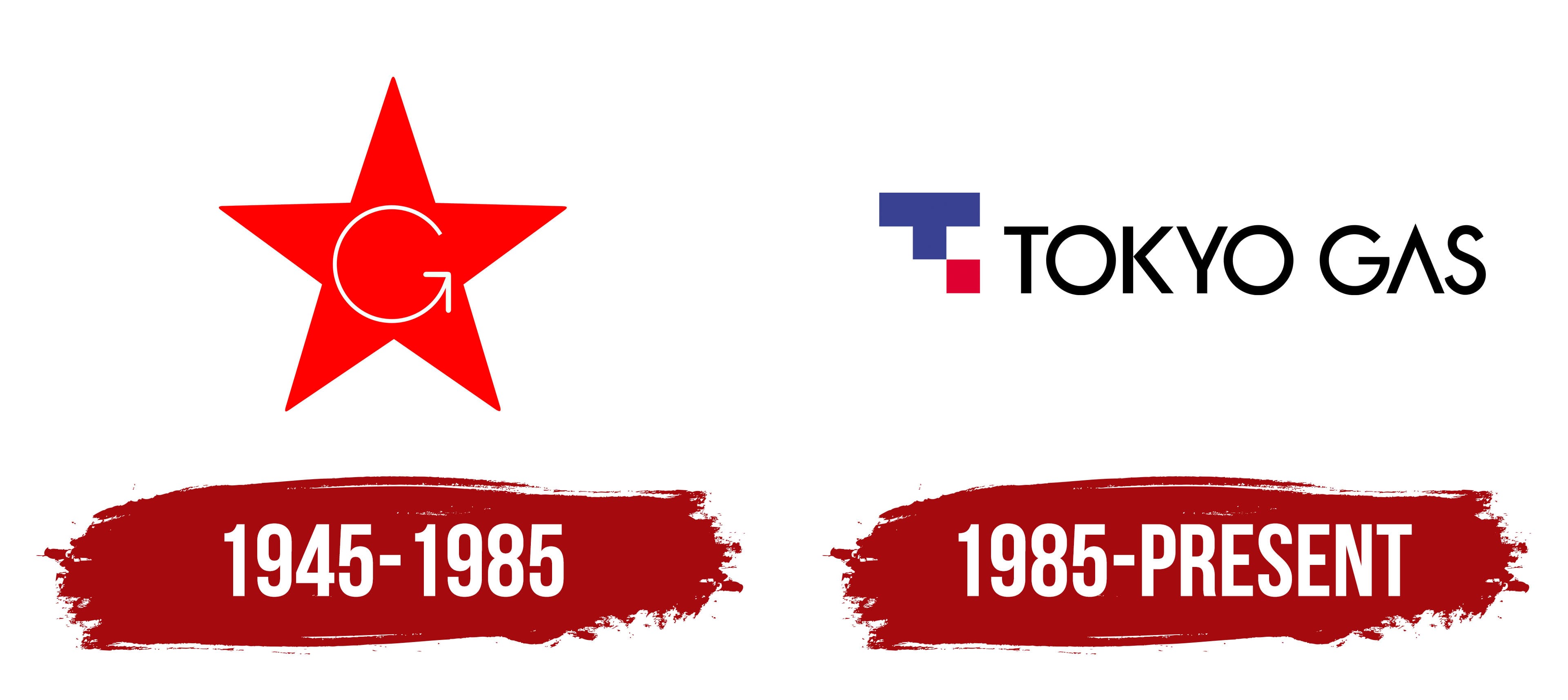
Before the 1985 update, the company used a red five-pointed star containing the letter “G.” The emblem appeared against a light circular or oval background. At the center was an open white circle formed by a thin line with a pointed end extending upward and to the right. The outline resembled an uppercase “G” and referred to the word “gas.”
The star connected the company with gas lamps. Evening lights along the streets resembled artificial stars and maintained a link with the history of lighting in Tokyo.
1985 – today
For Tokyo Gas’s 100th anniversary, the former star containing the letter “G” was replaced by an emblem consisting of five squares. The new identity was introduced in October 1985. Fumi Sasada and Osamu Ieda of Landor Associates developed the project.
Three blue squares form the upper row of the symbol. Two additional squares appear beneath the middle and right blocks. The lower left square is blue, while the one beside it is red. Equal white spaces separate the shapes. The blue blocks form the letter “T.” At the same time, the red square completes the combination of the letters “T” and “G.” The geometric form is suitable for signs, vehicles, printed materials, and screens.
The five squares received individual meanings. The upper row represents clothing, food, and housing, the main areas of daily life. The lower blue block represents a person’s inner world. The red square refers to the future. The complete arrangement represents the energy company’s role in people’s lives and the development of the urban environment.
The blue and red colors are connected to a gas flame. Complete combustion of natural gas produces a blue hue. Red refers to warmth and the company’s plans. The combination of the two colors has remained part of the identity for many years.
The inscriptions TOKYO GAS and TOKYO GAS GROUP appear beside the emblem. The second version represents the entire group of companies. Legal documents use the full name Tokyo Gas Co., Ltd.
In January 2001, the company adopted the slogan “Energy Frontier, The Future Opened by Natural Gas.” The phrase referred to advances in natural gas technology and the expansion of the energy business. In April 2023, the company introduced the motto 未来をつむぐエネルギー, meaning “Energy That Creates the Future.” The wording describes the group’s work for people, cities, and future generations.