 Unreal Tournament Logo PNG
The Unreal Tournament logo captures the spirit of intense battles, where speed, tactics, and skill are everything. The game has created a world where competitive excitement reaches its peak, providing space for fast-paced, strategic combat.
Unreal Tournament began as a response to Unreal’s limited multiplayer experience; Epic MegaGames, later renamed Epic Games, released Unreal in May 1998, along with Canadian studio Digital Extremes. However, Unreal received attention for its technology and graphics; its online mode had technical problems. Epic began developing a multiplayer expansion, but the project grew into a separate game with a larger scope.
Unreal Tournament was released on November 22, 1999, with development led by Epic designer Cliff Bleszinski and Digital Extremes founder James Schmalz. The game launched only ten days before id Software’s Quake III Arena, creating one of the most notable rivalries in first-person shooter history. Unreal Tournament featured multiple competitive modes, including Assault, along with advanced bot AI, unusual weapons, and responsive gameplay. Many gaming publications named it the best shooter of 1999.
The series continued with Unreal Tournament 2003 in 2002, built on Unreal Engine 2. While the game introduced improved graphics and physics, some players criticized gameplay changes. Epic answered with Unreal Tournament 2004 in March 2004, adding vehicles and the Onslaught mode with strategic battles around control points. The title became the series’ most successful and influential entry.
Unreal Tournament 3 was released in 2007 using Unreal Engine 3 but received mixed reactions. In 2014, Epic Games announced a new free Unreal Tournament developed with community participation on Unreal Engine 4. Work slowed after Fortnite Battle Royale launched in 2017, and Epic effectively abandoned the project by 2018. In 2022, Epic discontinued most online services for Unreal games, while fans continued maintaining the series through unofficial servers and community projects.
Meaning and History
What is Unreal Tournament?
It is a series of multiplayer first-person shooters that have changed the arena shooter genre. Players fight in futuristic arenas, utilizing a variety of weapons and mastering dynamic movement techniques, including dodges and double jumps. The game features various modes, including classic survival combat and team battles that involve capturing the flag or completing tasks. The player community has created thousands of additional maps and mods, making the project even more interesting and diverse thanks to the built-in level editor and support for custom modifications.
1999
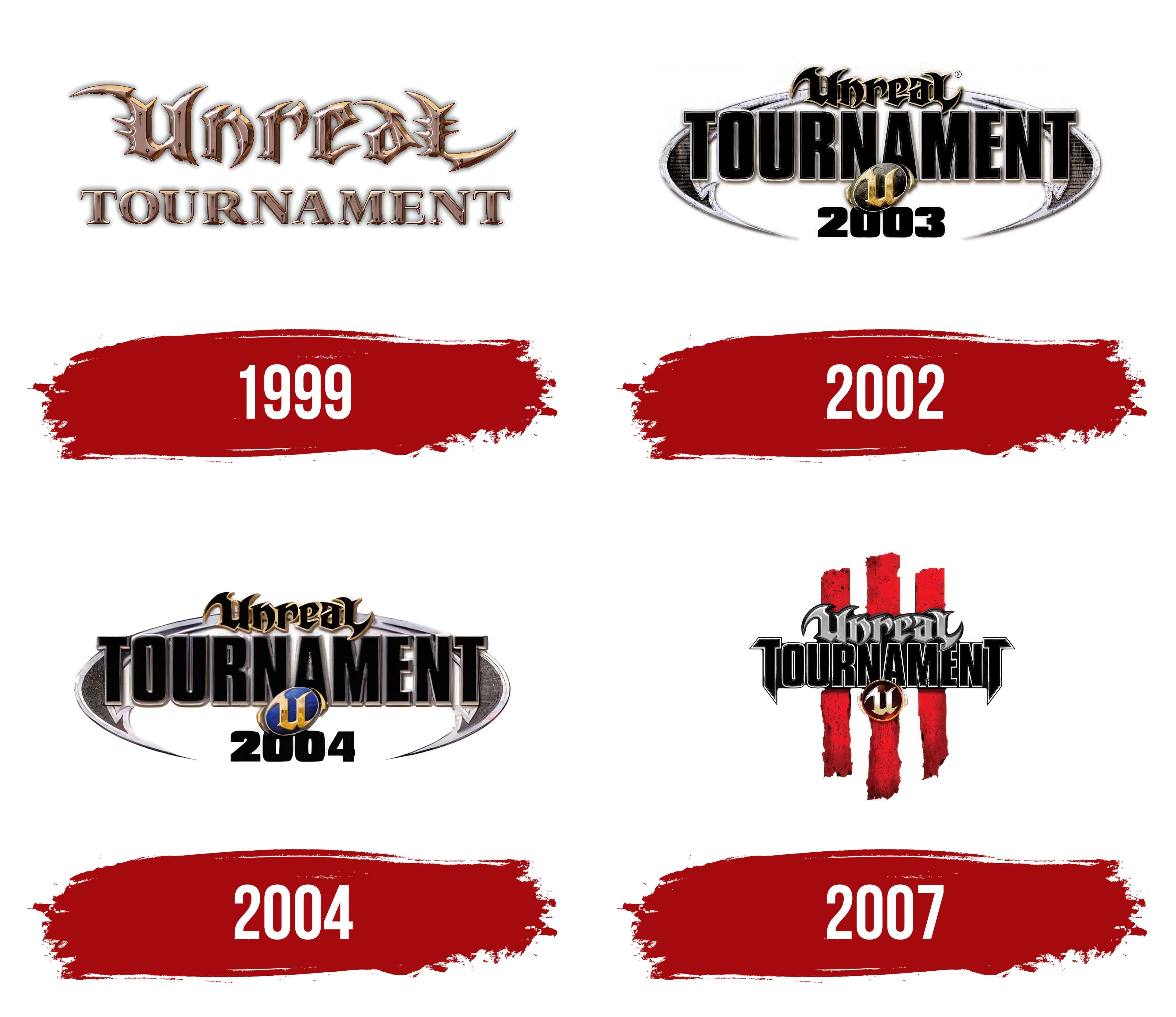
Unreal Tournament appeared on the gaming scene in 1999 and stood out among competitors as a striking representative of the first-person shooter genre. Epic Games aimed to make the game spectacular and memorable, which was reflected in its logo.
The brand name is divided into two levels. The upper level, “Unreal,” resembles a weapon from the arsenal of game characters. The letters are gothic, sharp, and aggressive. The font features a metallic texture with rough plates and heavy bolts, giving it a hand-assembled appearance. The elongated, sharp edges of the letters resemble claws or blades, evoking an atmosphere of competition and intense confrontation, filled with adrenaline and brutal battles.
The second level, “Tournament,” provides the necessary balance. The strict capital letters in a serif font are symmetrically placed. They also feature metallic finishes and rivets, but the style is calm, heavy, and stable. The contrast conveys the essence of the game: dynamic, aggressive battles occur within clearly defined tournament rules and boundaries.
The primary shades of the logo are dark brown, bronze, and metallic. All colors complement each other, enhancing the impression of metal and durability. The letters’ volume is achieved through shadows, highlights, and outlines. The relief effect conveys a technological style, linking the logo to the game’s industrial theme, where high-tech weapons and armor play a key role.
2002

With the release of Epic Games’ updated shooter in 2002, the Unreal Tournament logo transformed, reflecting the game’s new focus. The emblem’s appearance became horizontal and more athletic, resembling logos of futuristic tournaments or competitions.
The series name “Unreal” remained in the upper part of the logo, retaining its familiar style: a gothic typeface with sharp curves and aggressive letter endings that resembled sharpened blades. Beneath it, the central word “TOURNAMENT” became dominant and massive. The uppercase, sans-serif letters are elongated vertically and positioned closely together, creating the impression of a unified, monolithic block.
The color palette became more contrasting and saturated. The primary black color of the letters is emphasized by metallic and silver elements in the oval background, forming a frame with sharp, pointed ends. The texture of the frame resembles armor or mechanical elements of an arena from the game world.
A golden medallion with the letter “U” appeared, becoming a recognizable symbol of the entire Unreal series. Its placement between “TOURNAMENT” and “2003” highlights the game’s athletic format and competitive nature, reminiscent of championship awards or battle medals earned in the virtual tournament.
The lower text, “2003,” is presented in large, strict, and concise bold lettering, indicating the specific game version. The entire logo composition became more dynamic and energetic, combining elements of technological sports and military aesthetics. Epic Games reflected the spirit of virtual combat competition in the new logo, which became the core idea and direction for developing the Unreal Tournament series.
2004

When Epic Games released another Unreal Tournament update in 2004, the series logo underwent minor changes, becoming brighter and clearer with the introduction of new color accents.
At the center of the composition is a medallion with the letter “U,” the key symbol of the entire Unreal game series. The emblem is executed in gold and deep blue colors. Because of these shades, the medallion stands out more and appears like a prize or combat award, suitable for tournaments and competitions within the game world.
The bottom inscription with the year was updated to “2004,” maintaining a strict, massive, and black style.
The overall color palette of the emblem, black, silver, gold, and newly added blue, makes the visual design richer and more energetic, conveying the competitive excitement characteristic of the game. Epic Games logically chose not to significantly alter the structure and accents, instead using color to emphasize that the 2004 version continues to develop the ideas of the Unreal Tournament series.
2007

In 2007, Epic Games decided to rethink the visual design of Unreal Tournament, and the logo underwent a drastic change, becoming more aggressive. The emphasis was on brute force and a fierce atmosphere of confrontation.
The composition is built vertically. The upper part features the familiar word “Unreal” in metallic-gray shades. The letters are heavy gothic, with smooth yet sharp curves, reminiscent of heated and cooled metal with darkened shadows. Below is the central word, “TOURNAMENT,” written in a bold and monumental sans-serif font. The first and last letters, “T,” are enlarged like columns supporting the entire structure, reinforcing a sense of solidity.
A new addition is three red stripes behind the lettering, depicted as torn, rugged marks. They resemble combat marks or claw scratches, underscoring the game’s harsh style. This is a direct reference to the third installment of the series, emphasizing its aggressive nature and the atmosphere of constant tension in matches.
In the center of the lower part is a medallion featuring the familiar letter “U,” colored with a red-orange gradient resembling molten metal, which reinforces the overall brutality of the design. The medallion acts as a combat reward, showcasing the spirit of the tournaments.
The color scheme became significantly more intense, with red symbolizing danger, cruelty, and a fighting spirit. Black adds weight and contrast to the text, while silver-gray highlights the series’ technological aesthetics. The medallion with the burning metal effect ultimately ties the composition together, visually conveying the game’s core idea of continuous, chaotic, and aggressive battles in a futuristic combat atmosphere.