


 WRC Logo PNG
The WRC logo conveys the dynamism and extremity of the World Rally Championship. It reflects the nature of racing, where speed, precision, and the participants’ bravery are critical.
The World Rally Championship began in 1973, when the FIA combined major international rallies into one series. The opening round was the Monte Carlo Rally, which Alpine-Renault won. A manufacturers’ championship existed from the start, while the drivers’ competition followed later. Sweden’s Björn Waldegård became its first official champion.
Group B defined the first half of the 1980s. Lancia, Audi and Peugeot built cars producing up to 600 horsepower under limited technical restrictions. Their speed, combined with crowds standing close to the road, contributed to fatal accidents. The FIA banned the category in 1986 and replaced it with Group A, followed later by the regulated World Rally Car class.
During the 1990s, Japanese manufacturers controlled much of the series. Tommi Mäkinen won four consecutive titles with Mitsubishi. At the same time, the Subaru Impreza WRX became closely associated with the decade, and Toyota also fought for titles. From 2004 to 2012, Sébastien Loeb secured nine consecutive championships for Citroën, establishing the longest title run in WRC history.
Sébastien Ogier continued French success and won multiple titles, including with Volkswagen, whose factory team entered in 2013 and took the manufacturers’ crown in its debut season before leaving after 2016. In 2022, Rally1 hybrid cars replaced the previous top class. Kalle Rovanperä became the youngest world champion at 21 and retained the title in 2023. An American round was planned for 2026.
Meaning and History
What is WRC?
The World Rally Championship features races on extreme tracks through mountains, over snow, and across gravel. Competitions take place on public roads rather than asphalt racetracks. Success on narrow mountain roads or snowy routes depends heavily on teamwork between the driver and the co-driver, who provides high-speed pace notes. Rally cars resemble standard models from well-known brands but are more powerful and faster. Fans often watch from the roadside, sometimes risking their safety.
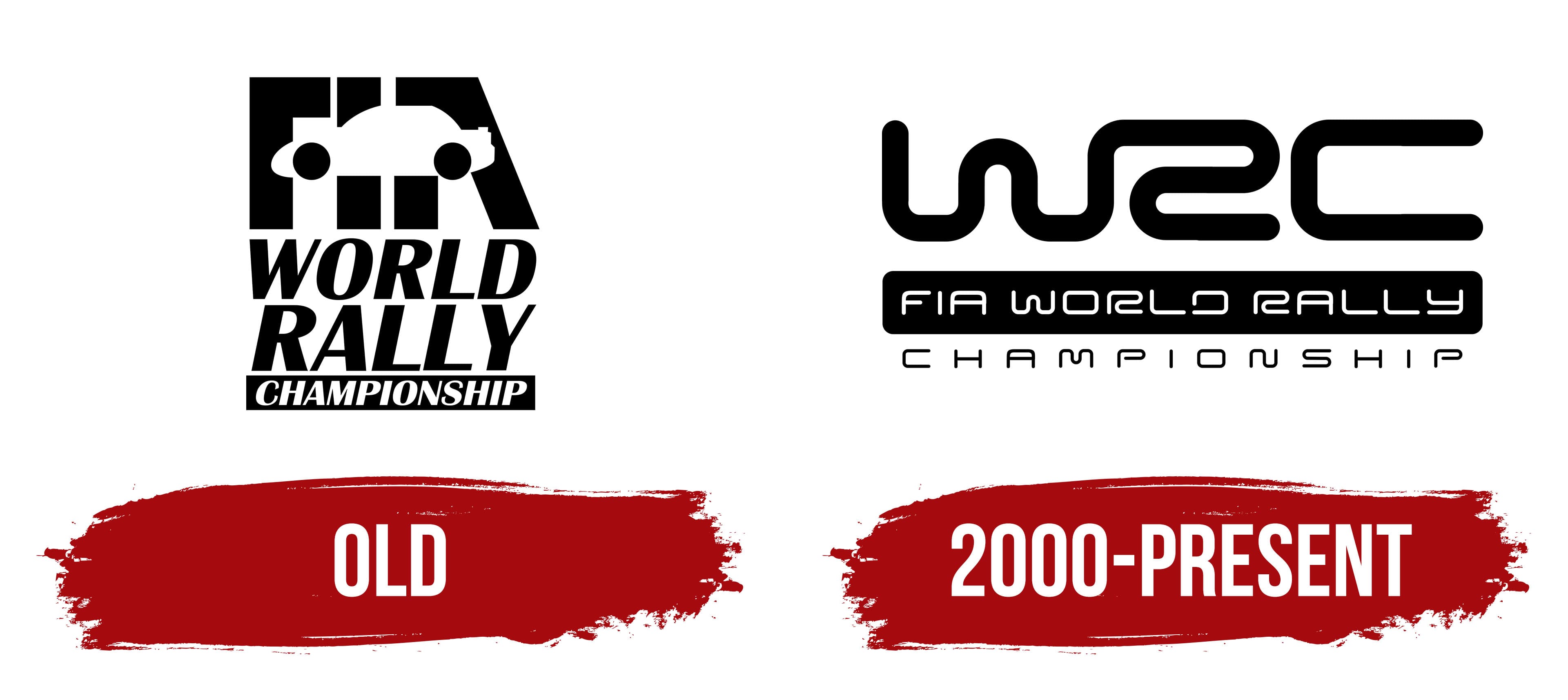
Old

WRC’s visual style reflected the energy of the World Rally Championship. The design was built around the image of a car, symbolizing motion and the sport’s power.
The design was based on negative space, with the car’s silhouette formed by black lines extending beyond the emblem. Through the use of diagonal directions and perspective, an effect of speed and forward motion was created. The lines’ shape resembled an inverted letter “W,” giving the symbol an associative character.
The word “Championship” was written in bold italics. The sans-serif font with a slight slant enhanced the sense of acceleration and emphasized the sporting context. The text complemented the visual idea of competition and forward movement.
The logo design was universal, reflecting the championship’s openness to teams and manufacturers from around the world. Black was used as the main color, setting a sense of seriousness, technology, and discipline.
The emblem’s structure conveyed the spirit of professional rallying. Its plasticity and form were associated with determination, speed, and tension, which defined the character of WRC participants.
2000 – today

The updated WRC logo reflected the championship’s new visual direction, with an unconventional typeface replacing graphic details. Instead of the previous realistic car image, an abstract typographic structure was used to convey the same idea of motion through form and line.
The key element was a glyph combining the letters “W” and “R.” It resembled a winding track, with lines flowing into one another, creating visual continuity. This shape referred to rally roads and conveyed the nature of races held on challenging surfaces and in varied conditions.
The letter “C” was placed separately but repeated the outlines of the first two symbols, giving the image completeness and maintaining visual balance. Below the main inscription was a rectangle that read “FIA World Rally.” Their smaller size emphasized the main abbreviation.
The lower row contained the word “Championship,” written in a thin font contrasting with the heaviness of the upper line. Their combination reinforced the perception of the logo as the competition’s official symbol, highlighting the WRC’s institutional nature.
The rejection of realistic details shifted the focus toward form, rhythm, and the symbolism of movement. The new logo reflected the modern understanding of the WRC brand and its international status, uniting rally fans worldwide.
