 AMD Radeon Logo PNG
The AMD Radeon logo represents the balance between computational and graphical power. The company has developed technologies that integrate processing and graphics capabilities, creating versatile solutions for work and gaming that eliminate the need for a separate graphics card.
Radeon began in 2000, when ATI introduced the Radeon DDR as a direct rival to GeForce graphics cards. The Canadian company had developed graphics hardware since 1985 and became one of the two main suppliers of discrete GPUs. Its Radeon X1000 series, released in 2005, strengthened the brand in premium gaming and kept competition with NVIDIA at the center of hardware reviews and enthusiast debates.
In 2006, AMD acquired the graphics company for $5.4 billion, combining processor and GPU development under one owner. Integration took several years, and products briefly carried a dual corporate identity. In 2010, the company removed the former name from its graphics branding, leaving Radeon as the sole consumer label and completing the transition from a Canadian business to a unified division.
Graphics Core Next arrived in 2011 and powered the HD 7000 family. The architecture supported gaming and parallel computing, while Mantle, introduced in 2013, gave developers lower-level hardware access and later influenced Vulkan. In 2015, the R9 Fury X became the first graphics card to use HBM, delivering high memory bandwidth in a compact design.
A major redesign followed in 2019 with RDNA and the RX 5000 series. RDNA 2 appeared in 2020, raised performance in the premium segment, and powered PlayStation 5 and Xbox Series X/S. RDNA 3 debuted in late 2022 with the RX 7000 family and a chiplet-based layout. New models followed in 2023 as work continued on drivers, mobile graphics, and energy use.
Meaning and History
What is AMD Radeon?
This versatile solution combines processor power and graphics capabilities in a single chip. The technology enables the device to function without a separate graphics card, striking a balance between performance and compactness. It is used in laptops and small PCs where space-saving and energy efficiency are important. The integrated graphics ensure smooth multimedia playback, gaming, and the operation of resource-intensive applications while delivering high-quality visuals and fast data processing.
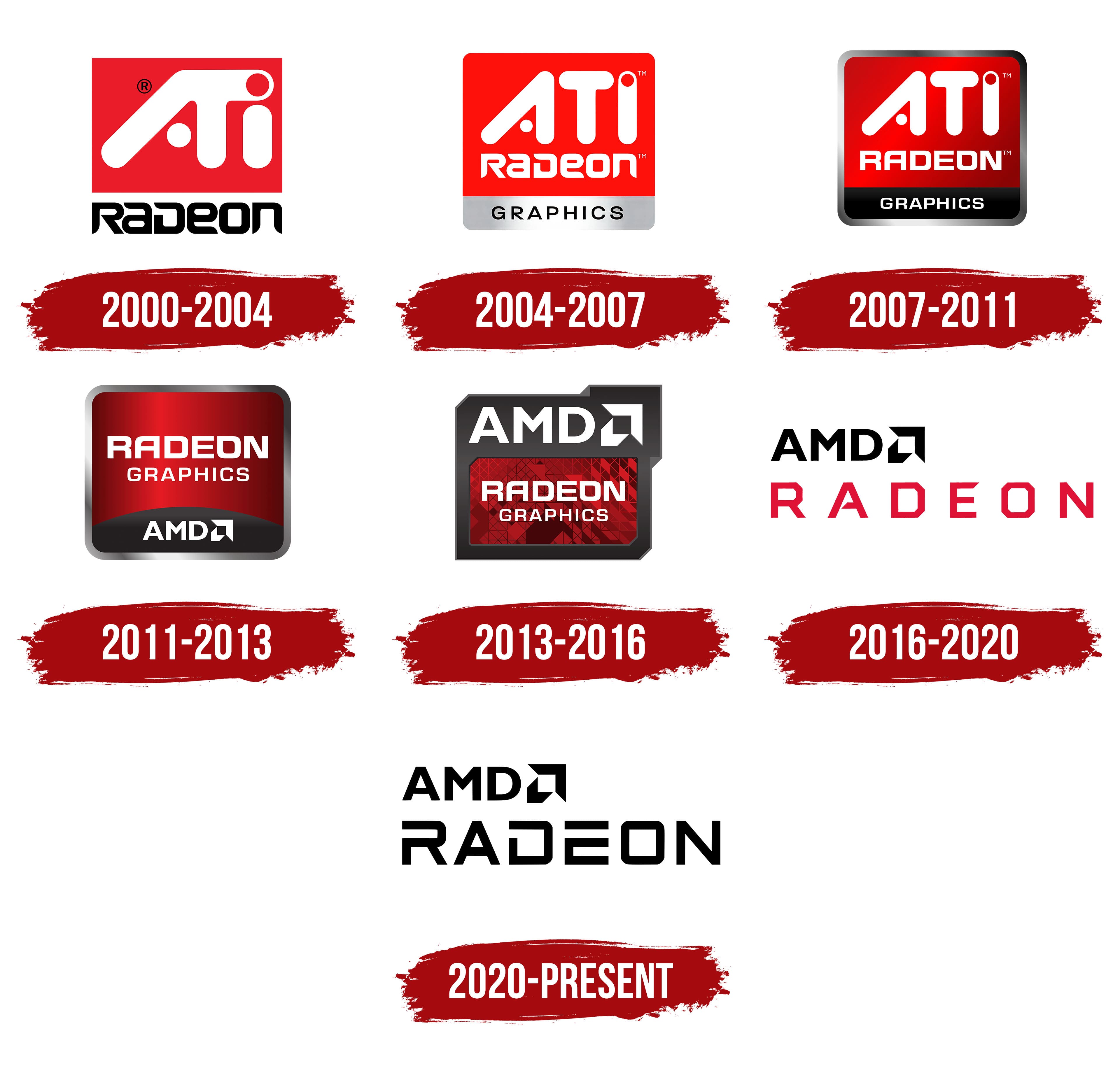
2000 – 2004
The ATI Radeon logo, used in the series’ early releases, became a brand symbol with the introduction of the R100 architecture. Models such as the Radeon DDR and Radeon 7500 entered the market with this logo, offering hardware acceleration for transformation and lighting operations, compatibility with Direct3D 7.0, and the proprietary HyperZ technology. The latter was introduced at the end of 2000 and delivered up to a 20 percent performance increase, which became a competitive advantage for the cards.
The logo composition was divided into two blocks. The upper part featured a red rectangle with white ATI letters. Below it was the black word Radeon. The contrast between the elements enhanced the composition’s expressiveness and emphasized its multi-level structure.
The word “Radeon” was written in a technical sans-serif font. The uppercase letters had rounded forms and smooth corners with thickened strokes that gave the text a digital character and a unified appearance. The typeface appeared proportional and balanced, resembling styles commonly used in technological and engineering design.
The ATI logo in the upper red block played the biggest role in recognizability. The letters had a simplified, schematic design. The “A” was tilted to the right, forming the base for the vertical line of the “T”. The horizontal bar of the “T” connected all three letters and acted as the top point for the “i”. Rounded lines and smooth connections gave the mark originality and integrity.
The color scheme included an energetic red background, white letterforms, and black Radeon text. Sometimes variations with added silver or black frames appeared for different media uses. The combination of red and white conveyed a sense of technological progress and highlighted Radeon’s focus on multimedia and gaming solutions.
2004 – 2007

The updated ATI Radeon emblem retains key details while maintaining continuity. The redesign affected the shape, structure, and composition, adding new accents that reflected the brand’s technical orientation and product specificity.
The basis was a square with softly rounded corners, vertically divided into two zones. The upper part was a rich red, featuring the ATI mark and the word “Radeon,” while the lower part was silver with a metallic gradient.
The ATI symbol received a new design. Unlike earlier versions, where the letters were connected, in this version each letter became independent. The “A” acquired a slant due to an extended diagonal line, inside which there was a rounded dot instead of a crossbar. The top of the “I” featured a circular cutout, adding a touch of originality. All three letters were rendered in a bold geometric font with smooth stroke endings.
The word “Radeon” moved to the center and turned white.
In the lower zone, the word “GRAPHICS” appeared. It was done in a thin uppercase font. Even spacing between letters and minimalist design created a sense of restraint and professionalism.
The logo’s color scheme was enhanced with a metallic silver shade, which, combined with the black text, added a sense of solidity to the design. Red and white retained their traditional meanings, symbolizing energy, performance, and innovation.
2007 – 2011
The final version of the ATI Radeon emblem became a symbol of the transitional period during which the brand was being integrated into AMD. The visual structure remained the same. The same layout included the upper red block labeled ATI, the middle section labeled Radeon, and the lower line labeled Graphics. The changes altered details that gave the logo a distinct character and emphasized the line’s premium positioning.
The main addition was the appearance of a metallic frame. It had a silver gradient that created a sense of volume and a three-dimensional contour. The red background in the upper part now uses a deep gradient, which increases visual depth and contrast with the white ATI letters.
The Radeon text underwent the most significant redesign. The soft, rounded forms of the previous font were replaced with an angular sans serif featuring straight lines and strict proportions.
The letters in the lower part of the word Graphics became more elongated and narrower, with more evenly spaced letters. The line appeared visually neat and emphasized the company’s area of expertise.
The composition featured red and white tones, black accents, and a silver outline. They created a sense of premium quality.
The emblem marked the end of the ATI brand in the graphics technology industry. After its use, video cards were released under the new AMD Radeon trademark, and the ATI logo remained as the last reminder of the company’s independent existence.
2011 – 2013
The transition of the Radeon brand under the AMD name was marked by a new version of the emblem, which dropped the ATI designation and visually integrated the line into AMD’s corporate logo system. The logo retained its vertical orientation, rounded corners, and silver frame, but the redesign altered its internal structure and focal points.
The upper area, previously occupied by the ATI symbol, was now dedicated to the Radeon name and the word Graphics. The red background received a rich gradient transitioning from burgundy at the edges to a brighter tone in the center. Against this background, the white letters appeared highly contrasting, enhancing clarity and giving a strict look.
The lower part featured a black arc-shaped background. The AMD logo was placed there to emphasize the Radeon line’s affiliation with the corporation and to ensure unity with other brand visuals.
The Radeon lettering retained a straightforward sans-serif style but became bolder, with consistent stroke thickness and sharp corners. It enhanced the sense of power and confidence. The word Graphics was rendered in a thinner font.
The color system was based on red, black, white, and metallic silver. Their combination created visual depth and emphasized technological precision. The emblem was used on Radeon HD 6000 and HD 7000 cards, as well as in marketing materials, establishing the new Radeon name under the AMD brand and marking the conclusion of the ATI era.
2013 – 2016
The AMD Radeon emblem, following the departure from the ATI brand, demonstrated full integration with AMD’s corporate style and an emphasis on technological character. The updated logo design resembled a microchip or technical block with uneven edges and unconventional angles, conveying an industrial appearance and a connection to the hardware component of graphics systems.
Inside, the upper part of the composition was dedicated to the AMD symbol. The white logo was set against a dark gray background and featured the name, along with a geometric arrow pointing upward and to the right. The symbol was associated with ideas of development and progress, and in the context of Radeon, it reinforced the visual affiliation with the AMD ecosystem.
The lower block had a red fill and was enhanced with a decorative texture. Inside was a geometric pattern resembling a digital grid or printed circuit design, composed of diagonal lines and diamond-shaped elements. The mesh created a sense of depth and layering. Against this background appeared the white inscriptions “Radeon” and “Graphics”. The upper line looked massive thanks to an angular sans-serif with sharp contours. The lower line was lighter, using a font with even proportions.
The palette included deep red, gray-black, and white shades. Red remained the main identifying color of the line, gray-black added a sense of strictness, and white enhanced contrast and structure within the composition.
The logo accompanied Radeon graphics cards of the R7, R9, and Fury series built on the second-generation GCN architecture. It was used in the Catalyst Omega and Crimson driver materials. This version reinforced Radeon’s image as a high-tech product.
2016 – 2020

The new AMD Radeon logo was created when Radeon Technologies Group was established as a separate division within the company. The changes in identity coincided with the release of Radeon RX 400 graphics cards based on the Polaris architecture. They accompanied AMD’s strategy to expand the use of graphics technologies beyond the gaming industry. The goal was to highlight the versatility of GPUs, including professional applications such as computing processes, virtual reality, and engineering tasks.
Brand Union San Francisco developed the design and was later incorporated into Superunion. The agency’s task was to create a logo that would be simple to scale and have a strict technological character.
The composition was built in a two-tier format. The upper line contained the AMD name in the company’s corporate style, rendered in black. Below it was the word RADEON, written in bright red, the “Radeon Red” shade officially identified with the RTG brand. The Radeon Display Font was developed for this purpose. Its features included a geometric base, truncated and cut-off strokes, and octagonal letter contours. The structure referenced pixel shapes and visual motifs commonly found in electronic circuitry. The inscription appeared industrial and emphasized the products’ engineering foundation.
Red served as the main accent, symbolizing energy and high performance, while black connected the new mark with AMD’s overall aesthetic, highlighting continuity with the parent brand.
The logo’s creation is linked to Raja Koduri, who led Radeon Technologies Group and gained autonomy in GPU development and promotion. The new style became a tool for establishing an independent identity and strengthening Radeon’s competitiveness alongside the Ryzen processor line.
The emblem was used on Polaris (RX 460, RX 470, RX 480), Vega (Vega 56, Vega 64), and Radeon VII cards. The design was featured in Radeon Software Crimson ReLive and Adrenalin interfaces, as well as in RTG public presentations.
2020 – today
The evolution of Radeon’s style this time was driven by the goal of unifying the visual language across all AMD divisions and creating a cohesive system for the company’s CPU and GPU brands. While maintaining the logo’s general structure, with the AMD corporate mark in the upper line, the changes primarily affected the typography of the Radeon name in the lower part.
Instead of the Radeon Display Font used previously, a new typeface based on the AMD Ryzen Display Typeface was introduced. It was developed by North Design, the agency that collaborated with AMD on the design of the Ryzen and EPYC identities. All key product lines of the company were to be designed in a unified style and brought under one typeface.
The primary features of the new design are its strict geometry. The letters received rectangular contours and precise cuts in the structural elements of R, D, and E. Their shapes evoke digital processing and engineering precision.
Another change involved the color palette. While the previous generation of the AMD Radeon logo used the “Radeon Red” shade, the new version is rendered in black. This simplified integration with AMD’s identity and allowed Radeon to coexist more seamlessly alongside the company’s other divisions.
The logo update coincided with the release of the RDNA 2 architecture and the launch of the Radeon RX 6000 (Big Navi) series. The products introduced hardware-accelerated ray tracing for the first time, becoming direct competitors to NVIDIA’s GeForce RTX solutions. The same emblem was retained for the next-generation RDNA 3 series in the RX 7000 lineup.
The transformation aimed to eliminate the visual boundary between AMD’s CPU and GPU divisions. The Radeon logo in its new form reflected the company’s goal to unite CPUs and GPUs under a shared platform philosophy, including technologies such as Smart Access Memory and Infinity Cache.