


 BlackBerry Logo PNG
The BlackBerry logo conveys the compact size and versatility of the company’s devices. It hints at a long search for its market niche and a test of the pen in several related directions. The emblem encodes the brand’s gradual growth and maturation.
In 1984, engineering students Mike Lazaridis and Douglas Fregin founded Research In Motion in Waterloo with $15,000 borrowed from their families. Early work ranged from digital displays to industrial electronics and barcode readers for film editing; a contract with General Motors brought technical Emmy and Oscar awards.
Cooperation with BellSouth on Ericsson’s Mobitex network shifted RIM toward wireless data. In 1992, Jim Balsillie invested $125,000 and became co-CEO. In 1996, the Inter@ctive Pager enabled two-way messaging. RIM was listed on the Toronto Stock Exchange in 1998 and on NASDAQ in 1999, raising $250 million. The BlackBerry 850 introduced the brand name.
Balsillie promoted devices through direct trials among bankers and lawyers. During the September 11 attacks, BlackBerry networks remained operational while other systems failed, strengthening its adoption in corporate and government communications. By 2006, subscribers exceeded 8 million; Pearl added camera and media functions, while Curve became a leading smartphone in the US by 2009.
After Apple released the iPhone in 2007, RIM underestimated the importance of touch interfaces and app ecosystems. Samsung’s Android accelerated competition across segments. By 2012, the market value had dropped 75 percent, and both co-CEOs had stepped down.
In 2013, CEO Thorsten Heins rebranded the company as BlackBerry Limited. He launched BlackBerry 10 with Z10 and Q10, but weak developer support led to a $934 million inventory write-down. John Chen later shifted strategy toward software, ending in-house phone production by 2016 and focusing on enterprise security, QNX systems, and mobile management.
Meaning and History
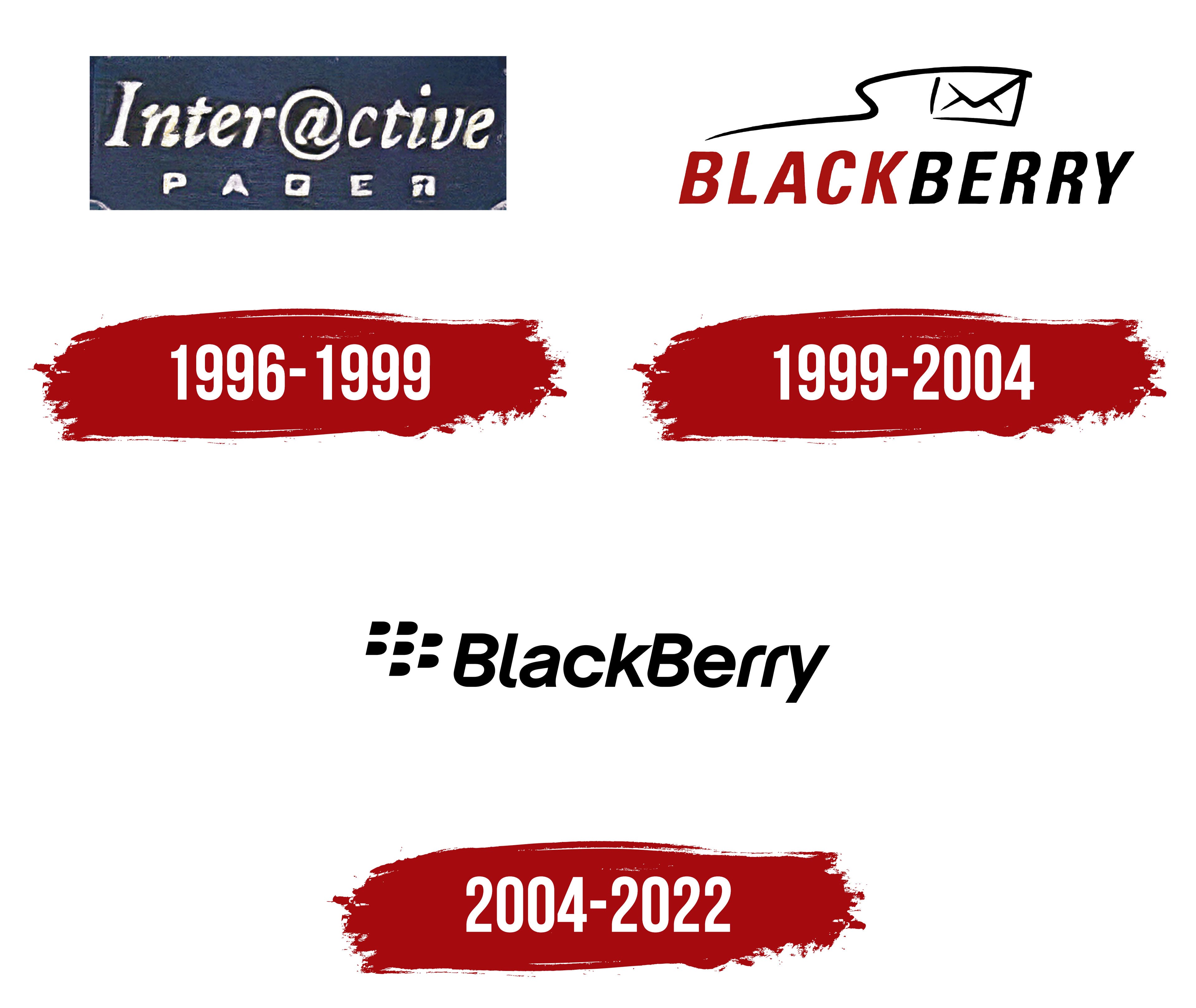
The American marketing corporation Lexicon Branding developed the BlackBerry brand. It closely linked its logo and name, depicting a multifilament fruit and the inscription “BlackBerry” on the trademark. This word was not chosen by chance: the company’s specialists thought the black device with many small buttons resembled the famous forest berry.
What is BlackBerry?
It is a mobile device brand owned by BlackBerry Limited. It started as a pager startup but gradually evolved into a full-featured communicator. Its technology falls under the business smartphone category.
1996 – 1999

Initially, the logo was a large inscription “Inter@ctive.” It was cursive, white, with an imitation of calligraphic handwriting. The first letter in it was uppercase; the rest were lowercase. At the same time, the letters were spaced apart and clearly positioned. An interesting typographic technique was replacing the classic “a” with a non-standard “@.” This emphasized the brand’s electronic focus. The light text stood out clearly against a dark background.
1999 – 2004

The debut emblem combines graphic and text elements in a balanced way. At the top, a stylized envelope features a thin, wavy line twisting from the left corner. It connects to the letter’s contour and continues it harmoniously. At the bottom is the one-piece trademark name “BlackBerry.” The word is written in capital letters and divided by color into two fragments: the left is red, and the right is black. Above each is a graphic element: a curved strip above “Black” and an envelope above “Berry”. The main background for all elements is white.
2004 – 2022
The emblem consists of seven semi-ovals that align with the in-letter gaps and form a “B”. To create these elements, the designers used the original negative space art technique. Although the graphic sign components are arranged chaotically, the brand documents strictly prescribe their proportions and style.
Font and Colors
The logo’s copyright holder prohibits any distortion of the image. It allows only changes to the color palette, and only within certain limits. Preferred shades are classic white, black, Obsidian Blue, and Blackberry Blue. Additional blue tones are also allowed: Indigo, Space, Ocean, Regal, Azure, and Brilliant. Accent colors can be turquoise and satin.

In the new logo, the two “Bs” give the brand name a distinct sonic expression. In writing, they start in lowercase and then convert to uppercase. The Roboto typeface, invented by Christian Robertson for Google products, emphasizes their uniqueness. Bold, italic, sans-serif letters.
FAQ
What does the BlackBerry logo mean?
The logo is designed to resemble a blackberry. It has eight ‘bits,’ with seven visible and one missing, as if someone took a bite out of it. This plays on the word “byte,” connecting the logo to the tech world.
The negative space in the logo forms multiple letter B’s, representing the brand name “BlackBerry.” This dual symbolism highlights the brand’s identity and creativity, linking it to technology and the fruit.
The logo’s simple, clever design makes it easy to recognize and remember, highlighting the brand’s innovative, tech-savvy nature.
What are the BlackBerry company colors?
The company colors are blue and black, used consistently in their branding to create a strong, recognizable visual identity.
The specific shade of blue is Pantone® 285 C, with the hex code #1475DC. This vibrant blue, paired with black, gives a professional, sleek look that reflects the brand’s focus on innovation and technology.
These colors help convey BlackBerry’s image as a reliable, cutting-edge tech company, reinforcing its brand identity across platforms and marketing materials.
What font is the BlackBerry logo?
The logo uses a custom grotesque typeface similar to Nimbus Sans Bold. This italicized font adds elegance and sophistication. Its bold, clean lines reflect the brand’s commitment to innovation and professionalism. The italicized design conveys forward movement and modernity, aligning with BlackBerry’s image as a cutting-edge tech company.
This unique typeface makes the wordmark distinct and easily recognizable, supporting a strong brand identity across media and marketing materials.
What does the BlackBerry symbol mean?
The symbol comprises seven D-shaped figures arranged in three columns (2-3-2). This design creates two letter B’s in the negative space of the first and third columns, symbolizing “Black” and “Berry.”
The D-shaped figures resemble blackberry texture, linking the logo to the brand’s name. The logo’s simplicity and ingenuity make it easy to recognize and remember, reinforcing the brand’s strong identity in the tech industry.
How many dots are on the BlackBerry logo?
The logo has seven elements that look like small buttons, similar to those on BlackBerry devices. These elements resemble blackberry seeds, tying into the brand’s name.
This symbolism links the logo to the brand’s identity, reflecting both the devices’ design and the fruit. The seven elements are arranged to create a unique, recognizable logo that reinforces the brand’s image and heritage.
What is the BlackBerry logo supposed to be?
The logo symbolizes the brand’s identity and heritage. It has seven elements that look like small buttons, similar to those on its devices. These elements resemble blackberry seeds, tying into the brand’s name. This links the logo to the device’s design and the fruit.
The logo features the brand name in italic type with smooth curves, giving it a sleek, modern look. To the left of the name is a seven-piece pattern that forms a shape resembling an uppercase “D” without an inlet. This pattern makes the logo unique and recognizable. The main color is black, adding to its sophistication and timeless appeal. This design keeps the logo distinctive and memorable, reinforcing the brand’s image in the tech industry.
Is BlackBerry a Chinese company?
No, it is not a Chinese company. It is based in Canada, with its main office in Waterloo, Ontario. The brand has long developed mobile and wireless communication solutions. Originally known for its smartphones, it now focuses on software and services, specializing in cybersecurity and the Internet of Things (IoT).
The company is a significant player in the tech industry. It operates independently of any Chinese ownership or influence. Its Canadian roots and Waterloo headquarters are central to its identity and operations.