 Belmont University Logo PNG
The Belmont University logo symbolizes where education intersects with creativity and ambition. Students with diverse interests, from music to business, explore new opportunities, develop ideas, and shape their future careers in an inspiring and collaborative atmosphere.
Belmont University’s history dates to 1890, when Ida Hood and Susan Heron founded Ward’s Seminary for Young Ladies in Nashville, Tennessee. Known for excellence in arts and academics, the institution merged with Belmont College for Young Women in 1913, creating Ward-Belmont. The school was located on the Belmont Estate, originally owned by the notable socialite Adelicia Eccles Hayes.
In 1951, the Tennessee Baptist Convention purchased Ward-Belmont, renaming it Belmont College and introducing coeducation. The school expanded in the following decades, particularly in music and business, adding new dormitories, athletic facilities, and academic buildings throughout the 1960s and 1970s.
Belmont gained university status in 1991, enhancing its profile through specialized programs such as music business. Major campus projects included the 2003 opening of the Curb Event Center and the 2007 opening of the Gordon E. Inman Center for Health Care Programs.
In 2008, Belmont hosted a nationally televised presidential debate between John McCain and Barack Obama, elevating its national visibility. Further expansions included the establishment of a law school in 2012 and the construction of new facilities for media and entertainment, such as the R. Milton and Denice Johnson Center (2015) and Tall Hall residence (2016).
Growth continued into the 2020s, with the addition of a new Performing Arts Center (2020), the Thomas F. Frist Jr. College of Medicine (2021), and the Jack C. Massey Center for Business Education (2022). By 2023, Belmont had firmly established itself in healthcare, business, and music education.
The university’s athletic teams compete as the Belmont Bruins and compete at the NCAA Division I level. Basketball, baseball, track and field, and swimming athletes represent the university under the symbol of a bear named Bruiser.
Meaning and History
What is Belmont University?
This private educational institution in Nashville, Tennessee, offers programs in entrepreneurship, performing arts, and music business. The campus combines modern learning spaces with historic architecture, creating a comfortable student environment. The School of Music Business is ranked among the best in the country. The university offers over 100 undergraduate and graduate programs in various fields, including humanities, business, education, and medicine. The institution’s athletic team competes in NCAA Division I events.
Old

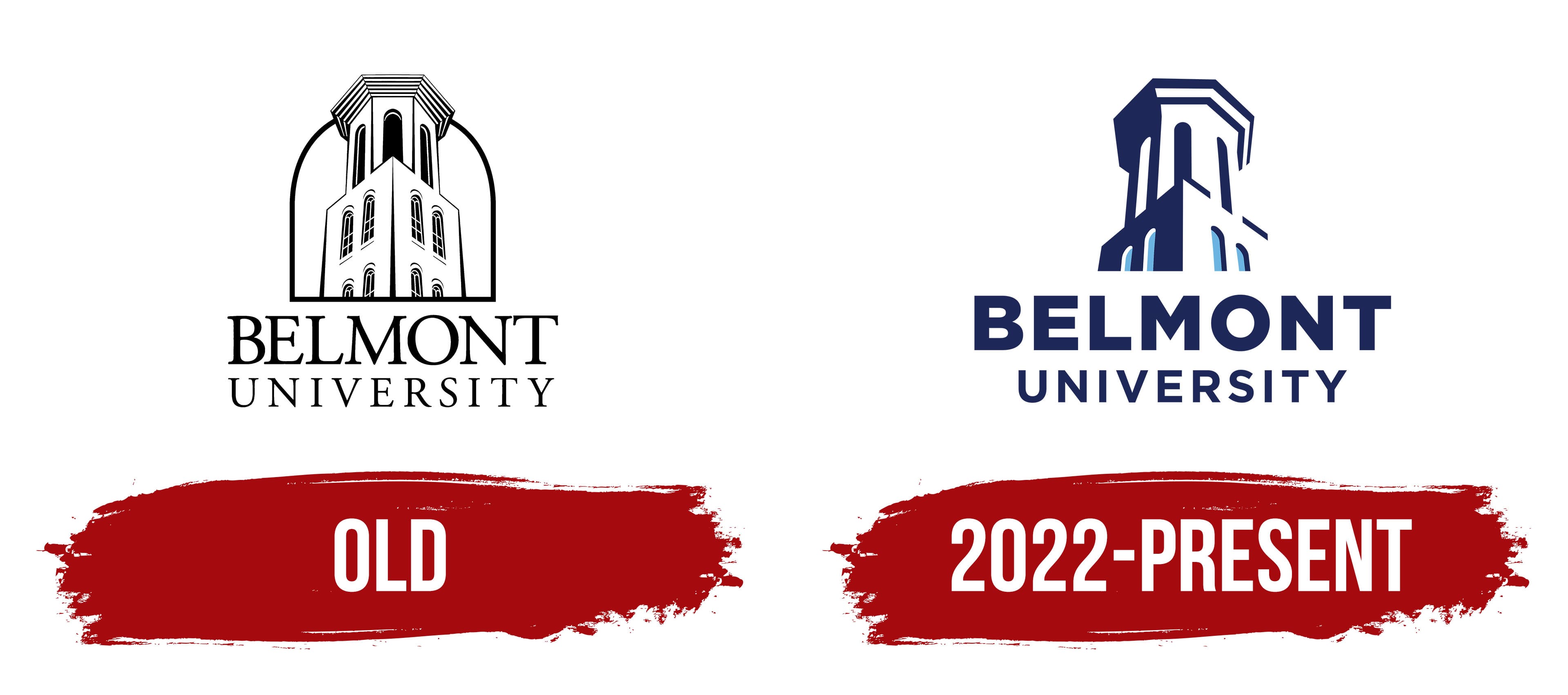
The architectural symbol of the campus, a mid-19th-century bell tower built between 1850 and 1853 by architect Adolphus Heiman, became Belmont University’s logo. The building is listed in the National Register of Historic Places and served as the primary inspiration for the mark. The silhouette of the tower is associated with academic heritage and is perceived as a local landmark, which determined its selection as the visual core of the university’s identity.
The composition is built vertically. The image of the bell tower occupies the upper area; beneath it is a two-line inscription. The top line features the word “BELMONT” in large type, and the second line displays the word “UNIVERSITY” in smaller font, centered along the vertical axis.
The silhouette of the tower is conveyed through simplified graphics. The arched openings are indicated by a series of strokes and contrasting spots; the roof is interpreted through octagonal planes; and the upper frieze section is enclosed in a semi-arched frame.
The typography of the text is based on a serif typeface close to Garamond or Times. The glyphs are uppercase, with thin serifs and moderate stroke contrast. Kerning and tracking are calibrated to ensure uniform spacing between letters and lines, resulting in a harmonious perception at various scales of use.
The palette is reduced to black and white. Black is used for outlines and light-shadow accents, while the white field functions as negative space.
The logo’s semantic foundation is connected to the bell tower’s function as both an acoustic and an architectural symbol of the campus. The vertical axis of the image represents elevation, and the arched forms create a rhythmic resonance with the historical style.
2022 – today
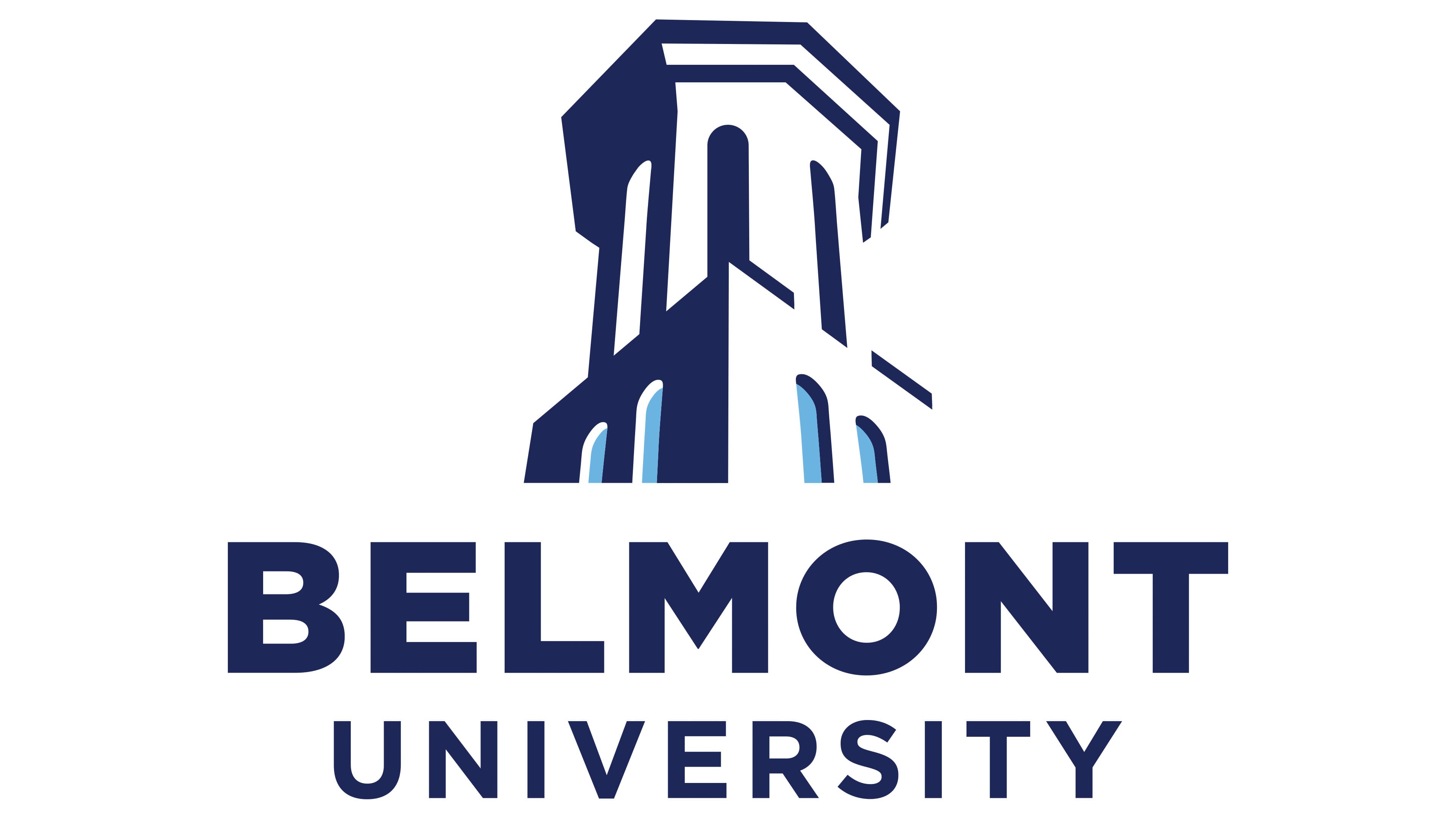
Unlike the earlier version, which emphasized a detailed silhouette of the historic bell tower, the updated Belmont University mark shifted its focus to a simplified and more geometric emblem. The decision was driven by the task of unifying the visual system for digital platforms and applied media while preserving architectural heritage in its recognizable form.
The tower remained the main motif, but its image was reworked. Its arched openings were reduced to simple cutouts, depth was created with contrasting fills, and the top of the tower was interpreted through angular planes. Light blue inserts in the windows model volume rather than serving as a decorative effect, supporting the sense of architectural solidity without overloading the design with details.

Instead of a serif typeface, modern sans-serif typography was used. All letters are uppercase, stroke contrast is minimal, and endings are flat. Apertures are widened, and letter spacing is balanced, improving legibility in both large and small formats. The proportions between the lines were adjusted. The word “BELMONT” became dominant in the composition, while the word “UNIVERSITY” plays a supporting role in hierarchical reinforcement.
The color system moved away from the previous monochrome and is now based on a cool palette. Dark blue lends the composition solidity, while light blue shades serve as a tool for the plastic decomposition of form. The system of versions includes full color, mono, reverse, and grayscale, which facilitates reproduction in print and digital environments.
The seal

Old

The seal of Belmont University was created as an instrument of official representation. Its structure follows the canon of heraldic seals, in which the circular form and architectural motif are combined in a strict, functional composition.
The outer ring was made of two concentric outlines, between which the name BELMONT UNIVERSITY was placed. To enhance the effect of a stamped impression, an additional row of lines was added along the circumference, forming a relief frame.
In the center is a motif of a Corinthian capital, reduced to an inverted triangular shape. The volutes and plant ornaments are simplified and interpreted as silhouette elements with even stroke density. This interpretation preserves the architectural references to classical tradition and gives the image the compactness necessary for scaling.
The circular inscription is set in a serif typeface. Wedge-shaped serifs, strokes with moderate contrast, and calculated kerning ensure the even distribution of text along the arc.
The seal’s semantic focus is based on architectural symbolism. The Corinthian capital is interpreted as a metaphor for the continuity of the classical tradition, and its circular form emphasizes its connection to official documentation.
2022 – today
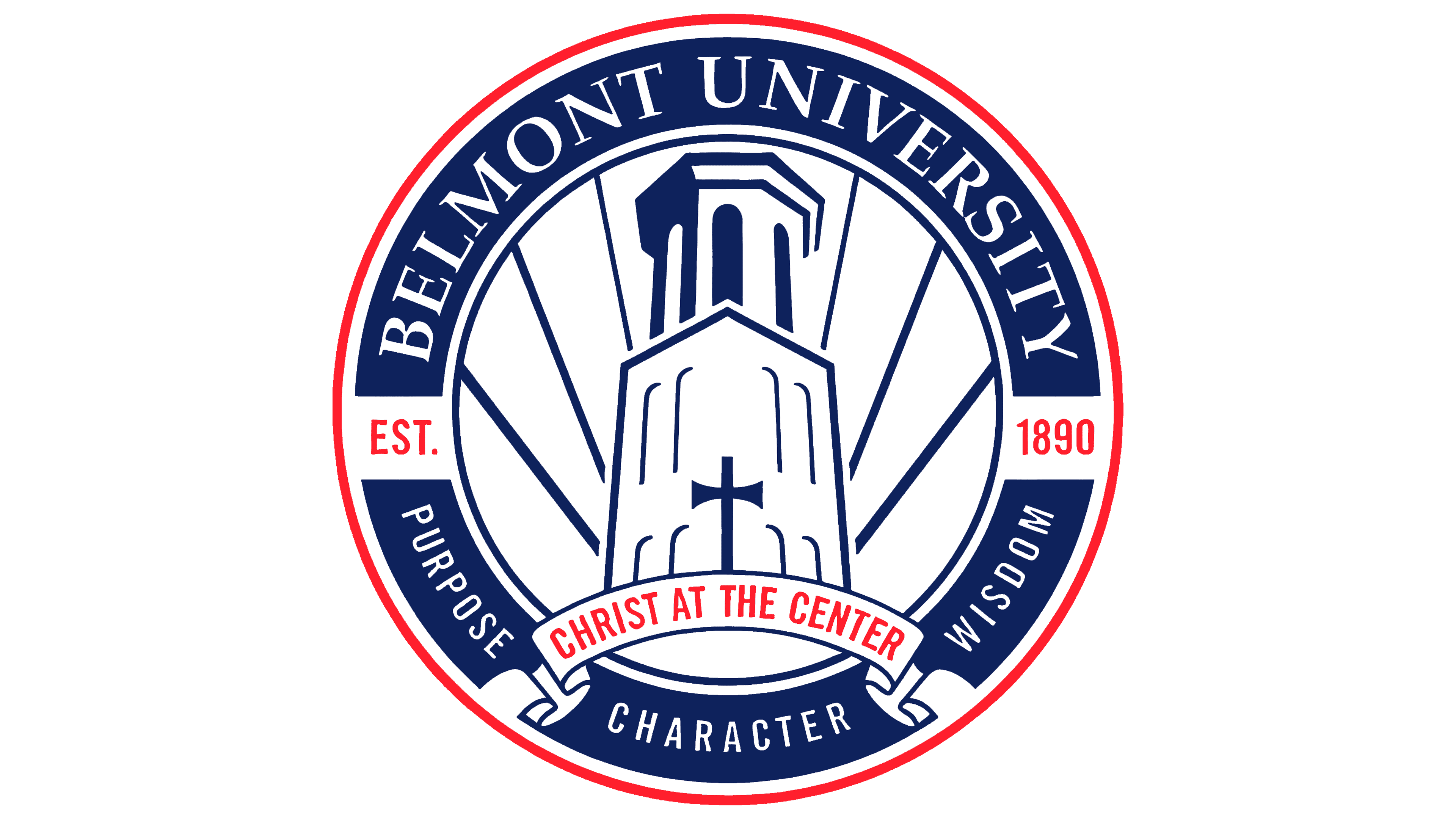
Unlike the earlier Belmont seal, which focused attention on architectural references and classical ornamentation, the updated mark features a different image. It incorporates elements that emphasize the university’s mission and its religious foundation.
The construction is based on concentric rings. The outer red border forms a frame, and the inner dark blue band displays the university’s name and year of foundation. In the lower sector, three words were added, serving as semantic pillars and designating the fundamental principles of the institution: Purpose, Character, and Wisdom. The year EST. 1890 is placed in side accents to underline historical continuity.
At the center of the composition is a simplified silhouette of the bell tower, one of the campus’s key symbols. The architectural form is reduced to vertical strokes and a schematic roof. A cross is placed on the facade, referring to religious identity. Behind the tower, radiating beams spread outward, creating a light effect and lending the composition a spiritual emphasis. At the base, there is a ribbon with the inscription “CHRIST AT THE CENTER.” The text on it is highlighted in red and brought forward visually, with its edges connecting to the inner ring, forming a closed system.
Typography is built on the principle of hierarchy. The circular text is set in a serif capital style with moderate stroke contrast and kerning, ensuring an even text mass along the arc. The inscription on the ribbon is executed in a dense sans serif with accentuated proportions, which strengthens the contrast with the dark blue background.
The palette uses dark blue as the base, red for accent zones, and white for neutralizing the background.
The new design is oriented toward the university’s value-based and spiritual foundations, transforming the emblem from an architectural allusion into a symbol of its institutional mission.