


 Deftones Logo PNG
Despite the absence of complex graphic elements, the Deftones logo remains an important part of the brand. Its simple design creates a recognizable, memorable image that contrasts with the music’s heightened emotionality. In this way, the group emphasizes the directness and ambiguity of its creativity.
Deftones formed in Sacramento, California, in 1988, when Chino Moreno, Stephen Carpenter, and Abe Cunningham began rehearsing in Carpenter’s garage as McClatchy High School classmates. Carpenter had started playing guitar after being hit by a car while skateboarding at 15. Early lineup changes brought in bassist Chi Cheng, and Frank Delgado joined as a touring member in 1996 before becoming official in 1999.
The band first played in Sacramento, then in San Francisco and Los Angeles. At a Los Angeles show, Maverick Records, a label associated with Madonna and Warner Bros., noticed them. Deftones signed in 1995 and released Adrenaline, a raw debut promoted through constant touring, often with bands such as Korn, though Moreno rejected the nu-metal comparison.
Around the Fur arrived in 1997, with “My Own Summer” and “Be Quiet and Drive” gaining MTV rotation. In 2000, White Pony changed the band’s profile, combining heavy guitars with new wave, R&B, and electronic textures. The album earned Deftones a 2001 Grammy for “Elite,” while Moreno’s vocal injury forced Chi Cheng to cover some of the screamed parts on tour.
The self-titled album followed in 2003, and after tense sessions, Saturday Night Wrist arrived in 2006. In 2008, Cheng’s car crash stopped work on Eros, and Sergio Vega from Quicksand joined on bass. Diamond Eyes was released in 2010, Koi No Yokan in 2012, and Cheng died in 2013. Gore followed in 2016 with Jerry Cantrell from Alice in Chains, while Fred Sablan of Marilyn Manson later toured on bass. Ohms came in 2020, and Private Music followed in 2025.
Meaning and History

Deftones use their logo as a personal signature on numerous album covers, indicating their authorship. The emblem is often simple because it includes the group’s name. Some fans think it is formed from the words “deft” and “ones” to emphasize the musicians’ skill and individuality. However, this is not the case. The name of the metal group was invented by guitarist Stephen Carpenter, combining two parts:
- “def” is a slang term meaning “outstanding” (originating in the African American community and picked up by hip-hop artists in the 1980s, including Public Enemy and LL Cool J).
- “-tones” is a word often found in 1950s group names (e.g., The Harptones, The Monotones, The Quin-Tones, and other doo-wop and surf music performers).
The name Deftones does not hint at rock or metal. Carpenter showed a reluctance to focus on any specific genre. This is a bit self-ironic, since “Deftones” sounds like “tone deaf,” meaning the inability to recognize notes and reproduce melodies. The band’s logos also look universal; it’s hard to tell they’re heavy, experimental musicians.
What is Deftones?
Deftones is a metal band formed in Sacramento by three friends: Abe Cunningham, Stephen Carpenter, and Chino Moreno. Eventually, Frank Delgado joined them. The group performs music in various experimental genres, including avant-garde rock, art rock, and alternative metal. Its creativity has earned numerous awards. For example, in 2000, Kerrang! recognized White Pony as the best album. Awards, and 13 years later, Revolver magazine named Koi No Yokan Album of the Year.
1995 – today
This logo first appeared on the cover of Adrenaline’s debut album, released in 1995. It contains just one word, the band’s name, neatly written in lowercase letters. The font imitates calligraphic handwriting with alternating thin and thick strokes. The elegant inscription contrasts with the music’s heavy sound, creating dissonance. However, it must be acknowledged that the songs also contain an eclectic mix: the band members skillfully combine tranquility, melody, anger, aggression, and anxiety. Thus, behind the neat cursive glyphs lies something more than just an attempt to make a good impression. The fact that all the letters are already separated suggests emerging chaos.
2006 – today
In 2006, the band released its fifth studio album, Saturday Night Wrist. On its cover, in the top-left corner, the barely noticeable inscription “DEFTONES” was lost amid provocative images. This logo looks unremarkable, especially compared to other metal bands’ emblems. It’s impossible to tell the musicians’ genre, as the strict uppercase sans-serif letters feel more businesslike than informal.
B-Sides & Rarities (album) Logo
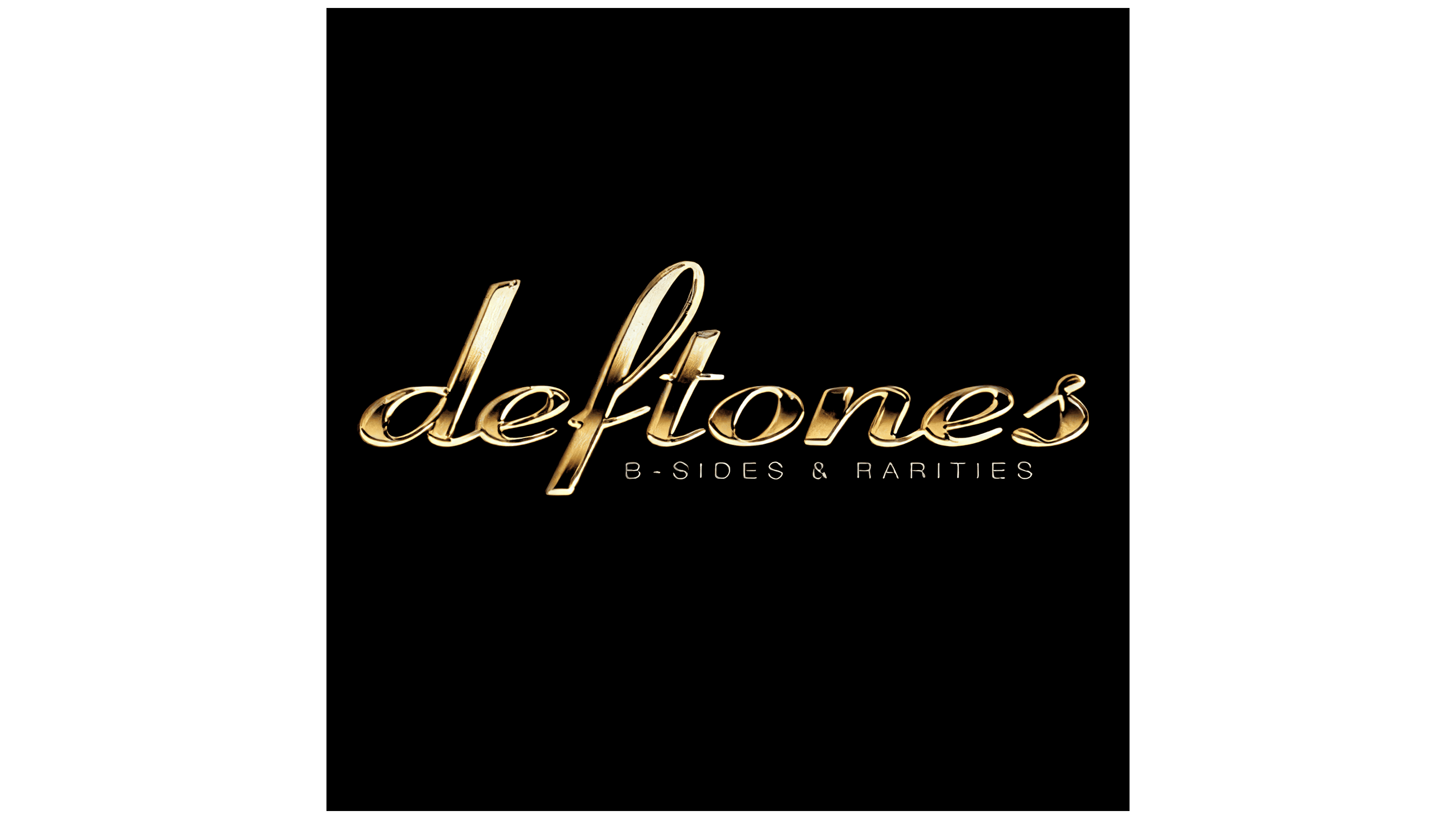
The album B-Sides & Rarities by the American alternative metal band Deftones was released in 2005. It compiles rare recordings, covers, acoustic versions, and other unique tracks not previously included on official albums.
The album cover logo is restrained. The Deftones’ inscription is set in an elegant font that the band has used throughout its career. It combines smooth lines and minimalism to emphasize the band’s aesthetic.
The visual design of B-Sides & Rarities features dark tones, soft transitions of light and shadow, and golden shades in the album title. The artwork visually creates an atmosphere of solitude and nostalgia.
Font and Colors
Two radically different styles define Deftones’ typography. In 2006, the band introduced a logo using the geometric, sans-serif typeface Selecta Black, known for its bold and impactful letterforms.
Earlier, in 1995, the band used a completely different design, a handwritten script with a calligraphic flair, similar to Ribbon 131 Bold or Coronet LT Std Bold, featuring soft, flowing letterforms.
Despite the stark contrast between these typographic approaches, the color scheme has remained consistent. Both versions use black lettering on a white background, emphasizing the contrast and balance between distinct forms and styles.