


 DTAC Logo PNG
The DTAC logo symbolizes movement and development, reflecting the company’s commitment to innovation in the telecommunications industry. The emblem’s smooth lines convey ease and freedom of communication, evoking unhindered access to the digital world and high-quality Internet connections.
DTAC, or Total Access Communication Company Limited, was founded in August 1989 as a joint venture between Thailand’s Bencharongkul Group and Norway’s Telenor. The company entered the market when Thailand was beginning to build mobile communications. In 1991, it received a concession from the Communications Authority of Thailand to provide cellular service in the 800 MHz band, providing the basis for a nationwide network.
In 1994, DTAC launched Thailand’s first GSM network, adding SMS and broader mobile communication services. In 1995, it introduced prepaid mobile service, helping expand access to mobile phones. The company was listed on the Stock Exchange of Thailand in 1997, then moved into online customer services in 2000 with its first website. In 2002, CAT granted an additional 1800 MHz concession, extending network capacity.
DTAC launched EDGE in 2005, followed by a 2007 rebrand with the “Feel Good” slogan and a new logo. In 2009, it introduced 3G on the 850 MHz band, and in 2010, Telenor raised its holding to 42.6%. A flagship store opened in Bangkok in 2012. In 2013, DTAC received a 2100 MHz 3G license and launched 4G LTE in 2014, starting in Bangkok and later expanding to other major cities.
From 2015, the company invested in digital support, mobile apps, and service management. In 2016, it launched the DTAC Accelerate Startup Program. New spectrum licenses followed in 2018 for 1800 MHz and in 2019 for 700 MHz, supporting 4G and rural coverage. In 2020 and 2021, DTAC tested and expanded 5G services. In 2022, merger talks with True Corporation drew regulatory and market attention.
Meaning and History
What is DTAC?
It is one of the leading telecommunications service providers in Thailand. The company offers millions of users a range of services, including voice, data, and digital solutions. It operates an extensive network infrastructure and provides high-speed internet, various value-added services, and prepaid and postpaid mobile plans.
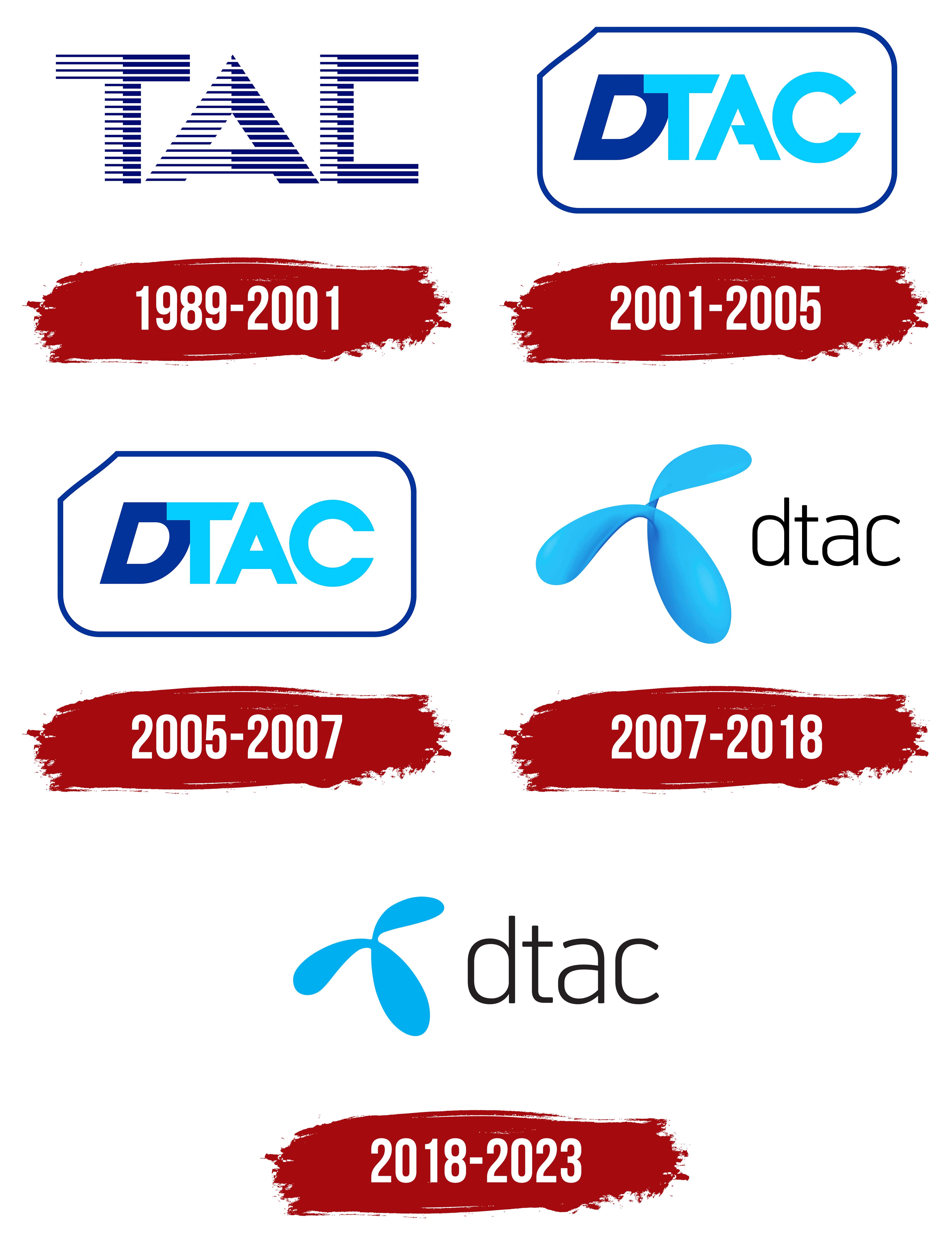
1989 – 2001
2001 – 2005
2005 – 2007
2007 – 2018
The company logo consists of three smooth, streamlined elements that resemble petals or drops of water, twisted at the center. These three shapes symbolize flexibility and fluidity, emphasizing the company’s ability to adapt to changes and offer modern communication solutions. The design is associated with technology and modernity while also conveying a sense of lightness and friendliness. These forms convey dynamism, highlighting the company’s innovative approach.
The blue color of the petals, with a gradient from light to a deeper tone, creates a sense of depth, adding dimension to the entire logo. This hints at the technology’s layered complexity, which remains invisible to the user, even though it appears simple and intuitive. Blue is often associated with reliability and calmness, fostering trust in the brand. It’s important to note that when the company updated its logo, blue became a common color among IT companies, emphasizing its focus on the future and technology.
The font is designed in a simple, clean, sans-serif style, emphasizing minimalism and accessibility. The logo quietly communicates that the company is open, easy to use, and customer-focused. Lowercase letters enhance this effect, giving the emblem an additional sense of groundedness and approachability.
2018 – 2023
The emblem still consists of three blue petals connected at the center. These elements, resembling drops of water, create a sense of dynamism and lightness. In the past, a gradient was used to add depth and dimension to these petals, but in this version of the logo, the company opted to remove that effect, leaving a solid color fill. This decision reflects a trend toward simplification that has become popular in design.
The petals symbolize connection and movement, key aspects of the company’s operations. Each element seems to point in different directions, symbolizing expansion, growth, and forward movement. They also resemble a figure, giving the logo a friendly, “alive” appearance. This creates an association with the user, who remains the company’s central focus.
The blue color emphasizes the brand’s service reliability. The shift from gradient to solid fill represents the company’s commitment to simplicity and clarity, conveying that its technologies are easy to use.