


 Great Wall Logo PNG
The company’s mark conveys the machines’ perfect, impeccable quality. The Great Wall logo shows a powerful core encased in a sleek, streamlined shell, making the brand’s cars wear-resistant and reliable.
Great Wall Motors began in 1976 as the Great Wall Repair Factory, a cooperative workshop in Baoding, Hebei, founded by Wei Deliang in collaboration with the local authorities in Nandayuan. The shop first repaired agricultural equipment and modified vehicles. By 1984, it was building the CC130 light truck and the CC513 SUV based on the Beijing BJ212, and it then renamed itself Great Wall Industry Company.
In 1987, the company produced only 355 vehicles. After Wei Deliang died in 1989, local authorities took control and appointed his 26-year-old nephew Wei Jianjun as director in July 1990. In 1993, Great Wall entered the passenger car market with models based on the Nissan Cedric Y30 and Toyota Crown S130, including the CC1020 and CC1020S. New state rules ended that line by late 1994.
Wei then turned to pickups after studying markets in Thailand and the United States. In 1996, Great Wall launched the Deer, based on the Toyota Hilux and priced far below Japanese joint-venture rivals. The Deer became a hit, making Great Wall China’s largest pickup maker. In October 1997, it began exporting to the Middle East. After Deer, Sailor, and SoCool, the company moved into the SUV market. In 1998, it was privatized as Great Wall Motor Group, and by 2001, the Wei family controlled 56% of the company.
A supply crisis in 2001 prompted Wei to establish Great Wall Internal Combustion Engine Company and to build a parts network. On December 15, 2003, Great Wall became the first private Chinese automaker to list on the Hong Kong Stock Exchange and launched the Haval brand. Haval CUV arrived in 2006, with exports to Asia, Russia, Latin America, and Italy. Haval H6 launched in 2011 and became China’s top SUV for eight straight years. By 2024, H6 output passed 4 million units.
Meaning and History
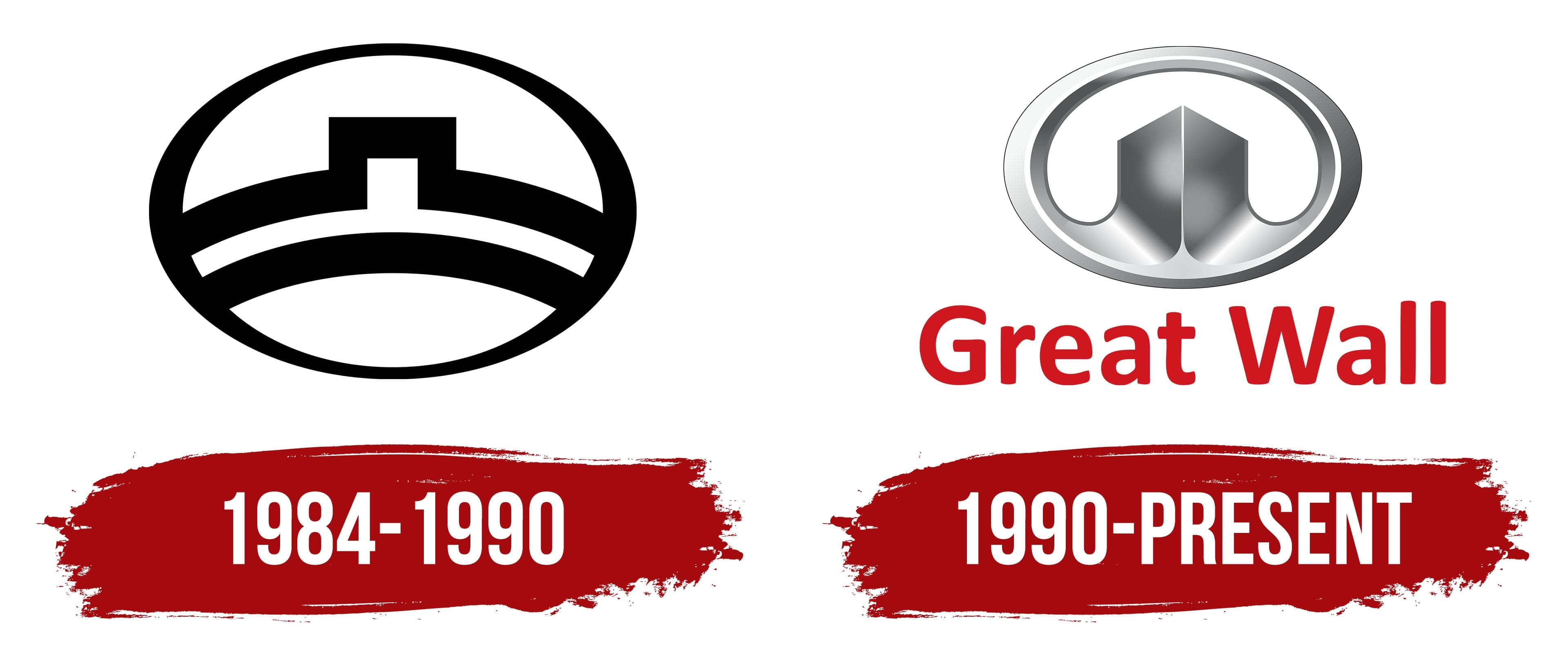
Great Wall Motors Holding was named after an ancient landmark: the Great Wall of China. This name symbolizes the company’s greatness, stability, and resilience, and it continues to expand its sales geography. In 2006, it entered European markets, and in 2009, it conquered Australia. Its logo, like its cars, is known in many countries worldwide. It has a classic oval shape, which has not changed since 1990. The design comes in two versions: a simple two-dimensional version and a high-gloss chrome finish.
What is the Great Wall?
Great Wall is one of China’s largest automobile manufacturers. It is known by its abbreviated name GWM, which stands for “Great Wall Motor.” The company was established in 1984 and initially specialized in trucks. Nine years later, it began producing passenger cars, including sedans, pickups, and station wagons. By the end of the 1990s, it refocused on trucks. Currently, the company produces vehicles under the brands ORA, POER, TANK, WEY, Haval, and GWM.
1984 – 1990

The first Great Wall badge lived up to the brand name by featuring a fragment of the Great Wall of China. The artists chose an abstract style, so the associations are not obvious. The black-and-white drawing consisted of several geometric elements: two arched lines, one above the other, and an oval-shaped ring frame. The upper arch had a rectangular protrusion in the central part. The oval created a dynamic feel through its contrasting thickness.
1990 – today

The new logo has a modern look. It appears three-dimensional due to the silvery gradient, subtle dark outlines, and a light gray stripe down the center. The structure has also changed: the symbol is solid and looks like an oval with a cube-shaped protrusion. It depicts the Loulu watchtower, part of the Great Wall of China, which was used for storage or for sending messages via smoke signals.
At the bottom, a red inscription shows the brand’s name. The designers chose simple lettering to balance the icon’s visually “heavy” appearance. The first letters of words are capitalized. The font lacks serifs, and the corners are slightly smoothed.
Font and Colors

The car company’s main symbol is the Great Wall of China, reflected in both the name and the logo. This references a tourist attraction and reflects the overall concept. The badge can be interpreted as the embodiment of China’s industrial spirit. It demonstrates the process of uniting a nation to achieve a common goal. The emblem’s core meaning is generational continuity: it shows that modern production is as close-knit as the workers who built the Great Wall of China. This encrypted hint suggests that the result of joint work will be reliable and durable.
The Great Wall lettering balances the logo’s graphic element. It is simple but stylish: the designers used a classic sans-serif typeface. The letters are bold; the first “G” and “W” in both words are capital letters. All corners are slightly rounded.

Quite modest typography is combined with a rich red color. It was also chosen to contrast with the hand-drawn emblem. The oval with the protruding element inside is painted in several shades of silver. A narrow, dark gray, almost black outline and white highlights complement it. These colors make the image look three-dimensional, like a real metal car symbol.