


 Grey Goose Logo PNG
Bacardi’s vodka gives connoisseurs wings, letting them rise to heaven and forget their problems and hardships. The Grey Goose logo embodies flight and lightness. According to the emblem, the drink is soft to drink thanks to a special recipe and various additives.
Grey Goose is a French premium vodka brand developed by American businessman Sidney Frank. It appeared in the 1990s but was later sold to Bacardi in 2004. François Thibault from the city of Cognac, who is professionally engaged in alcohol, improved the recipe of the alcoholic drink. As a result, the product is available in several variations, including lemon, cherry, cinnamon, orange, vanilla, melon, and caramel. The company no longer plans to expand the flavor range to avoid deviating from the original. The company created this vodka in 1997.
Sidney Frank, the founder and CEO of SFIC (Sidney Frank Importing Co.), presented a unique project in the late 1990s. He wanted to create a luxury vodka for the American market. To do so, the company entered into a partnership agreement with the famous cognac master, François Thibault. Drawing on all his knowledge of cognacs, he applied it to vodka.
France became Grey Goose’s source for US consumers. With strong culinary roots, the country’s alcoholic products stand out from the rest. The base water comes from natural sources. Local farms supply wheat intended for distillation. Limestone is used as a filter. As a result, just a year after vodka’s introduction, the Beverage Testing Institute recognized it as the world’s most delicious vodka.
It later moved to the US, as Bacardi acquired the brand to distribute its products there. This event took place in 2004. At that time, over 1.5 million cases of vodka were sold, making Grey Goose the most sought-after premium brand. The alcohol is bottled in the original smoked-glass bottles, depicting a French goose in flight.
Meaning and History
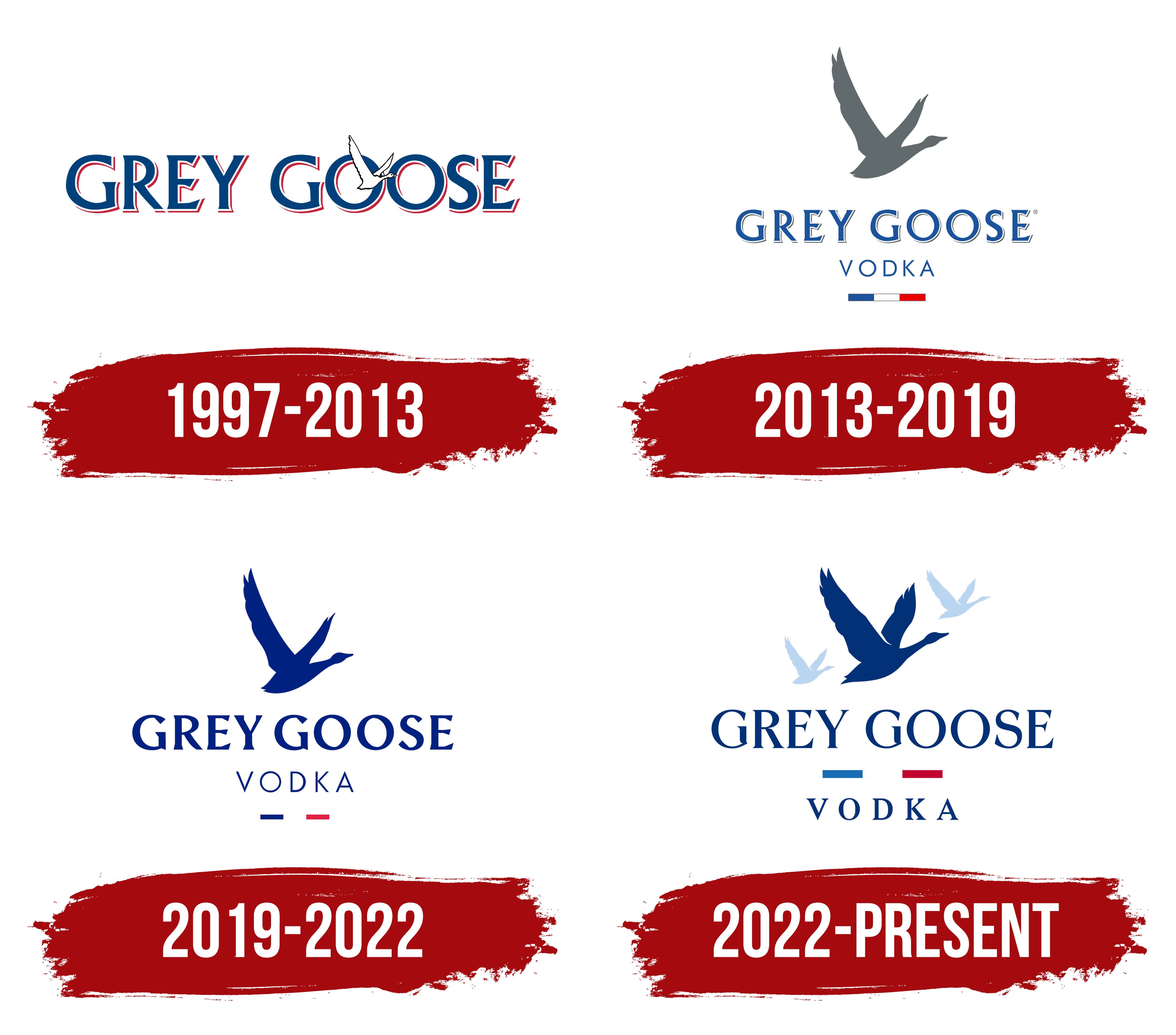
Created by a French master distiller for the American market, the high-end vodka brand made a name in the 1990s when it introduced the flying goose logo. This sign adorned the label of an alcoholic drink but didn’t last long: the designers modified it, giving it a more luxurious personality.
In 2019, London-based company Ragged Edge tampered with the Gray Goose logo, making the bird more expressive and the typeface crisp and modern. A few years later, the staff at Intertype Studio enhanced the visual lightness with additional thin lines and “gave” the goose a flock so it would not seem so lonely.
Premium packaging and a progressive brand image appeal to consumers who love the combination of luxury and minimalism. As a result, the Grey Goose logo has never strayed from its established framework: almost all versions are simple yet elegant.
What is Grey Goose?
Grey Goose is a Bacardi vodka that embodies French luxury. It is produced exclusively in France, using spring water gently filtered through the limestone of the Champagne region and soft winter wheat from Picardy. The range includes uniquely flavored versions such as Grey Goose La Poire, L’Orange, and Le Citron, while maintaining the original’s incredibly smooth character. This product is distinguished by attention to every detail of production, from grain selection to a specialized five-step distillation process, creating vodka with subtle citrus and almond notes and a crystal-clear finish.
1997 – 2013
The debut logo was a set of black letters with unique serifs that widened at the ends. The alcohol brand name was written in capital letters on a white background. The signs were massive and bold, so the thin outline of a solitary goose was visible in the “O” area. Each letter in the phrase “Grey Goose” had a thin, light-gray stripe, complemented by subtle shadows that created a three-dimensional effect.
2013 – 2019
In 2013, the developers modernized the logo: they expanded the space between the letters, repainted the inscription blue, enlarged the goose’s silhouette, and raised it slightly. They also added new elements to the Gray Goose emblem. For example, they added the word “Vodka” (centered) and a small stripe with three segments in the colors of the French national flag. The designers also made the bird gray to make it stand out against the light background.
2019 – 2022
Branding agency Ragged Edge from London helped create the new emblem. The designers modernized it by removing the side stripes on the letters and the shadows. As a result, we got a simple yet stylish inscription that meets the requirements of the time and is visible across any medium. In addition, they slightly changed the font to a graceful style and raised the goose above the text. Now the drawn bluebird looks like an independent icon.
2022 – today
Intertype Studio is behind the new Gray Goose logo. The designers have fixed an old bug that prevented geese from flying alone. They decided to finish drawing two more birds so the goose would have a flock. The parallels here are to a friendly company, which is why one drinks vodka.
Before creating the emblem, the agency staff developed a concept called “The big idea.” Its core principle was lightness and movement. Therefore, the artists changed the goose’s silhouette, adding a dividing line between the wings and enhancing the feathers’ wavy shape. Such seemingly minor details added dynamism to the image. To make the two additional birds look harmonious, the designers made them small and light gray. As a result, they seem to fly in the distance and fade behind the clouds.
The rounded letters also convey visual lightness, repeating the smooth movement of the wings. Intertype Studio modified the existing font in collaboration with the independent company Dalton Maag and the British design studio Ginger Monkey. The latter is known for developing lettering for alcohol brands.
The French vodka brand now has two official fonts: Gray Goose Natural Book and Gray Goose Natural Light. The logo uses the first one in a bolder font. It creates a feeling of smoothness, fluidity, and softness. The color palette has also been changed: the designers chose deep shades of blue (#16267E) and navy blue (#001446), complemented by burgundy, white, and silver gray.
Font and Colors
French vodka has always featured a flying goose on its label, even after the redesign. In the early versions, it was painted white; in later versions, it was gray. Around the middle of the logo’s history, it began to link to the alcoholic beverage’s country of origin because it was supplied far beyond France’s borders. We are talking about the lower strip, divided into three color segments in the state tricolor tone.
The typeface used in the Gray Goose logo is called Albertus Roman. This Art Deco typeface features serif glyphs. The designer, Berthold Wolpe, created it for Monotype’s London branch and named it after the German theologian and philosopher Albertus Magnus.
The alcohol brand’s emblem retains its corporate palette, consisting of soothing shades. Even the red in it looks discreet and restrained. The current color scheme includes blue and white. Early versions were dominated by black and grey.