 Hoonigan Logo PNG
To win, one must be highly focused and not distracted by external irritants. This is precisely what the Hoonigan logo asserts. It conveys unity, team spirit, and the determination to stay within bounds, even in unfavorable circumstances.
Hoonigan’s history is closely tied to Ken Block, born in Long Beach, California, in 1967. Before entering motorsport, he co-founded DC Shoes in 1994, a brand rooted in skateboarding and snowboarding culture. In 2004, DC Shoes was sold to Quiksilver for about $87-88 million, giving Block the resources to focus on racing.
In 2005, Block debuted in rally with Vermont SportsCar in a Subaru WRX STI and was named Rally America Rookie of the Year. In 2008, he and Brian Scotto of 0-60 magazine began developing Gymkhana, a video format that mixes precision driving, drifting, and skate-video aesthetics. The first low-budget film, shot on a California airfield, gained a large online audience.
In 2010, Block founded Monster World Rally Team with Monster Energy and Ford, which used a Ford Focus RS WRC. That year, he became the first American driver to score points in the World Rally Championship. Hoonigan appeared in the same period, first as a T-shirt logo created in New York. The name combined the Australian slang “hoon” with “hooligan,” and the early products were stickers and clothing.
From 2010 to 2014, Gymkhana episodes with the Ford Fiesta, Universal Studios, San Francisco, and a modified Ford Mustang in Los Angeles turned Hoonigan into a media and merchandise business. In 2013, Monster World Rally Team became Hoonigan Racing Division. After later projects with Ford, Subaru, and Audi, Block died in a snowmobile accident in Utah on January 2, 2023. Hoonigan filed for Chapter 11 protection in September 2024 and exited the process on December 2, 2024.
Meaning and History
Ken Block was a professional racing driver and an avid rally promoter. He loved speed, extreme driving, and sharp turns in cars, and he shared this passion with others by uploading his own content on YouTube. His team developed stunts, brought them to life, and filmed them. Car enthusiasts attracted attention not only with their thrilling videos but also with their own stories. They produce and sell several categories of goods, including clothing for adults and children, accessories, and merchandise with the logo, which remains virtually unchanged: the brand name, bracketed on both sides by square brackets.
What is Hoonigan?
Hoonigan is the shortened name for Hoonigan Racing Division, a racing team, its YouTube channel, and its online store. The brand’s visionary creator is professional racing driver Kenneth Paul Block, who organized it to participate in the American Rally Association. Initially, the club was called Monster World Rally Team. It was established in 2010, with its headquarters located in Park City, Utah.
2010 – today
The Hoonigan logo is textual. It features the brand name in a stencil-style font. All letters are uniform: massive, uppercase, geometric, blocky, bold, combined from two or three elements. The exception is only “A,” which is formed from one part with an open crossbar. The distance from the crossbar to the neighboring leg is similar to the space between parts of other glyphs, so the single-component letter is visually perceived as multi-component.
“O” is double: it is divided into two mirror fragments. “N” is triple: it has two vertical strokes, and in the gap between them is a diagonal stripe hanging alone in the air. There is also a version with the crossbar attached to one of the halves. The team’s name is enclosed in square brackets as if to denote the boundary of its interests.
Font and Colors
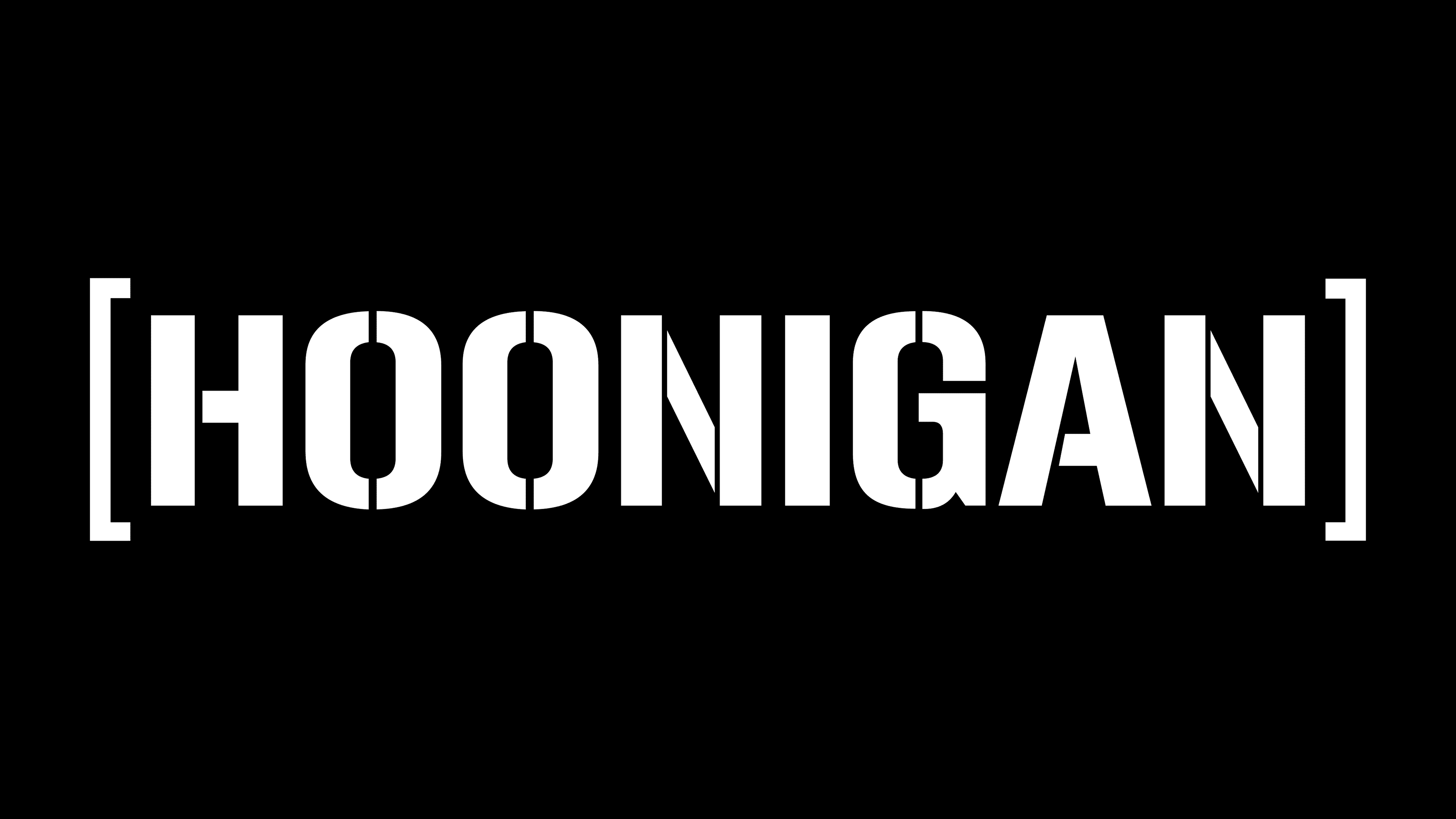
The text in the Hoonigan emblem is set in a stencil-style typeface reminiscent of Gunplay Regular (developed by designer Ray Larabie). It was inspired by the lettering on a poster for the 1972 film The Getaway. The only discrepancy is in the letter “N”: in some versions of the logo, it is formed from two parts, and in others, from three.
The visual identity palette is more straightforward and traditional, featuring black and white. If a light background is chosen for the name, the glyphs themselves are dark, and vice versa. This ensures excellent contrast and makes the word easily readable despite the presence of empty spaces in the letter lines.