


 McKinsey Logo PNG
The McKinsey logo is as serious as the services this company provides. It works with businesses, helping their owners solve a range of management problems. So the second side of the emblem is sophistication. It symbolizes high status and aristocracy.
McKinsey & Company began in Chicago on July 1, 1926, when University of Chicago accounting professor James O. McKinsey opened a consulting practice. His earlier books, Budgetary Control (1922) and Managerial Accounting (1924), shaped the firm’s early approach: applying financial discipline to management problems. In its first years, staff called themselves “management engineers,” not consultants.
In 1933, Marvin Bower joined the firm and took charge of the New York office. After McKinsey died in 1937, the company split in 1939: the Chicago office became A.T. Kearney, while Bower kept the McKinsey & Company name in New York. As managing director from 1950 to 1967, he built the firm’s professional culture, including the “up or out” promotion system.
McKinsey expanded beyond New York after World War II. It opened San Francisco in 1944, advised the Eisenhower administration in 1952 on creating the role of White House chief of staff, and helped NASA organize its structure in 1958. London opened in 1959, followed by Melbourne, Paris, and Zurich in the 1960s. In 1964, the firm launched McKinsey Quarterly, and in the late 1970s, its consultants developed the 7-S model. McKinsey Global Institute followed in 1990.
The firm became part of the consulting “Big Three” alongside Boston Consulting Group and Bain & Company. Its record also includes major controversies: Enron, a client until 2001, and Purdue Pharma, where McKinsey’s opioid-related consulting led to a roughly $574 million settlement in 2021. In 2015, McKinsey bought QuantumBlack, adding data analytics and artificial intelligence to its consulting work.
Meaning and History
McKinsey & Company is a firm that provides professional assistance to institutions across sectors. A team of experts works with clients who are well-versed in managing social, public, and private organizations. Strategic advice is particularly valuable because McKinsey & Company’s experts are among the best in the world.
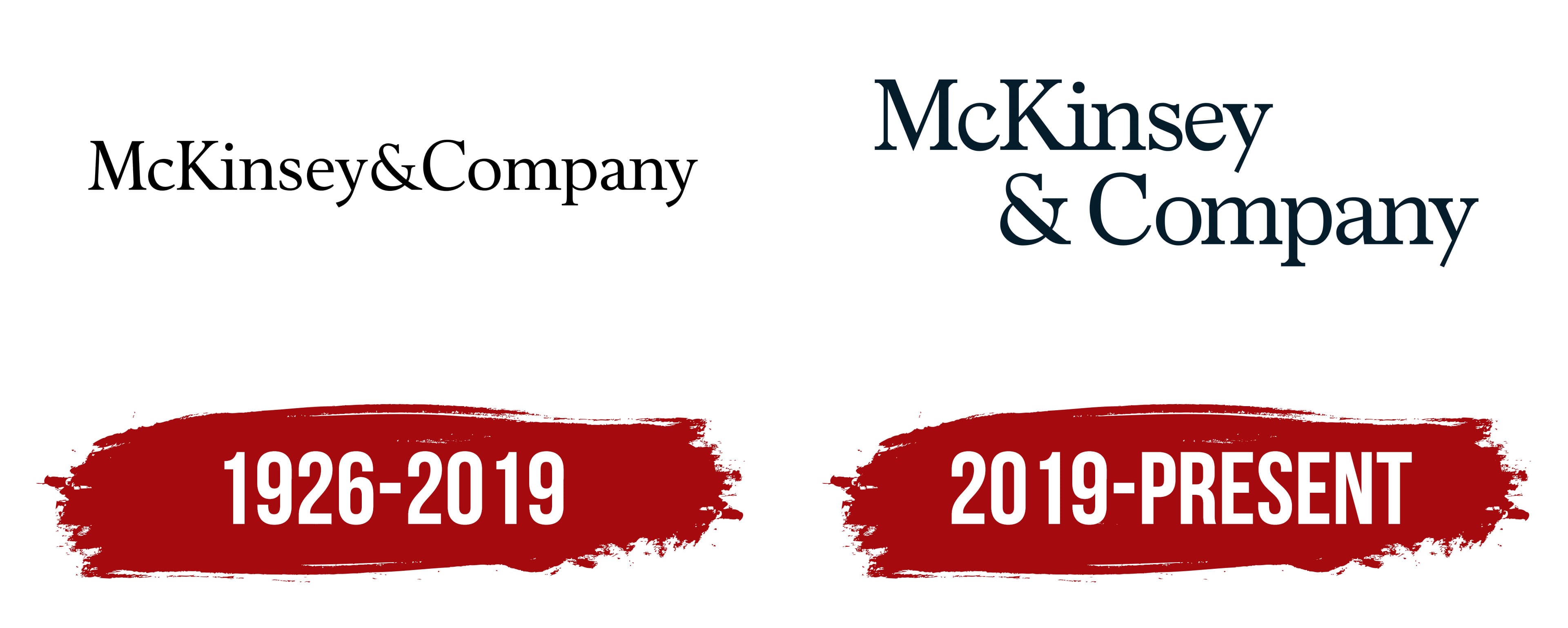
Throughout its existence, the company has been continually developing, a trend also evident in its visual identity. The modern logo is a more refined version of the original badge, which was introduced when the company was founded. The new concept demonstrated the company’s growth and development, as well as its main goal: high-quality services. These features are reflected through the elegant, strict lines of the font, as well as the creative arrangement of the parts of the word symbol.
What is McKinsey?
McKinsey & Company is one of the world’s largest management consulting firms. The main office is located in America, and more than 100 offices are outside the country. The network of structural units in different countries allows us to provide a full range of services to foreign clients. They can get professional help in strategic consulting, regardless of sector.
1926 – 2019
McKinsey & Company was founded by a University of Chicago professor studying accounting and business management techniques. He was the first to use financial planning to organize management processes effectively. He decided to put his work to the test. To do this, in 1926 he created his own company that provided management services.
The enterprise’s visual identity was based on a simple, concise logo featuring only the name. The wordmark was designed in a simple, uncomplicated font, which was often used for logos in those days. Classic serifs, graceful curves, and elegant lines distinguished it. The inscription itself was painted in a dark color and located on the same level. Another feature was the full compliance of spelling with the rules of grammar.
The McKinsey & Company inscription has lowercase and uppercase letters, arranged according to spelling. This clearly confirms the company’s strict observance of the established requirements and standards. The simple and concise format also demonstrated several other strengths of McKinsey & Company. Among them are honesty, high quality, professionalism, and reliability. These principles were components of the brand’s philosophy at the time and remain relevant today.
2019 – today

In 2019, the company had already achieved impressive results in its segment. It was also decided to consolidate the result at the level of visual identity, which became a prerequisite for changing the logo. The central element of the updated version was still the inscription but in a new interpretation. The designers made the font lines thicker, and in the letters A and C, they added originally pronounced serifs. The letters Y have also changed. In the old version, they are smoother, and in the new one, they are straight and sharp.
Such changes indicated an increase in the firm’s self-confidence and an improvement in the quality of services provided. During this period, McKinsey & Company has already actively established cooperation with foreign customers and expanded the office network. The new layout of the word mark also confirmed this fact. It became two-level, symbolizing the transition to a new stage in development. In addition, this decision made the emblem more stylish.
Font and Colors
The current version of the McKinsey & Company logo is a strict, laconic inscription indicating the name. The words are located on two levels but are made in the same style. The font is distinguished by the original serifs on the letters C and A, as well as the straight letter Y. In general, the wordmark is highly readable due to the small, clear spacing.
This format demonstrates confidence, reliability, and professionalism. The picture is complemented by an achromatic color scheme consisting of black and white. Dark shades convey prestige, authority, and elitism, while white emphasizes the company’s integrity and honesty. In addition, white can be seen as a symbol of openness.
In the case of McKinsey & Company, this means a positive attitude towards expanding operations and establishing international partnerships. Such a policy positively impacts activities and opens new opportunities for the company’s specialists. Based on all these principles, the firm achieved impressive results and became a member of the “Great Three” consulting companies.