MongoDB Logo PNG
The MongoDB logo reflects the database’s flexibility and scalability. The leaf image symbolizes growth, development, and the system’s ability to easily adapt to various tasks and user requirements.
MongoDB grew out of the experience of DoubleClick veterans Dwight Merriman, Eliot Horowitz, and Kevin Ryan. Their advertising platform processed up to 400,000 ad impressions per second, exposing the cost and scaling limits of Oracle, MySQL, and relational databases. After Google bought DoubleClick for $3.1 billion in 2007, the trio founded 10gen to build a cloud application platform.
Google App Engine soon made that market hard to contest, so 10gen focused on the database component, which attracted the most developer interest. MongoDB entered public release in 2009. Its name came from “humongous,” referring to large-scale data handling. The system stored flexible BSON documents rather than fixed relational tables and supported Windows, Linux, and other operating systems.
The open release spread among web developers seeking faster changes to application data structures. Before its IPO, the company raised more than $311 million from investors including Flybridge Capital Partners and In-Q-Tel. In 2013, 10gen became MongoDB, Inc., while version 2.4 added improved text search and geospatial queries.
Atlas launched in 2016 as a managed database service for AWS, Google Cloud, and Microsoft Azure. MongoDB listed on NASDAQ in October 2017 at a $1.6 billion valuation. In 2018, it replaced AGPL with the Server Side Public License, limiting cloud providers such as Amazon Web Services from offering the database without a commercial agreement. Full ACID transaction support followed in 2019.
Meaning and History

What is MongoDB?
It is a popular NoSQL database system using JSON documents for data storage. Unlike traditional databases, MongoDB uses flexible data structures that adapt quickly to change. The absence of a strict schema allows data modifications without complicated migrations. MongoDB easily scales and efficiently distributes data across multiple servers. The platform supports full-text search, geographic queries, and data aggregation.
2009 – 2022

The MongoDB logo was introduced with the launch of the first stable product version in 2009, when development was managed by the company 10gen, which was later renamed MongoDB, Inc.
The emblem’s core is a stylized green leaf with slender, elongated proportions, smoothly tapered at both ends. The development team, including Meghan Gill, proposed this symbol to reflect flexibility and naturalness, in contrast to the rigidity of traditional relational databases. Like a plant shoot, the leaf metaphorically conveys freshness, organic growth, and the living dynamism of MongoDB’s innovative technologies.
The logo’s typography uses a serif typeface that conveys professionalism and seriousness. The wordmark is divided into two semantic sections through letter case and color. The first part, “mongo,” appears in lowercase in a dark graphite gray, while the second, “DB,” is uppercase in a slightly lighter gray-blue. The letter “g” stands out for its gently curved lower loop, adding elegance and distinctiveness to the composition.
The MongoDB color palette features deep, dark gray and soft gray-blue tones that highlight the product’s technological strength and reliability. The bright green of the leaf serves as an accent, adding freshness and a modern feel to the brand’s otherwise traditional appearance. Green symbolizes new beginnings and progress, aligning with the company’s philosophy of positioning itself as an innovative player in the modern technology market.
MongoDB effectively communicates its mission and product focus through visuals. The combination of a natural metaphor and strict typography effectively blends flexibility, reliability, and accessibility through an innovative approach to data management.
2022 – today
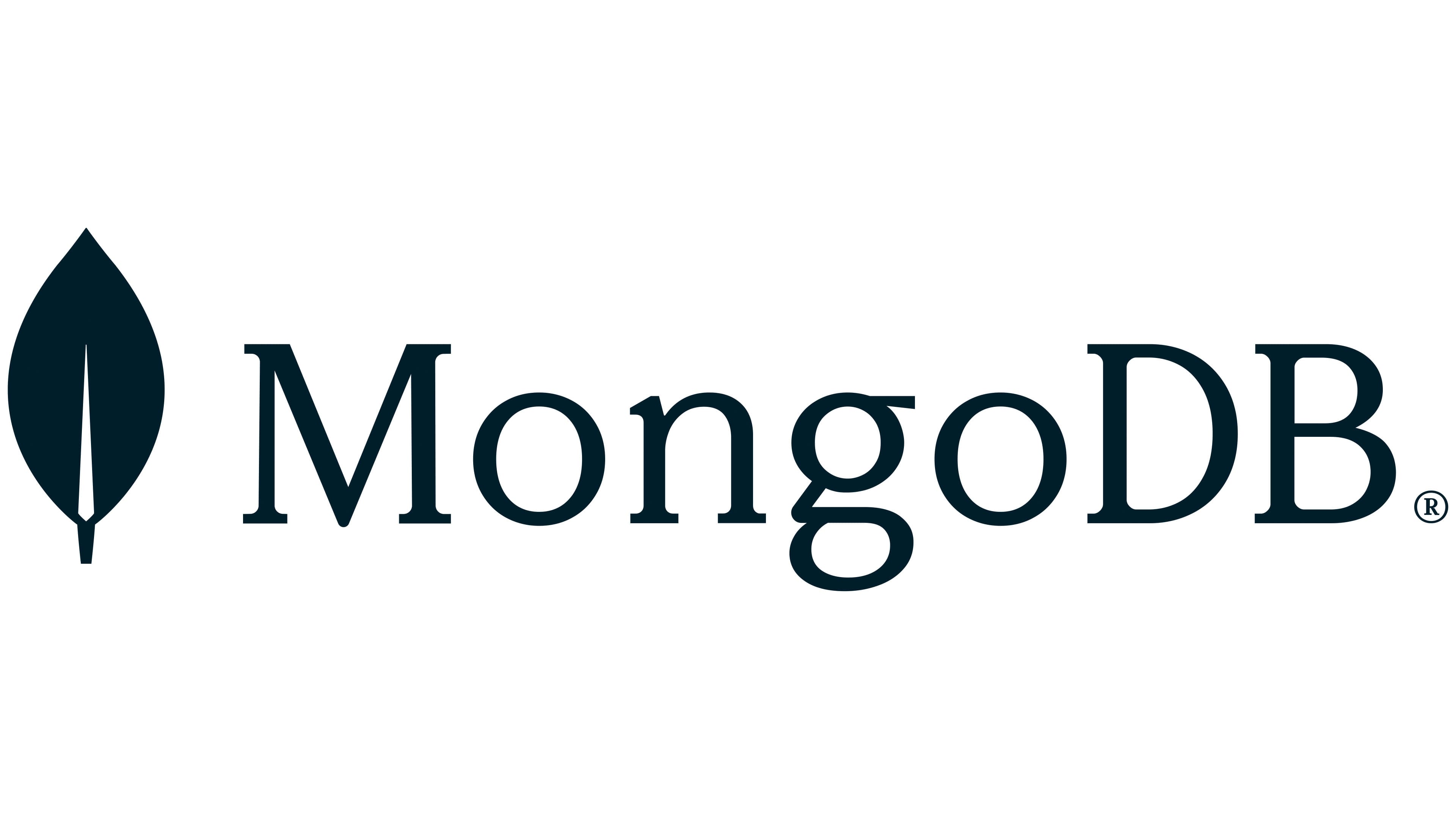
In 2022, MongoDB introduced a global rebrand, resulting in a redesigned logo and a new visual identity. The reveal coincided with the MongoDB World conference in New York in June of that year, marking the company’s shift toward a modern communication system and visual language.
The update, led by designer Saloni Soni in collaboration with type designers from Colophon Foundry, affected nearly all elements of the logo. One of the most significant changes was the introduction of a custom typeface, MongoDB Value Serif, created specifically for the wordmark. This typeface features understated serifs, moderate stroke contrast, and smooth proportions, adding formality and technical confidence to the brand.
The brand’s symbol, a stylized leaf, retained continuity with the previous version but underwent a complete stylistic redesign. The new leaf is presented in a simplified, flat form with clean, geometrically precise lines, moving away from the previous dimensional style and its use of gradients.
The logo’s color has been unified into a deep, dark blue, close to black. Choosing a single color symbolizes the company’s maturity and professionalism, reinforcing its leadership role in the modern digital solutions market. Removing the previous multicolored accents enhances the design’s simplicity and overall cohesion.
In addition to the updated logo, the company introduced a flexible visual language system. This includes grids and “fluid” modules that allow the brand’s style to adapt effectively to various formats and communication needs. A range of icons and illustrations based on the new element structure supports consistent perception and strengthens MongoDB’s recognition in the digital space.