


 Munchkin Logo PNG
The Munchkin logo indicates that the company makes products for children. It looks bright, fun, and straightforward, targeting loving parents. The emblem symbolizes the good mood that Munchkin products give.
Munchkin was founded in Los Angeles in 1991 by Steven Dunn, a Harvard MBA who had worked at Bear Stearns, Smith Barney, Idanta Partners, and later in real estate. After becoming a father, he saw the baby-products market as repetitive and technically limited. Large competitors such as Playtex, Gerber, and Evenflo already dominated the shelves. Still, Dunn built Munchkin around practical invention and unusual product design.
The company began with $2.5 million in start-up capital from several partners. Its first hit was a baby bottle shaped like a soda can, released under a licensing agreement. The idea set the brand’s tone: familiar forms used in new ways. First-year sales reached $15 million, and by 1995, Munchkin products were sold in 20 countries. Dunn later led the development of about 120 of the company’s 150 patented products.
Munchkin expanded into feeding items, changing mats, diaper pails, travel accessories, and bath products. Its patents covered everyday problems for parents, including burn-prevention lids, spill-proof cups, and divided formula containers. By the mid-2010s, the company held several hundred U.S. and international patents.
Growth also came through acquisitions. In 2010, Munchkin bought the British child-safety brand Lindam, entering a category in which Graco competed. In 2014, it acquired Brica, a U.S. maker of travel accessories for babies and toddlers. In 2016, it bought Milkmakers, a brand of lactation cookies and teas. In 2020, it expanded with prenatal teas, belly balms, and nausea drops. By the mid-2010s, Munchkin’s revenue was approaching $300 million, with Dunn still serving as CEO.
Meaning and History
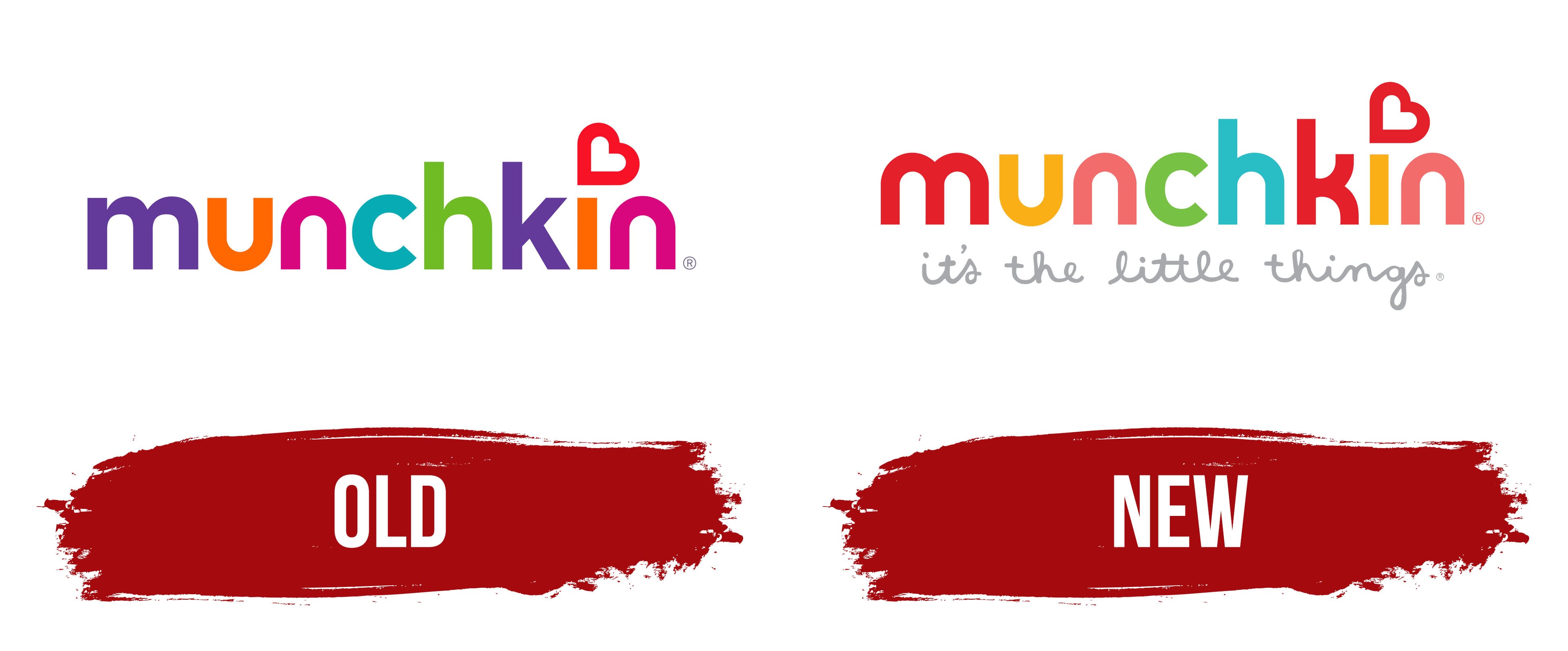
Only two logos were presented to the target audience over the company’s entire period of operation. Both are made in a multi-colored palette that most buyers immediately associate with childhood and positive emotions. They immediately stand out from the competition by focusing on potential buyers.
What is Munchkin?
This is one of the most famous American brands that specializes in products for pregnant women and children. Its clients include young mothers in the United States and millions of buyers worldwide.
Old

The company introduced its original logo immediately after its creation. It consisted solely of a wordmark. All letters were lowercase to evoke positive emotions in potential customers. Each letter is painted in one of five colors: purple, orange, blue, green, and pink. Only purple is repeated twice: in the letters “m” and “k.” If we talk about unique elements, it is a white heart with a red outline, which is used as a dot over the letter “i.”
Globally, the logo used a classic bold sans-serif font with rounded corners and straight lines.
New
The only redesign made the logo more voluminous, and the company’s slogan, “it’s the little things,” was added. It was handwritten and immediately caught the eye, although it is much smaller than the main inscription.
As for the brand name, the base remains unchanged, but the color scheme has shifted somewhat. It now uses red, orange, pink, green, and blue. Notably, the sixth, seventh, and eighth letters were painted in the same colors as the first three. As a result, the color palette has been reduced to five shades. As expected, a white heart with a red outline was retained in the logo.
The company logo is often placed on a white background, but it also looks quite harmonious when framed in a different color.
Font and Color
The logo is based on a classic sans-serif font with straight and clear lines. Both versions use a consistent, easy-to-read letter style that is easy to remember.
The multi-colored range clearly links the brand to children’s goods. Probably, other shades will be used in the future, but the essence itself will remain unchanged. Indeed, the multi-colored letters help the company attract parents’ attention not only in the United States but also far beyond its borders. Since the company changed after the redesign, you might think each color had no special meaning. Munchkin’s primary goal was to stand out from the competition by adopting a friendly tone.