Network 10 Logo PNG
The Network 10 logo evolved as the channel grew from a bold media project into a major player in Australian television. It always stayed connected with its audience, offering content that resonated with viewers across exciting premieres, popular shows, news, and entertainment.
Network 10 began broadcasting in Australia in 1964 with the launch of Melbourne’s ATV-0, becoming the city’s third commercial TV channel. That year also saw the establishment of Sydney’s TEN-10 station, forming the network’s foundation.
Expansion continued with TVQ-0 in Brisbane in 1965 and NEW-10 in Perth in 1970, increasing national coverage. In 1980, Melbourne’s ATV-0 rebranded as ATV-10 after a frequency change, aligning the stations nationally.
The network expanded into the Northern Territory in 1988 by adding a Darwin station. However, financial problems in 1991 resulted in ownership changes and substantial restructuring.
In 2001, the network launched its digital sports channel, ONE. Further diversification occurred in 2011 with ELEVEN (later 10 Peach), targeting younger viewers.
In 2017, Network 10 entered voluntary administration and was acquired by the American media company CBS Corporation. Following the 2019 merger between Viacom and CBS, the company became part of ViacomCBS, now known as Paramount Global, marking another strategic shift.
From 2020 to 2023, Network 10 boosted its digital presence through platforms like 10 Play and rebranded its channels as 10 Bold, 10 Peach, and 10 Shake. As of 2024, Network 10 remains prominent in Australian media, blending digital growth with traditional broadcasting.
Meaning and History
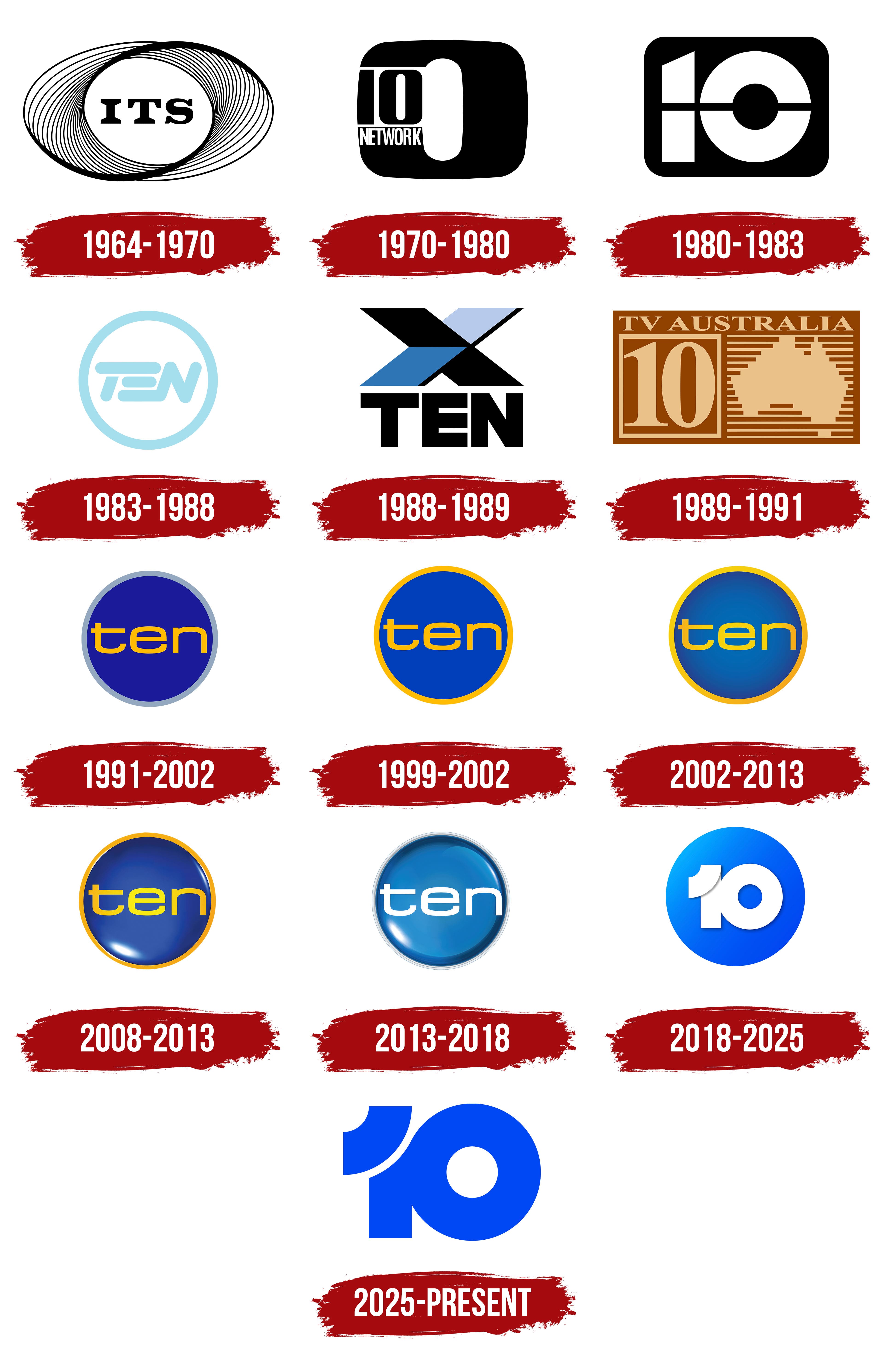
What is Network 10?
This Australian television channel offers viewers a range of programs, including news and sports broadcasts, as well as popular reality shows. The channel airs global hits and original local projects. It targets a young audience by selecting relevant, dynamic formats. The streaming service lets viewers watch content anytime, ensuring convenience.
1964 – 1970

The Independent Television System originated with the development of Australian television in the mid-1960s, when new channels began competing for audiences through modern broadcasting formats and recognizable identities. The network launched in Melbourne as ATV 0 in August 1964 and opened in Sydney as TEN-10 in April 1965. Three years after its debut, the network became the first in the country to begin broadcasting in color.
The ITS emblem was created in line with the visual trends of its time and showed stylistic similarities to the graphics of the German company Deutsches Fernsehen in West Germany. Its composition consisted of an abstract symbol and a text block.
The main symbol was a ring formed from thin lines. These lines intersected and curved, creating a complex structure that suggested depth and rotation. This effect resembles Op Art techniques used in mid-20th-century graphic design. Such illusory forms resembled hypnotic patterns or tunnel-like images, which at that time were associated with modernity and artistic experimentation.
In the center of the ring was the abbreviation ITS. It was written in a large serif typeface with strict proportions and a visually heavy appearance. The letters were uppercase, dense, and had geometric serifs. The typeface resembled Clarendon or Egyptian Bold.
The ITS logo combined optical effects with heavy typography, making the mark contemporary for its time and consistent with the seriousness of a television network.
1970 – 1980

Changes to the Independent Television System’s identity were linked to the new name, The 0 10 Network, and to the creation of a unified visual style that reflected the specifics of television in the late 1960s and early 1970s. The unification of ATV 0 in Melbourne and TEN 10 in Sydney formed the basis for the network’s name, which was officially adopted in 1970. By that time, the channel had already established its technical leadership. In 1967, ATV 0 was the first in Australia to demonstrate color broadcasting, and by 1975, the entire network had switched to full-color transmission. To promote the innovation, the slogan “First In Color” was used in major cities such as Sydney, Melbourne, and Adelaide.
The 0 10 Network logo was designed as a retro television screen. The composition consisted of a large black figure with rounded corners that resembled a cathode-ray tube. Inside the frame was a vertically elongated number 0, created by the empty central area of the stylized screen.
The typographic part was integrated into the outline of the large black figure and consisted of two elements. The first was the number 10, written in a geometric sans-serif font. Below it was the word “NETWORK,” written in a narrow, vertically stretched sans-serif font.
The color palette was limited to black and white, reflecting the era’s minimalist television style.
The 0 10 Network logo combined simplicity, strict geometry, and a reference to the screen, emphasizing the network’s pioneering role in developing Australian television.
1980 – 1983

ATV Melbourne’s frequency change from channel zero to channel ten coincided with a major network-wide rebranding and led to the introduction of the name Network Ten. Three days after GLV-10 switched to channel eight, ATV took over the available frequency, and this technical shift marked the start of a new emblem known as “Network Ten (Zeroth era).” The name change emphasized the brand’s renewed status and was tied to the new channel number.
The logo’s structure reflected industrial minimalism and the optical art techniques used in late-1960s graphics. The composition centered on a black rectangle with smooth edges. Its shape and proportions resembled early television screens or remote-control buttons, emphasizing its connection to broadcasting technology.
The internal space contained the number 10 in a simplified geometric form. The number 1 was designed as a vertical rectangle with a diagonally cut upper corner. Next to it, the number 0 was drawn as a circle. Inside it was a small black circle, evoking a camera lens or an optical aperture.
A horizontal line ran through both digits, intersecting the composition at the center. It created an optical effect of division while linking the numbers.
The black background gave the figures a rigid, technical character, while the white elements focused attention on the structure of the numbers and their optical play.
The emblem “Network Ten (Zeroth era)” expressed a shift toward a new stylistic concept, combining simple form and optical techniques with visual associations with television equipment.
1983 – 1988
The first station to introduce the new Network Ten style was TEN 10 in Sydney. It launched the updated emblem on air, followed by ATV 10 in Melbourne and SAS 10 in Adelaide. The implementation was gradual, and by the end of 1985, all major stations in the network had adopted the unified identity. However, some regional variations remained.
The emblem’s composition centers on a light blue circle. Inside the circle is the word TEN.
The font is smooth and rounded, a sans serif with uniform line thickness. Horizontal strokes connect the letters, forming a single structure. The letter E has no vertical base. It is made up of three horizontal bars, with the top one joining the letter T and the bottom one extending into the letter N. This integration creates a unified mark, evoking a digital indicator or electronic circuit and reinforcing the association with television technology.
The color choice reflected emotional and visual goals. The light blue shade conveyed lightness, clarity, and modernity. It conveyed freshness and matched the mid-1980s aesthetic.
1988 – 1989

Network Ten’s expansion to a national level was accompanied by the introduction of the “X TEN” symbol. The new logo first appeared on the major stations ATV 10, ADS 10, and TEN 10, followed by NEW 10 in Perth and Brisbane’s TEN, formerly known as TVQ 0, which switched to channel 10. The Perth launch, combined with satellite technology, enabled nationwide coverage and solidified Network Ten’s status as a national broadcaster.
The logo is built along a vertical axis and divided into two blocks. The upper section features the X symbol, composed of four geometric segments formed by intersecting diamond-like shapes. Each segment has a different shade, ranging from dark to light blue. The color transitions and contours give the figure a sense of volume. The symbol’s structure resembles a perspective view, road markings, or a conceptual television matrix divided into color fields.
The lower section contains the name TEN. The text is rendered in a bold, rectangular sans-serif typeface. The letters are tightly spaced, forming a single block of text.
The color palette combines black with shades of blue. The “X TEN” logo reflected the brand’s technological focus and its drive for growth and audience expansion.
1989 – 1991
The transition to 10 TV Australia was an attempt to recover from financial difficulties and declining viewer interest. The new style aimed to emphasize seriousness and national reach, but ratings did not improve. By the end of 1989, the parent company, Northern Star Holdings, had gone bankrupt and entered external administration, and the Canadian corporation Canwest subsequently acquired its assets.
The 10 TV Australia logo consists of a strict rectangular structure divided into visual zones. The left side contains the number 10 enclosed within a frame. The enlarged shapes and heavy lines of the numerals convey stability and highlight the channel number.
The right side features a stylized outline of Australia composed of horizontal stripes of varying lengths. The design resembles the graphics of early digital interfaces or television effects of the past century. The linear structure evokes associations with a television signal, code, or pixel image.
Above the entire composition is the inscription TV AUSTRALIA. It is written in the classic serif typeface Times New Roman. The font, with its thin strokes and proportional serifs, gives the text an official tone that contrasts with the more industrial graphics of the lower block.
The color scheme uses warm tones. The main brown background adds richness and emphasizes solidity. Beige highlights details and balances the dark base.
1991 – 2002

Network Ten’s large-scale relaunch came with major identity changes, developed by the design studio Zero Plus. As part of the rebranding, the channel introduced the slogan “The Entertainment Network”. It unveiled new visual symbols that would become the foundation of its design language for decades to come. This version of the logo underwent several modifications, but its original structure was preserved for many years.
The emblem features a deep blue circle with a thin silver-gray outline. Inside is the word “ten,” written in lowercase using the Microgramma Light typeface, adapted specifically for the network. The letter spacing was reduced to make the text more compact and visually effective in television graphics. The lowercase letters emphasized the channel’s informal, approachable character.
The color palette featured blue and bright yellow. The blue circle symbolized stability and seriousness, while the yellow “ten” added emotional emphasis, evoking optimism and energy.
The logo’s round shape evoked associations with a television screen, reinforcing its connection to broadcasting. The combination of technology, simplicity, and lightness created a logo that, for many years, remained Network Ten’s key visual symbol, reflecting its strategy as a national entertainment channel.
1999 – 2002

The main difference between the Network Ten version and the “Electric” package, compared to the previous version, was the accent color. Whereas the circle was previously outlined in a silver-gray line, the contour was now recolored in a bright yellow, matching the shade of the lettering inside the mark. This change highlighted the circle’s borders, making the emblem more noticeable in the air and in promotional materials.
The composition’s internal structure remained the same. The deep blue circle remained the base background, but the shade was made richer and brighter, which helped highlight the interaction with the yellow text.
The word “ten” remained in lowercase, maintaining the openness and friendliness established in earlier versions. The yellow-and-blue combination created a clear contrast, with blue conveying stability and yellow adding emotional emphasis and energy.
2002 – 2013

Unlike the previous version, which presented color elements statically and flatly, the new Network Ten logo introduced a gradient. It changed how the symbol was perceived, adding depth and volume to the composition.
The circle’s background transitioned from deep dark blue at the edges to a lighter shade at the center. This effect created spatial depth and simulated inner illumination. The text and outline color scheme was reworked in a similar way. The yellow of the letters and border transitioned smoothly to lighter tones, creating the illusion of a raised surface.
The symbol’s typography and structure remained the same. The glowing effect served as a metaphor for technological progress and Network Ten’s aspiration to stay aligned with current broadcasting trends.
2008 – 2013

The main difference between the new Network Ten logo and the previous one was its visual style. Previously, volume came from soft color transitions; the new version adds a glossy, reflective effect, giving the mark the look of a convex glass lens or button. The update coincided with the transition to HD broadcasting and reflected the channel’s desire to emphasize modernity and technological advancement.
The emblem retained its familiar circular shape and the proportions of the text inside it. The main background remained blue, but its shades were enriched with bright highlights. The surface reflections enhanced the illusion of material texture and evoked associations with real objects, making the logo appear more three-dimensional. The border remained yellow-orange.
The word “ten” remained lowercase and stayed in the Microgramma Light typeface.
The glossy effect became the main innovation. It added brightness and emotional expressiveness to the emblem. Similar techniques were used in the identity of the American network ABC, where a sphere with highlights became the signature symbol. For Network Ten, this visual transformation signified a transition to a new level of broadcasting and strengthened the channel’s image as a modern, technologically advanced brand.
2013 – 2018

The new Network Ten logo abandoned the warm color palette. The main change was replacing contrasting bright tones with a calm, light-blue background featuring smooth transitions. A thin silver outline appeared along the perimeter, replacing the previous yellow-orange border and enhancing the composition’s cooler character.
The word “ten” was presented in white for the first time. This shift in focus removed the emotional intensity characteristic of the previous version and introduced a sense of neutrality.
The glossy, three-dimensional circle remained unchanged, preserving continuity and maintaining its association with the modern television environment. However, the overall palette became cooler and more restrained. The light blue background created a sense of renewal, the silver ring added compositional balance, and the white text emphasized purity and transparency.
This transformation coincided with the company’s internal difficulties. In 2017, the channel faced a financial crisis, and in June, it entered voluntary administration amid the threat of bankruptcy. The new logo, executed in cool and neutral tones, reflected this challenging period. It expressed the brand’s intention to reshape its perception among viewers, to mark the seriousness of the moment, and to show readiness for change.
2018 – 2025

Network 10’s updated identity replaced the wordmark with a numeric form. Instead of the familiar “ten,” the symbol “10” appeared inside a circle. The number “1” is designed as a rectangular shape with a smooth curve at the upper corner, resembling a folded page edge, while the “0” forms a closed, rounded contour.
The transition to the new emblem was part of a rebranding effort, the first since the channel’s integration into the international corporation CBS, later renamed Paramount and then Paramount Skydance, and the first major redesign since 1991. All sub-channels were restructured. The channel “One” was renamed “10 Boss,” then “10 Bold.” The channel “Eleven” became “10 Peach,” later divided into “10 Drama” and “10 Comedy.”
The color palette features a rich blue background with a smooth gradient from light to dark. The white numerals enhance contrast and clarify the composition. The symbolism of blue conveys renewal and dialogue with the contemporary cultural environment.
Their slogan, “adventurous alternative,” is reflected in the logo’s character. It conveys openness and the brand’s unconventional image.
After presenting the Network 10 logo, the team systematically integrated the updated style across all company assets. The new identity established visual unity for the channel and set a clear direction for the network’s future development.
2025 – today

Removing the circle, part of Network 10’s visual system for more than three decades, became the key change in the updated logo. Today, the numeric symbol serves as the primary identifier, having been used occasionally but now adopted across all brand operations, including the 10 Comedy division. The new version debuted alongside the update to evening programming and the launch of the 10 News+ show.
The number “1” is designed as a vertical figure with a semicircular cutout at the top, enhancing its resemblance to the numeric symbol. The number “0” appears as a uniform ring with a clean inner opening.
Removing the circular background reflects the brand’s flexibility and adaptation to the new challenges of the media market, where priorities have shifted to news formats and current affairs coverage.
The use of a single dominant shade of blue has both functional and emotional significance. The color is associated with stability and reliability, which aligns with the channel’s mission to build trust through its news content. The color’s versatility makes it easier to implement the Network 10 logo in advertising campaigns and across platforms without overwhelming viewers.