


 Oldsmobile Logo PNG
The Oldsmobile logo is progressive and futuristic. It showcases new developments and popular, in-demand models. The logo is concise. It reads beyond the conventional, representing the brand as a trendsetter in the automotive industry.
Oldsmobile began on August 21, 1897, when Ransom Eli Olds founded Olds Motor Vehicle Company in Lansing, Michigan. The first major backer, Samuel Smith, later renamed the firm Olds Motor Works and moved production to Detroit in 1899. By 1901, Olds had built several prototypes, but a factory fire left only one usable car, the small Curved Dash.
The Curved Dash went into production at $650 and became a major early American automobile. Output rose from 425 cars in 1901 to about 2,500 in 1902 and nearly 4,000 in 1903. Its assembly method helped shape mass production before Henry Ford’s moving line. In 1904, Olds left after a dispute with Smith and founded REO Motor Car Company. In 1908, William Durant brought Olds Motor Works into General Motors, where Oldsmobile sat above Chevrolet and below Cadillac.
After World War II, the brand entered one of its strongest periods. In 1949, Oldsmobile launched the 88 with the 303 cubic-inch Rocket V8, creating an early muscle-car formula in a lighter body. The Rocket 88 paced the Indianapolis 500, dominated NASCAR from 1949 to 1952, and even inspired Ike Turner’s 1951 song “Rocket 88.” In 1964, the 442 arrived, followed by the front-wheel-drive Toronado in 1966, something Ford and Chrysler didn’t offer.
The decline came after GM shifted divisions toward shared platforms in the late 1970s, making Oldsmobile harder to separate from Buick or Pontiac. The 350 cubic-inch diesel V8 scandal damaged trust in the early 1980s. Later models, such as Aurora, Intrigue, and Bravada, failed to restore a clear role. General Motors announced the phaseout in December 2000, and the last Oldsmobile, a dark cherry Alero GLS, left Lansing on April 29, 2004.
Meaning and History
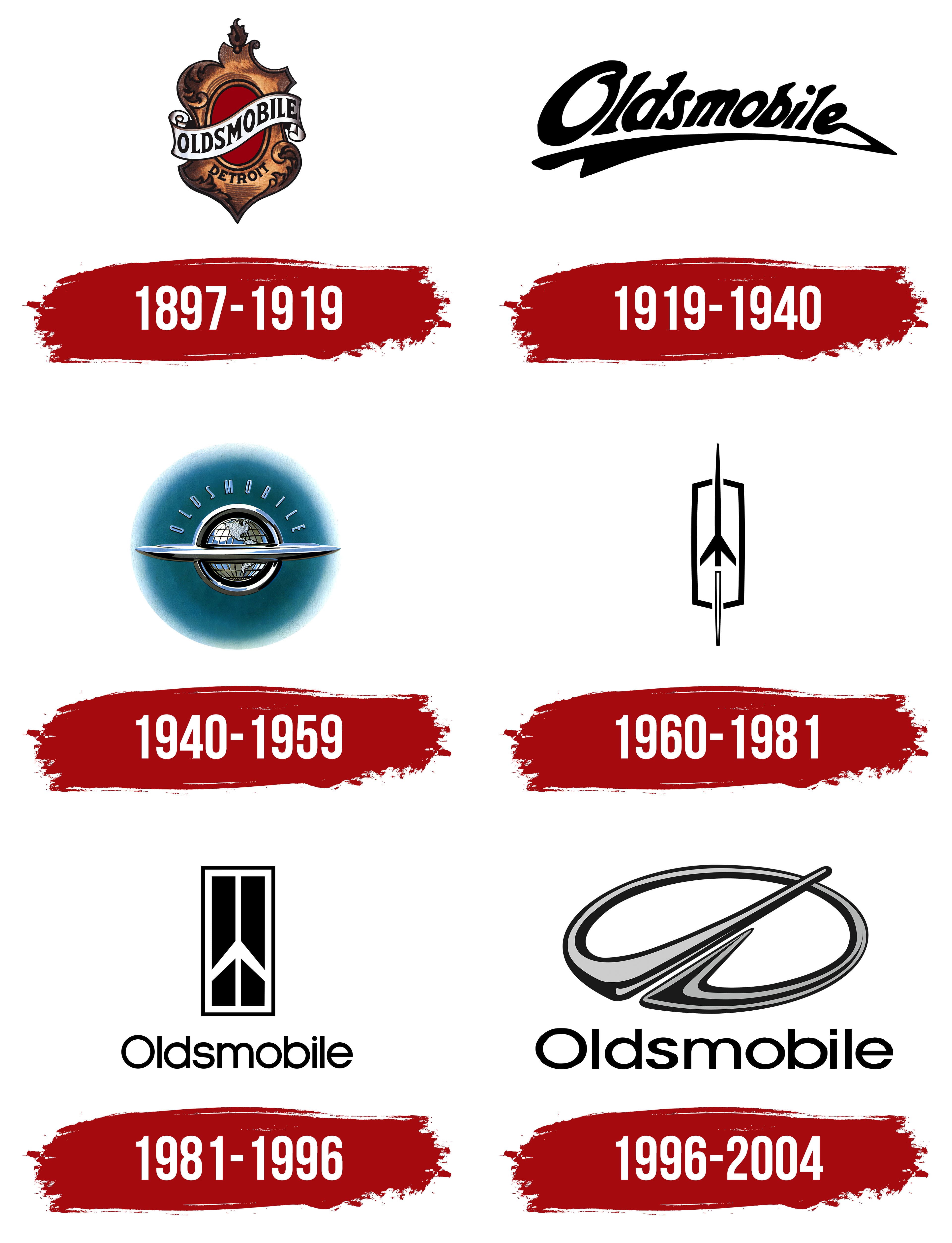
The logo represents forward momentum and technological progress, encoded in the rocket image, which changed gradually over time. The Oldsmobile star shone in the early and mid-20th century. It led the U.S. in large-scale car production and introduced front-wheel-drive cars, automatic transmissions, and the Rocket V8 engine. By the mid-70s, its Cutlass model was America’s best-selling car. These achievements reinforced Oldsmobile’s image as a modern company ahead of the competition.
What is Oldsmobile?
One of the most enduring automotive brands in the United States, Oldsmobile is a key General Motors division known for skillfully combining affordability with luxury. Founded in Lansing, Michigan, the company became a symbol of automotive innovation, producing iconic models that gained popularity among Americans, including the Fastback 442, the luxurious Cutlass Supreme, and the powerful Rocket V8. The brand is associated with reliable, comfortable family cars that project a prestigious image without Cadillac prices, offering a unique balance of luxury and functionality.
1897 – 1919
The first logo matches the spirit of the 19th century. It appears to be a mirror or shield adorned with a wide border of oak leaves. The style of the noble houses and knights’ tournaments conveyed the brand’s nobility and celebrity. A heraldic ribbon bearing the brand name surrounded the shield. And below the shield, the opening was shown.
The name Oldsmobile is derived from “Olds cars,” after the founder, Ransom E. Olds. This was the company’s fourth name, and it opened in 1892. The founder was involved in its creation only briefly, and in 1904 he sold his share after founding another company. However, the name originally referred to the nickname of the first car, the Curved Dash, which had stuck and remained for years, even after the business was purchased by the giant General Motors in 1908.
1919 – 1940
The new owners revised the brand’s concept several times. At first, they tried to produce very expensive, luxurious cars. However, they were gradually replaced by compact, modern ones.
The emblem of this period reflected a smaller size and lower price to meet greater demand. The logo features the Oldsmobile inscription, with the letters decreasing in size from left to right. The name is slightly curved, with the far edge raised. From the last letter, an underline extends to the letter O, resembling an arrow that indicates forward aspiration.
1940 – 1959
Oldsmobile became the first company to offer semi-automatic and fully automatic transmissions. This made driving easier and spurred long-distance car travel.
Therefore, the new logo featured a globe with a ring, like Jupiter, positioned as the car’s bumper. In the upper half of the sign, the Oldsmobile inscription was located in thin capital letters.
The emblem suggested the company valued travel. Its cars were known worldwide and were well-suited to long drives.
1960 – 1981

The entire ’60s logo looks upward. It tells the story of introducing technological innovations that marked the brand.
Oldsmobile produced the first car in America with a front-wheel-drive turbo engine and offered a glass roof, letting you take in the panorama.
All inventions advanced the brand, increasing its popularity and reputation. Order growth was comparable to a rocket launch. The white tail, representing the flame, indicates that the rise is due to new developments. The brand no longer competes with competitors on the ground; it hovers higher in the sky.
The new logo was very symbolic, reflecting the company’s products. By the late 1950s, an engine called the Rocket was introduced, which made the cars the fastest in the U.S. at the time. The new, elongated car bodies resembled rockets. The speed boost also echoed the Toronado sports car coming off the assembly line.
1981 – 1996

The company’s sales rose to 1 million cars annually, moving it into third place in America. To celebrate the success, the logo was updated. The rocket idea didn’t disappear from the logo, but it was used differently.
The space shuttle was depicted as a rectangle, lifted and set against a black background. The composition resembled a window or an open door, through which you could see the space. The reception showcased the heights Oldsmobile had reached, suggesting technology on par with outer space.
The rocket had no visible end, making it clear that observers could see only part of the corporation’s capabilities.
All elements of the image stretched upward, conveying sales achievements. After introducing the Aurora model, General Motors made the subsidiary the top exporter among all its brands.
In a rounded, thin font, the brand name is placed below. Unlike the previous two logos, the name’s appearance emphasized a desire for fame.
1996 – 2004
The latest company logo became futuristic and three-dimensional. An incomplete oval, tilted to the horizon, its unequal ends bent inward, pointing toward the tilt and slightly to the right.
The composition represents:
- Car wipers. The design elements indicate the firm’s direction.
- Innovation and development. A circular road is pierced by a forward-pointing arrow, indicating an exit from the usual framework and stereotypes, the development of new models, and non-standard solutions.
- A stylized letter O flying up into the sky, heading into the future.
- A rocket. The past logo was modified and transformed into a figurative sign that emphasizes the desire to maintain a leadership position.
The logo appears to be cast in metal. The concept echoes the emblems of Opel, Nissan, Hyundai, Mahindra, and many other famous brands that use a crossed circle as a symbol.
The sign, released to commemorate the brand’s centennial, ironically predicted its end. The closure was gradual. The last 500 cars received a special color and inscription; all employees signed the last car.
Font and Colors
The logo’s main colors are black and metallic gray. The shades convey power, strength, and speed. They reinforce the impression of a brand that has surged ahead of the competition. The colors indicate the technique, parts, engines, and roads.
The lettering is simple and austere, Widy Extra Light.