


 Ontario Reign Logo PNG
The Ontario Reign logo represents a hockey club that is a crucial part of the overall sports landscape. Players in the club undergo tests of endurance and readiness to move higher, maintaining a team-oriented style and discipline.
Ontario Reign began in 2008 in Ontario, California, east of Los Angeles. The club joined the ECHL and adopted its name through a fan contest. “Reign” linked the team to royal imagery associated with the Los Angeles Kings, while echoing the sound of “rain.” Carl Taylor became the first head coach, and the team won the Pacific Division in its 2008-09 debut season.
Strong attendance helped the club establish professional hockey in California’s Inland Empire. Its regional identity became tied to the Kings organization, which won Stanley Cups in 2012 and 2014 and rebuilt its player-development system around teams closer to Southern California.
In 2015, the Manchester Monarchs franchise moved from New Hampshire to Ontario. It became a new member of the American Hockey League (AHL). The former Ontario franchise moved east and continued as the Manchester Monarchs. The exchange placed the higher-level farm club near its parent team. Its crest adapted the main organization’s 1990s shield, crown, and crossed-stick design.
The new Reign won the Pacific Division in 2015-16 and reached the conference final in the Calder Cup playoffs. Toyota Arena became its home venue. Players including Tyler Toffoli and Andreas Athanasiou passed through Ontario before reaching the NHL. Later, the team made repeated playoff appearances while serving as the primary development affiliate and sending young players to the senior roster in later seasons across the Pacific Division.
Meaning and History
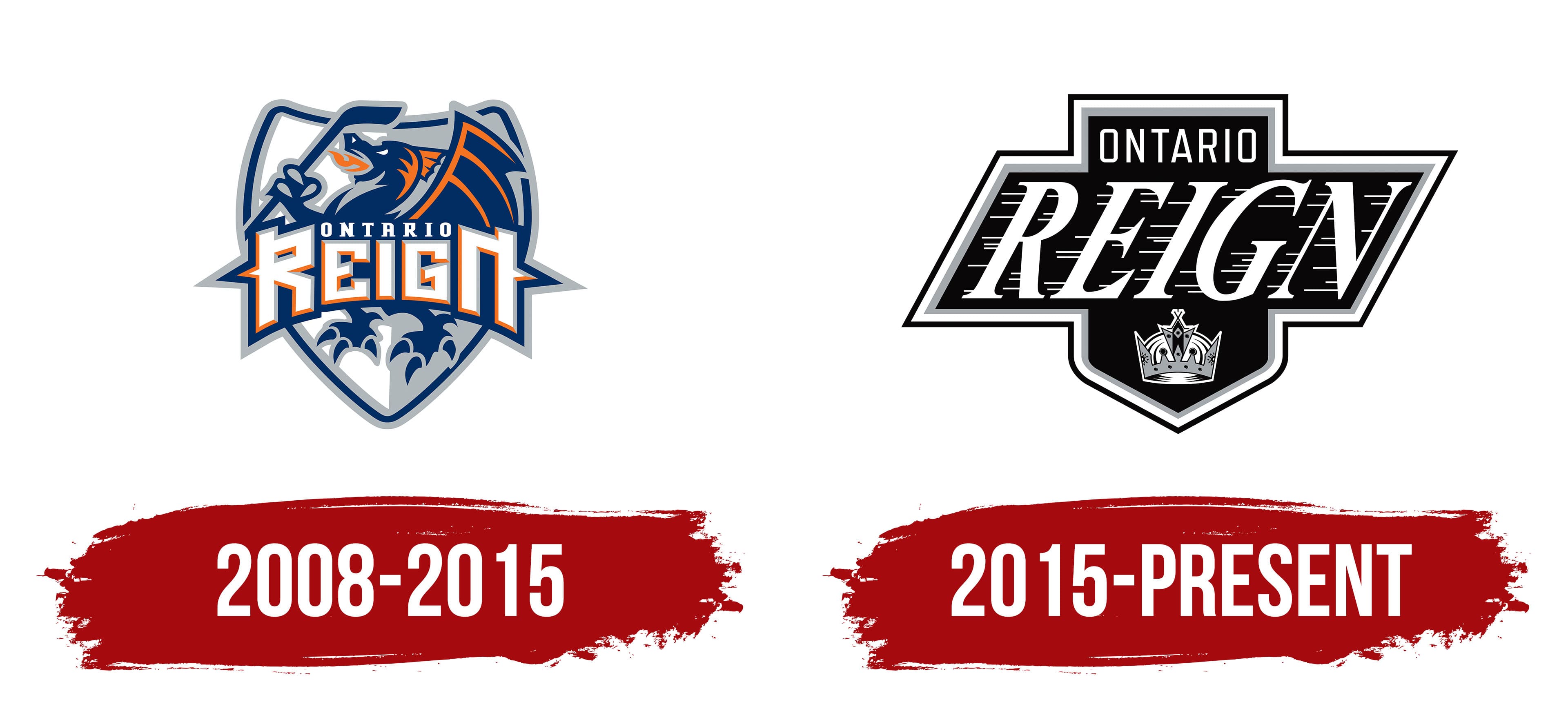
What is Ontario Reign?
It is a hockey team from California competing in the American Hockey League (AHL). The team plays at an arena with a capacity of about 10,000 spectators and develops young players for the NHL. The club employs an attacking style and promotes hockey’s popularity in a warm-climate region.
2008 – 2015

The first logo combined elements of hockey with medieval motifs. The central character was an aggressive dragon symbolizing the club’s strength. The dragon held a hockey stick, adding an unusual sports accent.
The composition was enclosed within a classic heraldic shield, colored white on the left and gray on the right.
The typography featured original letters with sharp geometric forms and pronounced sharp edges. The word “REIGN” was displayed in white letters outlined in orange and blue, emphasizing the dynamics of hockey. Above it, “ONTARIO” was placed compactly.
The combination of dark blue and orange represented the team’s energy and regional affiliation. Orange highlighted dragon details and letter outlines, adding visual depth.
2015 – today

The Ontario Reign logo was introduced on February 11, 2015, marking a new chapter in the team’s history linked to its entry into the American Hockey League (AHL) and its integration into the Los Angeles Kings NHL club system. The logo’s design was inspired by the iconic “Chevy Shield,” previously used by the Kings in the late 1980s and early 1990s, symbolizing continuity and a strong connection between the clubs.
The shield has an angular, symmetrical shape with a stepped outline in black, gray, and white colors. Prominently displayed at its center is the word “REIGN,” set in an expressive italic serif font with contrasting details and thin horizontal lines that emphasize hockey’s speed and dynamism. At the top of the shield is the word “ONTARIO,” set in a narrow sans-serif typeface that ensures readability and provides a clear contrast with the main name.
Positioned at the bottom of the shield is a stylized silver crown, signifying the team’s direct affiliation with the Kings organization and its status as a feeder club. The crown features sharp shapes and angles that reflect the aggression and competitive spirit typical of high-level hockey leagues.
The logo’s color scheme is strictly monochromatic, spanning shades from black to light gray and white, matching the Kings’ palette and reinforcing the visual connection between the teams. This monochrome scheme symbolizes the professionalism, discipline, and strength, which are fundamental values of the club on the ice.
The customized font used for the word “REIGN” combines classic Roman proportions with sharp, dynamic strokes. This typography evokes associations with player movement and the high speeds characteristic of hockey.
