


 Scholastic Logo PNG
The Scholastic logo is associated with a publisher that has become part of the school experience for many generations. It is a brand that provides books and learning materials, easily recognized by students and teachers, and has become an essential part of education.
Scholastic began in 1920, when Dartmouth graduate Maurice Robinson launched a four-page newspaper for high school students in Pittsburgh. With limited funds, he expanded the publication by covering subjects relevant to young readers. During the Great Depression, student writing contests and published anthologies helped the company retain its school audience.
In 1948, Scholastic introduced book clubs that allowed children to order inexpensive titles through classroom catalogs. The model gave the publisher direct access to students and distinguished it from traditional competitors such as Random House. School book fairs later extended the system by turning libraries and gymnasiums into temporary bookstores where children selected books independently.
Scholastic began expanding internationally during the 1960s. In the same period, it published Norman Bridwell’s stories about Clifford the Big Red Dog. The illustrated series became one of the publisher’s longest-running properties. They reached younger readers through clubs, classrooms, and repeated editions.
In 1997, Scholastic acquired the US publishing rights to Harry Potter. J. K. Rowling’s series produced record sales, midnight releases, and long lines outside bookstores, making it one of the company’s biggest successes in American children’s publishing. Its other major releases included Dav Pilkey’s Captain Underpants, whose humor attracted many reluctant young readers. Through its magazines, clubs and fairs, Scholastic continued distributing books directly through schools.
Meaning and History
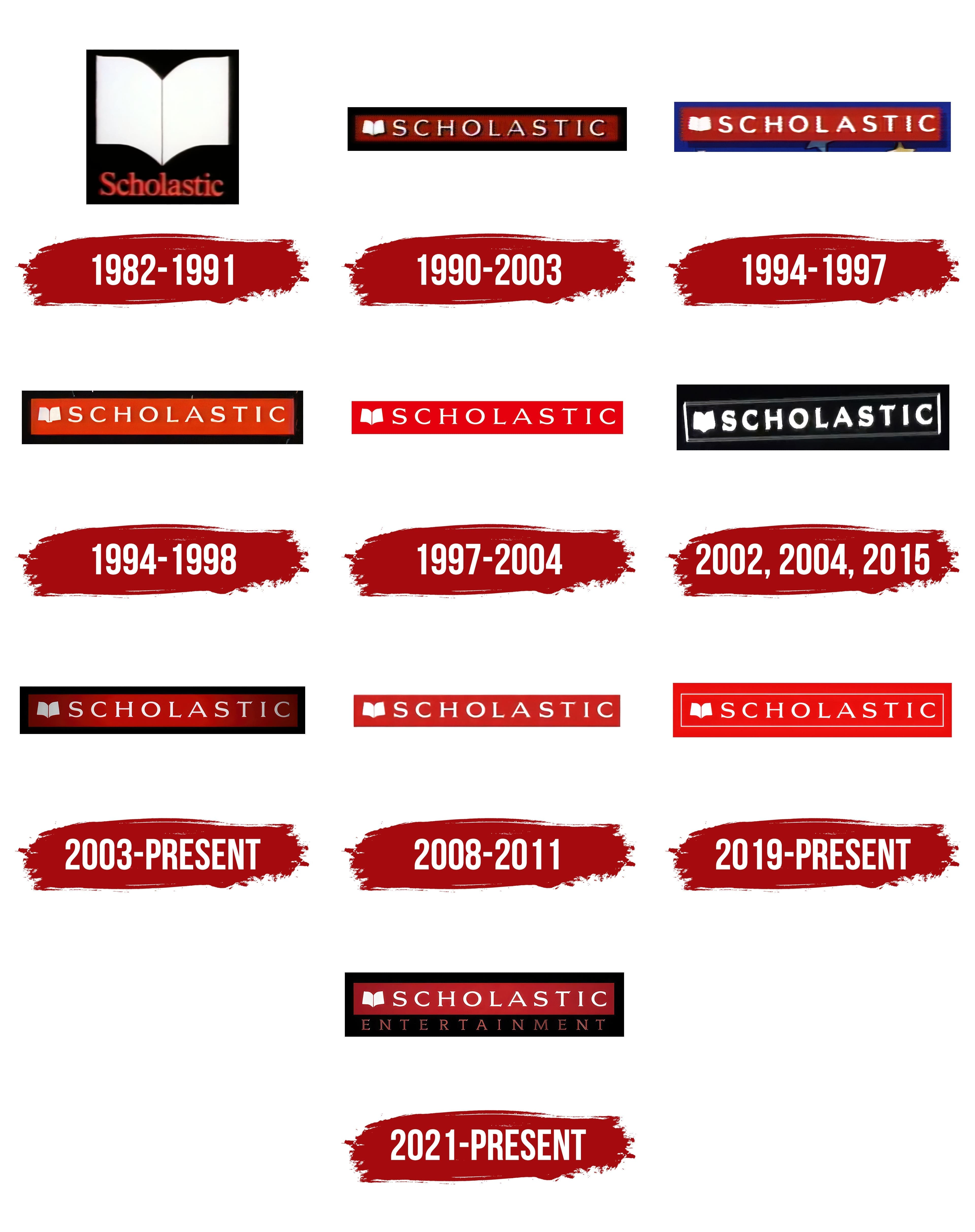
What is Scholastic?
It is a major American publisher known for children’s and young adult literature. The company has published numerous bestselling adventure and fantasy books. Scholastic collaborates with schools by organizing book fairs and publishes educational magazines, textbooks, and learning resources.
1982 – 1991

The image created by Scholastic in 1982 reflected the world of books and education. The design centers on the symbol of an open book, visualizing the publisher’s goal of making knowledge accessible to children worldwide. The book’s simple shape emphasizes the company’s mission as an educational publisher.
The logo’s color palette was chosen in the spirit of the time. The contrast of the black background and bright accents matched the visual aesthetics of the early 1980s. The black background enhances the perception of the open book. The word “Scholastic” is rendered in a rich red, evoking energy and engagement in the learning process.
The typographic part uses a serif font similar in style to ITC Cheltenham. It features balanced proportions and classic elegance, reflecting the publisher’s authority and its long-standing connection to academic tradition.
1990 – 2003

Scholastic’s transition to a new visual format in 1990 marked a change in the logo’s style and structure. Instead of the large, open book used before, a long, red rectangle with text appeared, along with a small, white open book on the left. This format reflected the minimalist trend and suited the needs of a publishing house working with print materials.
The white book on the red background retained its key meaning as a symbol of the brand’s educational mission. Its placement to the left of the name became a new accent, representing openness to knowledge and the continuity of tradition. The red rectangle used the Scholastic Red shade, established as a permanent element of the corporate identity.
The font became more elegant and visually lighter, with proportions similar to those of Times or its modern counterpart, Minion.
The redesign coincided with the publisher’s expansion of its activities. Scholastic developed its educational publishing direction and children’s book series, establishing a recognizable corporate identity.
1994 – 1997

The design changes in the mid-1990s aimed to update the color palette. The main symbol, a red rectangle with a white image of a book, retained its structure but was improved.
The red color intensified, strengthening the brand’s visual perception. The book and type lost their shadows. The adjustments increased contrast and improved legibility in print.
The main effect of the update was achieved through the background system. The background created a mood reminiscent of children’s literature, evoking imagination and energy. During this period, the company developed a book series, including R. L. Stine’s “Goosebumps,” which became popular among teenagers. The new focus reflected how the publisher adapted its appearance to a changing audience and expanding catalog.
1994 – 1998

In the mid-1990s, Scholastic’s visual identity underwent adjustments that enhanced depth and introduced color. The red rectangle took on a new tone, and the letters regained their shadows, creating a sense of relief.
The type retained a classic serif structure close to Times New Roman. It combined academic tradition with modern readability, consistent with the publisher’s reputation as an educational brand.
The rectangle background became slightly lighter, shifting toward a more scarlet shade, which enhanced the contrast with the white elements. The white book, remaining at the center of the visual system, preserved its symbolism of open knowledge and learning.
The logo changes coincided with the development of young adult literature in Scholastic’s catalog. During this period, the company released popular series, including “Animorphs,” which resonated with younger audiences. The new color balance and embossed typography reflected the brand’s energy as it adapted to the dynamic, mass-market book market of the late decade.
1997 – 2004

Scholastic’s transition to a new design at the end of the decade marked a move away from three-dimensional forms. The shadows disappeared from the text. The logo design became smooth and orderly.
The background adopted a lighter, more saturated scarlet tone, replacing the previous pale red. The update enhanced the contrast with the white book symbol, which remained on the left side of the rectangle.
Typography took a new direction. The letters became horizontally stretched while maintaining the proportions of a classic serif type. The font family is Trajan Pro, known for its architectural character.
2002, 2004, 2015

A separate stage in the development of the Scholastic style was associated with the rejection of the familiar color scheme. A black-and-white palette temporarily replaced the red rectangle that had long been associated with the brand. The black background enhanced a sense of reliability and aligned with the corporate aesthetics of a company working with academic content.
The font became denser and heavier. Structurally, it is closely related to the Gotham Bold family and other typefaces.
This version of the logo was used for a limited time. It was considered an experiment in finding a more formal graphic style that reflected Scholastic’s position as a major educational publisher.
2003 – today

The Scholastic logo update in the early 2000s coincided with the company’s transition to digital educational formats. A gradient appeared, adding depth and visual dimension. The red banner was created with a smooth tonal transition. The edges were darkened, and the center was illuminated. The color distribution enhanced the lighting, making the design feel more spatial.
The basic structure remained a traditional rectangle with a book image, but its perception changed. The gradient created an illusion of materiality and emphasized the brand’s modern tone as it introduced electronic products and multimedia resources for schools.
The font gained refinement while preserving the classic proportions of a typeface similar to Trajan Pro. The elongated proportions and precise line contours provided visual lightness and consistency with the updated color.
2008 – 2011

The new version of the emblem was somewhat similar to the 1997 version. The gradient disappeared, and the red background deepened to a burgundy hue, strengthening the symbol’s professional tone and reinforcing the publisher’s reputation as a leading player in the educational market. The new tone was more restrained and aligned with the brand’s expanding audience, which included school- and teenage-focused segments.
Structurally, the design resembled the late 1990s version. The image of the book and the rectangular shape remained, but the overall visual rhythm became calmer. The font was updated. The letters took on a thinner, more elegant form while maintaining a connection to classical type design.
Among the key projects of that time were “The 39 Clues” and “The Hunger Games,” which brought the company high recognition in the young adult literature segment. The new logo visually reflected this stage, during which the publisher demonstrated its focus on modern readers’ interests.
2019 – today

In 2019, another update to Scholastic’s identity took place. The company moved away from contrasting combinations and adopted a unified red palette. A deeper, more saturated red gave the design visual completeness and perceptual strength.
A thin white frame appeared inside the rectangle. It visually divides the surface and adds a sense of lightness. The typography remained unchanged. The typeface used is close to Trajan Pro, with balanced proportions and neat serif shapes.
The updated version symbolized the brand’s stability and modernity, continuing to unite educational and literary directions under a single visual identity.
2021 – today

The expansion of Scholastic’s activities influenced the logo’s visual structure. Under the traditional red banner, an additional line reading “Entertainment” appeared for the first time. This was the first case in which the company established a connection, through its main symbol, with the division engaged in film and television production based on its books.
The inscription color is a light red shade close to muted coral. It visually harmonizes with the rich banner background and maintains compositional balance.
The serif font used for the word “Entertainment” resembles classic Garamond. Its form features smooth outlines and slightly softened edges. The inscription appears soft and visually delicate.
The added line organically complemented the existing logo structure, emphasizing the company’s growth and its broader audience reach.
Font and Colors

Scholastic’s typography and color system are built in accordance with its educational mission. The company name is rendered in a serif typeface structurally close to Aviano Seriftrade, distinguished by refined lines and precise stroke endings. It also shares similarities with Columnatrade or Tripletttrade, which convey academic character and visual rigor. The typography reflects the brand’s authority in publishing and educational content, associating it with reliability and professionalism.
Red is the primary color and sets the emotional tone. It symbolizes energy and engagement. White is used as a contrasting element, ensuring visual clarity of the lettering and symbol, as well as design neatness. The use of black in certain versions creates additional contrast, highlighting the structure of the letterforms.
The logo combines the emotional strength of red with the orderliness of the typography. Together, they ensure the brand’s harmonious presence in educational, parental, and children’s environments.