


 TeamSpeak Logo PNG
The TeamSpeak logo symbolizes clear and prompt online communication. The platform gained popularity among those who valued a high-quality voice connection and the ability to coordinate actions without interruption.
TeamSpeak began in 1999, when a group of German gamers set out to build a lighter voice-chat tool than Roger Wilco. Their goal was stable communication with low delay and minimal bandwidth use on dial-up connections. The first public version appeared in 2001 for free. It gained users through low processor demand, efficient traffic use, and a client-server model that let communities control channels and permissions.
That structure made TeamSpeak popular with clans and guilds in EverQuest and World of Warcraft. Triton World acquired the rights in 2002, followed by GameSpy Industries in 2004. Commercial licensing was introduced for larger servers, while private noncommercial use remained free.
Work on TeamSpeak 3 began in 2004 to replace the older architecture. Development and testing continued for seven years. TeamSpeak Systems GmbH was registered in Germany in 2007, and the final version arrived in 2011 with digital user identities, a detailed permission system, server file storage, improved voice quality, and stronger encryption. The software later found use in companies, military organizations, and professional esports teams.
Discord entered the market in 2015 with free cloud hosting, a modern interface, and gaming integrations. Many casual users moved there, while TeamSpeak retained customers who preferred self-hosting, low latency, direct data control, and independent operation. In 2019, the company announced a redesigned client compatible with earlier servers.
Meaning and History
What is TeamSpeak?
It is specialized voice communication software widely used by gamers. Users connect to dedicated channels and communicate without delays and minimal computer load. TeamSpeak provides flexible channel settings, easy access management, and push-to-talk functionality. Gaming communities prefer it for stability, excellent audio quality, and the ability to independently manage servers.
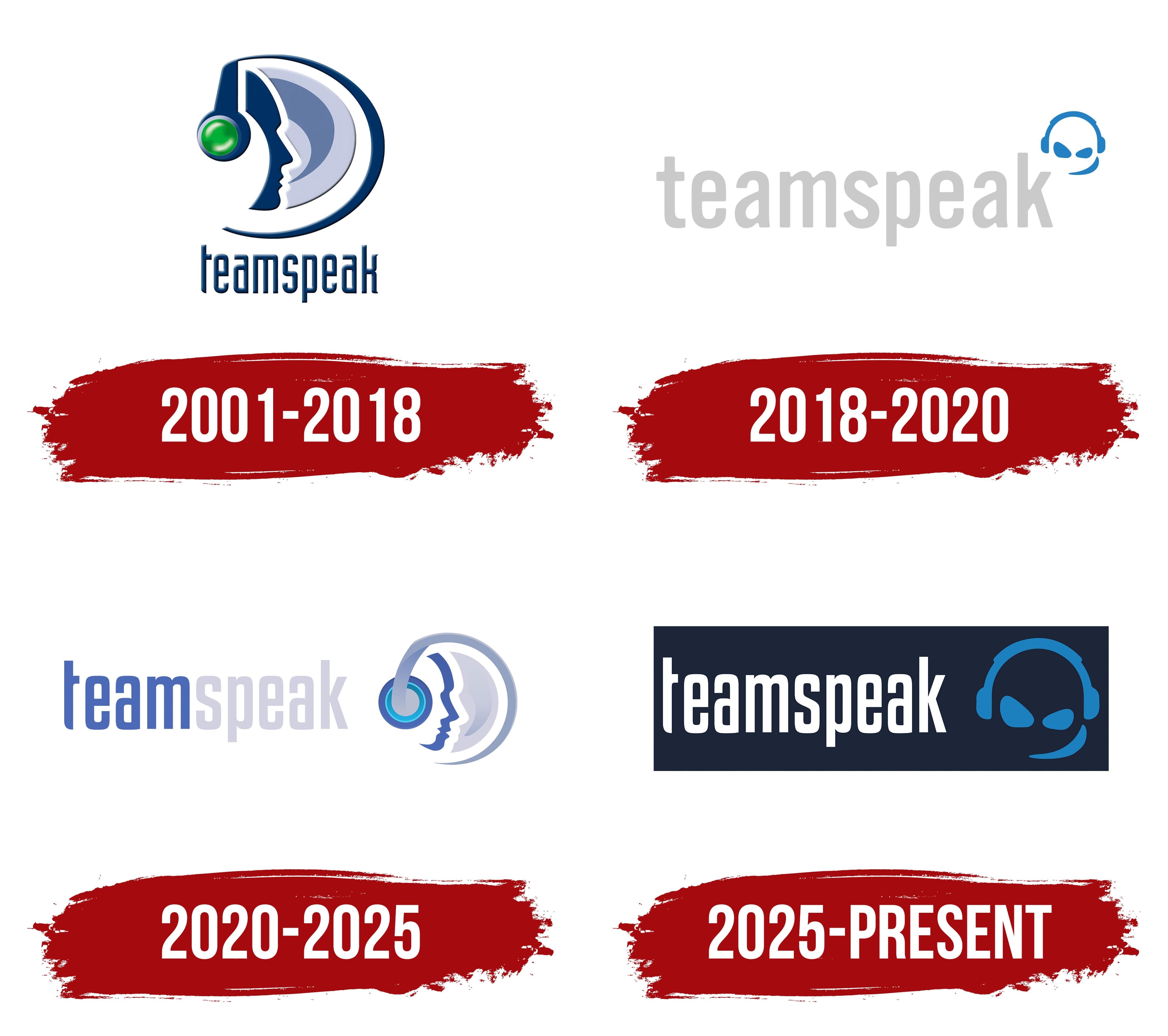
2001 – 2018
The first logo was created during the early stages of the growth of online communication. The graphic depicted a right-facing profile, highlighting the application’s primary function: voice communication. The TeamSpeak team visualized the idea to reflect the product’s mission of enabling seamless communication.
Blue shades symbolized trust. The green sphere in the headphones represented connectivity and activity, as indicated by device indicators.
The name was written in a strict futuristic typeface resembling Eurostile and Microgramma, popular during the technology boom. The vertically stretched letters created a technological feel.
The graphic of a face profile wearing headphones resembled an icon, illustrating voice communication among gaming teams. Smooth lines symbolized sound transmitted from a microphone across distances.
The logo’s longevity (over 17 years unchanged) demonstrated the brand’s stability and reliability, making it popular among gamers and online chat users for its high-quality voice connection.
2018 – 2020

In the next version, TeamSpeak adopted a minimalist design to align with modern mobile interface standards. Volume shapes and bright highlights were replaced by flat design.
The name turned gray and was written in a sans-serif font resembling Ubuntu Bold and Cera Pro, noted for screen readability.
The traditional profile evolved into a simplified, blue headset-wearing face.
Placing the new symbol in the upper-right corner, referencing mobile notification icons, emphasizes the brand’s integration into modern digital contexts.
The visual shift showed a focus on an audience accustomed to mobility and simplicity.
2020 – 2025
The following logo combines classic features with modern minimalism. The iconic profile of a person with headphones returns, simplified and transparent. This symbol emphasizes voice communication while remaining light and unobtrusive.
The name was written in a harmonious sans-serif font. The first part, “team,” appeared in soft blue, suggesting a sense of community unity. The second part, “speak,” colored gray, indicated the voice-focused service.
The calm color palette conveyed a sense of friendliness, reflecting the company’s goal of providing a user-friendly communication tool for gamers, streamers, and online conferences.
The font resembled Ubuntu Condensed Regular and PT Sans Narrow, well-suited for digital platforms, providing clarity, modernity, and technical precision.
2025 – today
The current TeamSpeak logo combines elements of previous branding into a minimalist, modern visual composition. The company name is set in lowercase letters using a vertically elongated geometric sans-serif font. The logo’s typeface, in terms of proportions and glyph shapes, resembles Ubuntu Condensed Regular or Eurostile Extended, with customized individual letters.
To the right of the name is the TeamSpeak symbol, a simplified silhouette of a head wearing headphones with a microphone, rendered in bright blue. Visually, this element evokes mascots typical of sci-fi gaming characters or esports symbolism, reflecting the platform’s core audience and the brand’s digital focus. The symbol is minimalist yet expressive: the curve of the microphone, the arch of the headphones, and the stylized eyes form a memorable, easily recognizable shape, even at smaller sizes.
The logo’s color palette relies on a contrast of white text and a light blue symbol against a dark blue background. Such a color scheme is typical for digital products and software, conveying reliability, professionalism, and the company’s confidence in voice communications for gamers. The dark blue background emphasizes the platform’s technical orientation and seriousness, while the bright blue accent adds dynamism and technological expressiveness to the design.
TeamSpeak’s new visual style was introduced during the active development of TeamSpeak 5, presumably in preparation for the release of its stable version after completing public beta testing. The current design logically builds upon and reinterprets previous logo versions, preserving brand recognition while emphasizing its contemporary, technological character.
Font and Colors

The TeamSpeak logo uses a geometric sans-serif typeface. Letters are elongated, narrowed, and dense.
The brand’s color palette features restrained blue tones with gray accents, creating a technological, functional atmosphere suited to gaming environments.