


 Toy Story Logo PNG
From the emblem, kindness and games breathe. The Toy Story logo conveys a cheerful mood and the emotional, dangerous adventures of its kind toy characters. Friendship, development, and joy are hidden within the symbols, all set against the backdrop of instructive stories.
Toy Story began as part of Pixar’s early experiments with computer animation. After leaving The Walt Disney Company in the 1980s, animator John Lasseter joined Lucasfilm’s graphics division. He later helped build Pixar after Steve Jobs purchased the studio in 1986. Pixar’s short film “Tin Toy Story” eventually inspired the character of Buzz Lightyear, named after astronaut Buzz Aldrin.
In 1991, Disney signed a $26 million agreement with Pixar for three animated features. Early versions of Toy Story nearly collapsed in 1993 after Disney executives demanded a harsher version of Woody. The rewritten material failed during an internal screening remembered as Pixar’s “Black Friday.” Even Tom Hanks criticized the character during recording sessions. Pixar paused production and rebuilt the script around a friendlier Woody.
The film premiered in November 1995, with Tom Hanks and Tim Allen voicing Woody and Buzz, respectively. Rendering the movie required about 800,000 machine hours, while Pixar could finish only a few minutes of animation per week. Toy Story earned $358 million worldwide on a budget of nearly $30 million and became the first full-length CGI animated feature. Pixar’s IPO followed immediately after release, valuing the studio at around $1.5 billion.
Toy Story 2 arrived in 1999, after being developed as a direct-to-video project. Toy Story 3 became one of the biggest animated hits of 2010, while Toy Story 4 passed $1 billion worldwide in 2019. Disney acquired Pixar in 2006 for $7.4 billion.
Meaning and History
John Lasseter directed Toy Story, making his directorial debut. In animation, he perfectly brought to life a script written by a team that included Joel Cohen, Andrew Stanton, Joss Whedon, and Alec Sokolow. It was based on a story by Joe Ranft, Pete Docter, Andrew Stanton, and John Lasseter. A constellation of brilliant actors and actresses voiced the heroes: Annie Potts, Wallace Shawn, Tom Hanks, Don Rickles, Tim Allen, and many others.
The story unfolds in the real world, but with anthropomorphic toy characters in an ordinary child’s ordinary family. When people are around, toys are just toys, but when no one sees them, they come to life and begin to think, speak, and act. The story focuses on a cowboy sheriff named Woody and astronaut Buzz Lightyear. They confront each other and fight for the affection of their owner, a boy named Andy Davis. One day, they find themselves in a dangerous situation together and get lost.
Both viewers and critics highly appreciated the cartoon. It has been praised for its technical innovation, sophisticated subject matter, wit, 3D animation, vocals, and music. It has won numerous film awards and is recognized as aesthetically, culturally, and historically significant.
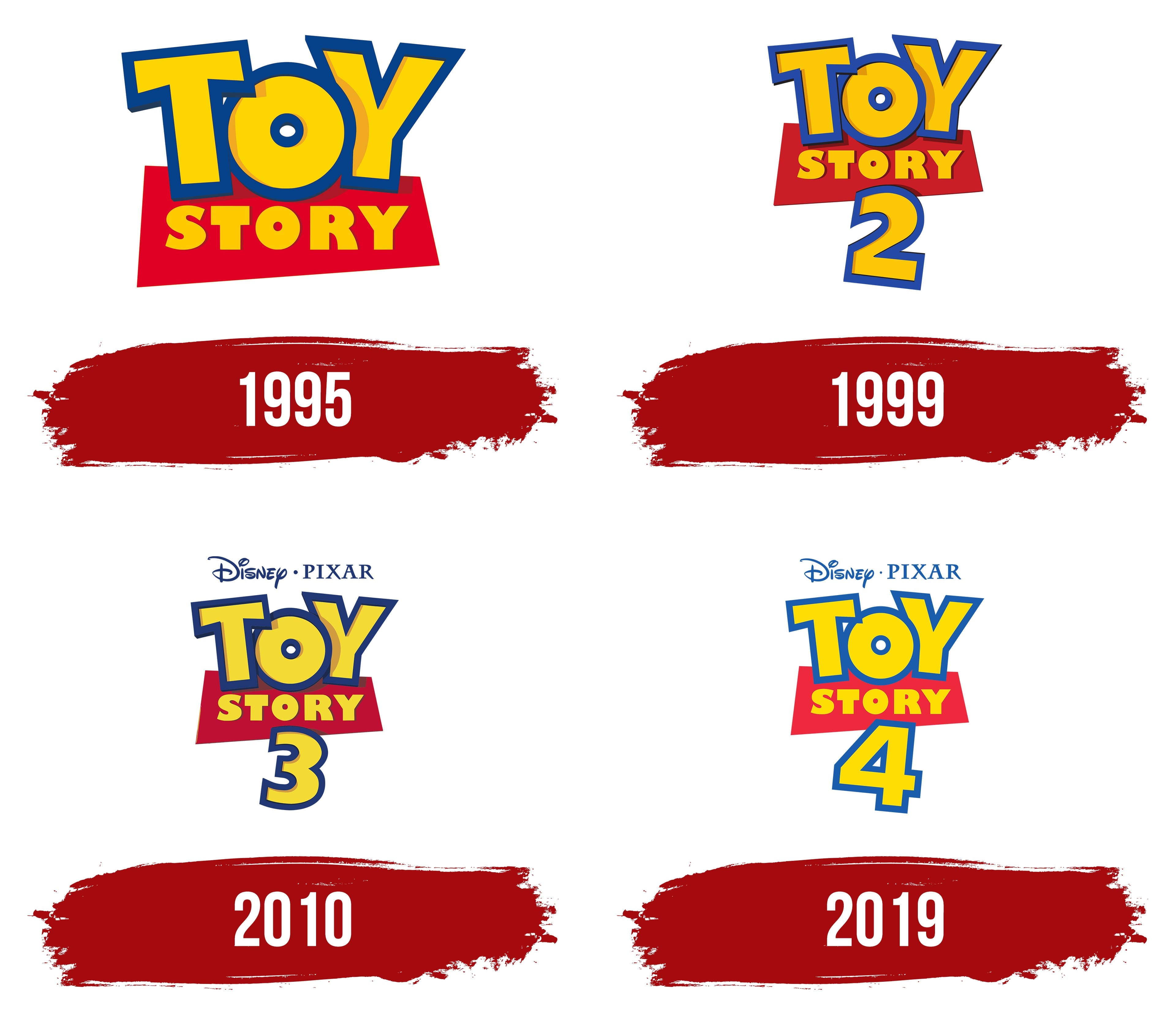
1995
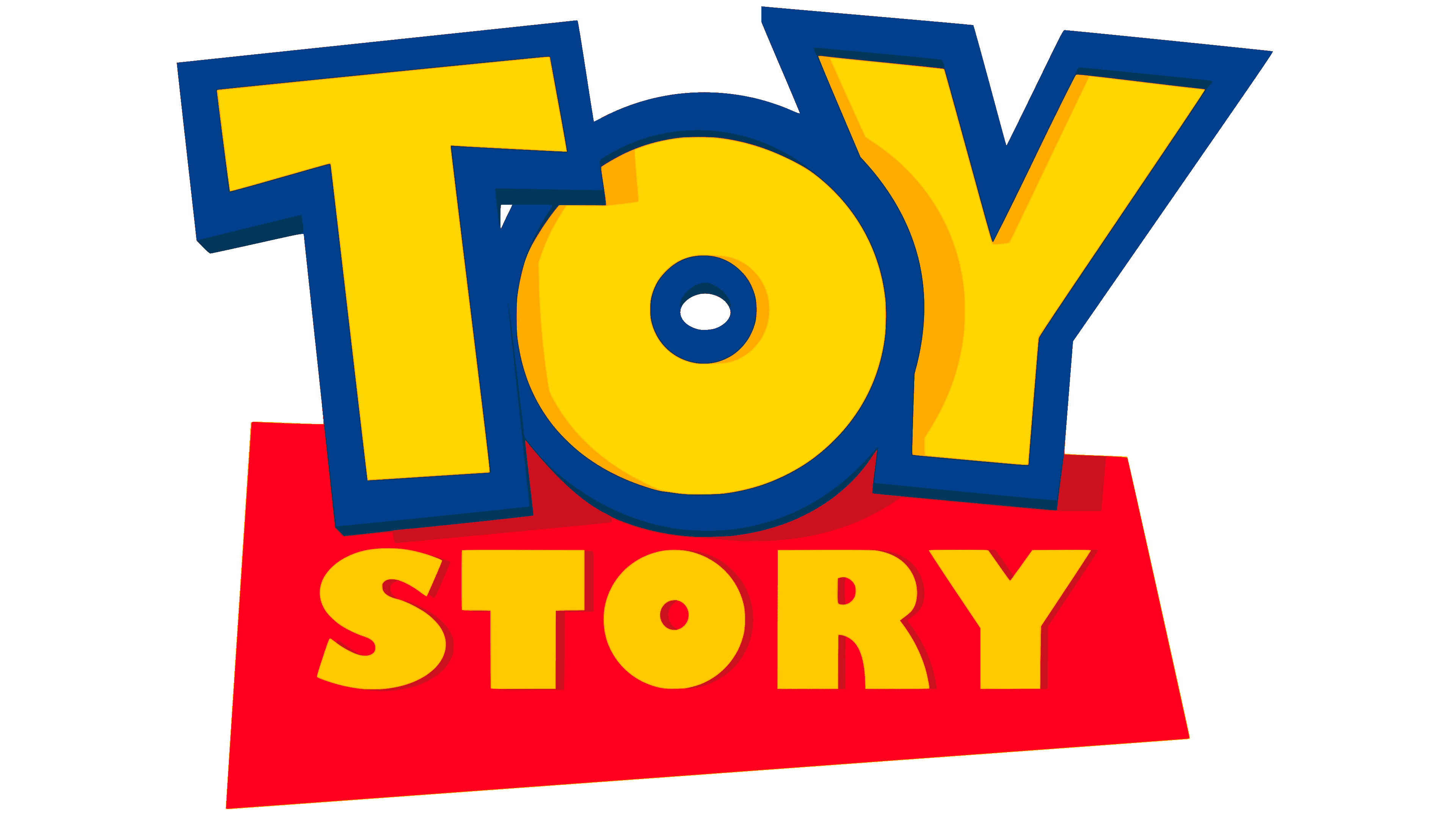
The animated motion picture’s debut emblem consists of a two-line title. The top word (“Toy”) has no background. It is executed in uppercase characters that “swing” in different directions: “T” tilts left, “Y” tilts right. A thick blue stripe surrounds each letter, and the letters are bright yellow. The bottom row contains the inscription “Story.” It is located on a geometric shape that resembles a rectangle. Solid yellow marks are visible against a red background. The upper word partially covers it.
1999
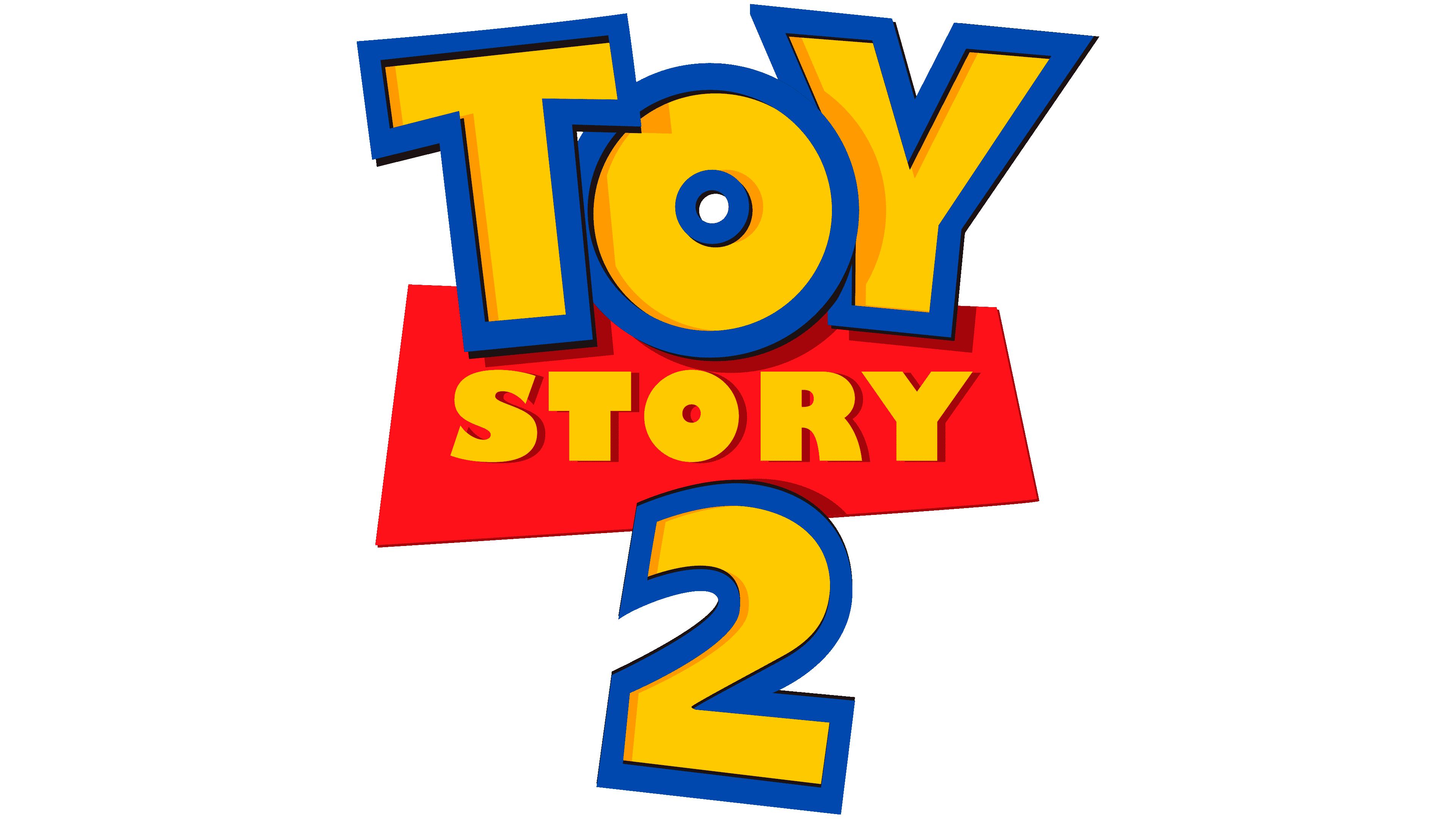
The second part of the cartoon received a more modern logo. It has a 3D effect. Shadows and blue frames enclosing the letters in the first row create this effect. As a result, the edging stands out visually from the rest. In this version, a third line also appeared, with the series number designation. The number is framed in the same style as the first word.
2010
The third version of the full-length animated film featured an emblem that was almost identical to the previous logo. The difference is insignificant, with only a few details. So, the developers made the light frame blue to increase the volume, removed the warm yellow and replaced it with lemon, changed the number “2” to “3,” and placed the names of Pixar and Disney at the top. To keep the words from merging, they added a small dot between them.
2019

The number of shadows on the logo of the fourth Toy Story series has been reduced. They have become thinner and more invisible. The darkened stripe on the left side of “Y,” cast by the letter “O,” is visible. The number “4” received the same style as the “3”, geometrically precise, even, smooth. But, of course, the four still have several right angles. The designers have slightly increased the background color of the word “Story” by adding a deep red tint.
Font and Colors
Since the first release, the iconic cartoon logo has remained highly recognizable. The adjustments affected only small details: strengthening the palette by several tones, drawing and removing shadows, and changing the series numbering.
The emblem uses two types of typefaces. The word “Story” is written in Gill Sans Ultra Bold, first introduced in the 1920s by Arthur Eric Rowton Gill. “Toy” is set in an individual style, similar to Agent Orange and Agent Red (developed by Pizzadude), as well as SF Slapstick Comic from ShyFonts.
The logo’s palette is juicy and catchy. The scheme includes yellow (warm, sunny, and lemon), red, and blue in two shades.