


 Atlantic 10 Conference Logo PNG
The Atlantic 10 Conference logo is strong and determined. The emblem symbolizes stable leadership and unwavering drive. It is difficult to defeat the league’s participants due to their athletic training, the experience gained through years of hard work, and the ability to act as a unified front.
The Atlantic 10 Conference began on March 2, 1975, when eight universities in the eastern United States agreed to form a regional basketball league. Its founders were Duquesne, George Washington, Massachusetts, Pittsburgh, Rutgers, Villanova, West Virginia, and Penn State. The organization received NCAA approval on October 15, 1975, and Duquesne won the first championship in 1976-77.
After its opening season, the league expanded beyond basketball and adopted the “Eastern Athletic Association” name. St. Bonaventure joined, followed by another reorganization in 1982, when the conference took its current name and added Temple University and Saint Joseph’s. Membership then shifted repeatedly as major programs moved to rival leagues.
A broader realignment arrived in 1995 with Fordham, Dayton, Xavier, and La Salle. Richmond joined in 2001, followed by Charlotte and Saint Louis in 2005. VCU entered in 2012 after its 2011 Final Four run, while Butler arrived after consecutive national championship game appearances. Both moves strengthened the league, yet Butler, Xavier, Charlotte, and Temple left in 2013.
George Mason University joined in July 2013, seven years after its unexpected Final Four appearance. The conference staged its men’s tournament at Barclays Center that year and placed five teams in the national tournament. Loyola Chicago entered in 2022, the conference moved its headquarters to Washington, D.C., in 2023, and Massachusetts prepared to leave for the Mid-American Conference in 2025.
Meaning and History
What is the Atlantic 10 Conference?
It is an NCAA Division I athletic conference that brings together universities in the eastern United States and organizes competitions in 21 sports. The program does not include FBS football but is known for its basketball teams. Men’s and women’s rosters regularly produce professional players and participate in NCAA tournaments. Conference universities compete in urban and suburban areas.
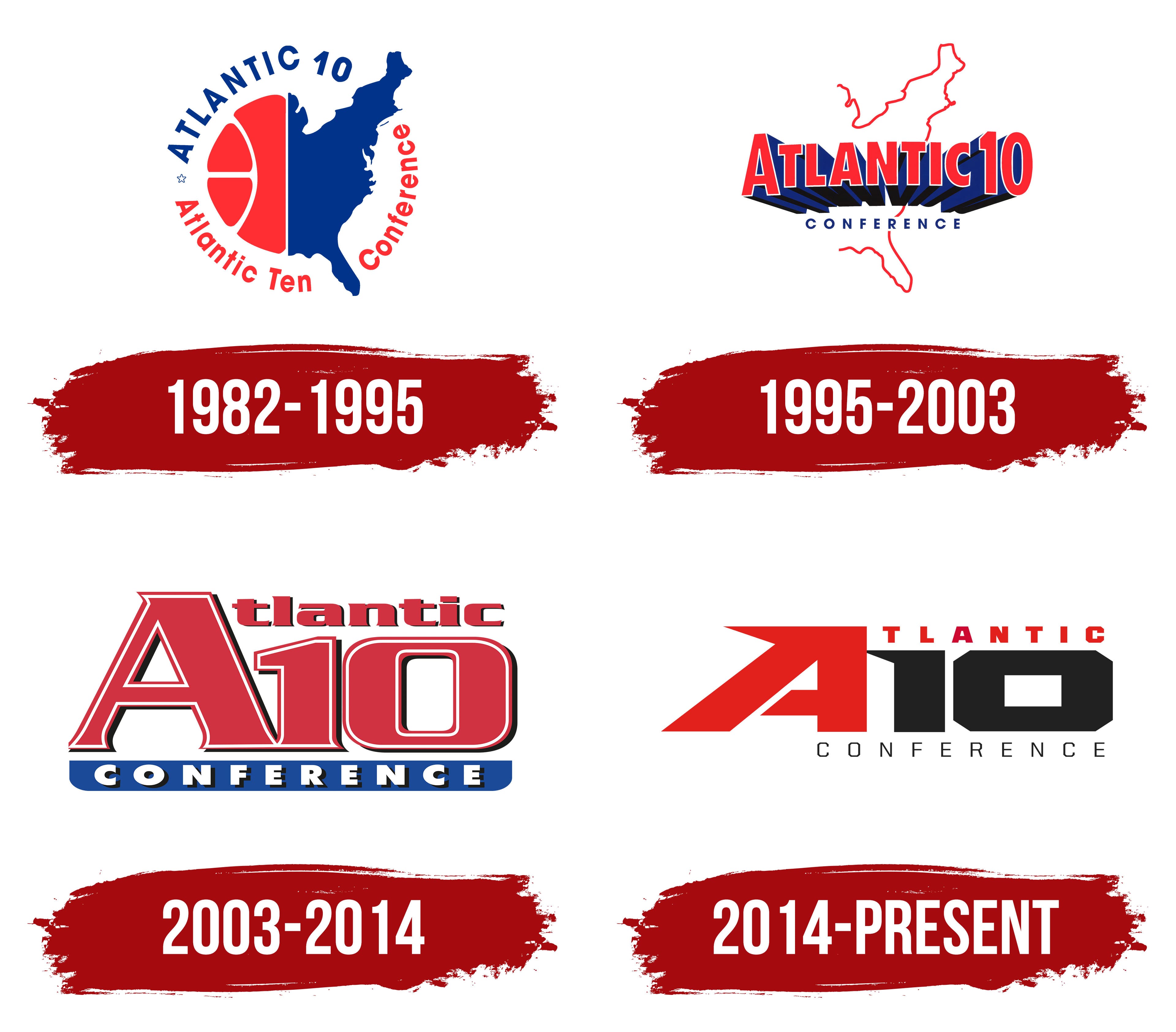
1982 – 1995
The emblem combines textual elements and graphic details into a unified composition. At its center is half of a basketball, seamlessly merging with a section of the U.S. map depicting the East Coast, bordered by the Atlantic Ocean. The choice of composition is tied to the conference’s origins. The organization began with basketball competitions, and its participants were teams from the country’s eastern regions. The organization’s original name, Eastern Collegiate Basketball League, reflects these geographic and athletic characteristics.
The core of the logo highlights the historical context and origins of the conference’s creation. The design, developed in 1982, emerged following the organization’s renaming to Atlantic 10. The new name combines a number and text arranged in a circle around the central image.
Two protruding elements of the map create the illusion of a dynamic athlete figure at the moment of striking a ball. This visual effect adds a sense of motion and conveys the excitement of competition among conference participants.
1995 – 2003
The expansion of sports disciplines led to a change in the concept of the emblem. The image of the ball was removed to emphasize the league’s universality. The background design features subtle map outlines that highlight the Atlantic Coast and resonate with the name “Atlantic.”
In the foreground, a bold inscription of the league’s name stands out from the background. The letters are styled with a movement effect that draws the viewer in, creating the impression of a three-dimensional semicircle reminiscent of a shockwave. The design conveys energy, dynamism, and durability, reflecting strength and determination. The red color of the symbols complements the overall image, associating with victories and achievements.
The logo emphasizes the union’s expansion, as the number of participants increased from 10 to 16. These changes highlight the conference’s growth and prosperity. The name Atlantic 10 is becoming increasingly recognizable, reflecting the high level and outstanding achievements of its representatives.
2003 – 2014
The updated emblem version focuses on the abbreviated name “A10,” placed prominently in the foreground. The large letter “A” at the top of the image visually transitions into the word “Atlantic,” written in a smaller font. This arrangement creates harmony with another text element, the word “Conference,” positioned below on a blue background. The sizes and styles of the symbols between the words are balanced, giving an impression of thoughtful design.
The rounded background adds smoothness and dynamism to the logo. The movement’s visual effect resembles sliding, like skiing, enhancing the overall perception of lightness and mobility.
The logo design is compact and complete. Its shape resembles a ball, referencing the football conference that is part of the “A10” structure.
2014 – today
The logo’s redesign became necessary after changes in the participants’ composition. The new symbol has a concise and expressive appearance. The serifs on the letters, directed to the left, evoke associations with flags, while their sharp ends emphasize the tension and competition accompanying the league teams’ field performances.
The design is based on the abbreviated name and uses a red-and-black color palette. The letter “A” and its continuation, “Atlantic”, are rendered in vibrant red, symbolizing passion and determination. The number “10” and the word “Conference” are in black, adding a sense of stability and strength. This combination of shades balances the pursuit of leadership and the union’s resilience.