Brave Logo PNG
The Brave logo has become a symbol of online freedom, representing a browser that redefined traditional internet browsing. Its emphasis on privacy, ad blocking, and high speed made it the choice for those who value control over their data.
In 2015, Brendan Eich, creator of JavaScript and co-founder of Mozilla, partnered with Brian Bondy to establish Brave Software. They intended to build a browser that prioritizes user privacy and reshapes the digital advertising landscape.
The first beta of the Brave browser launched in 2016, immediately drawing attention for its built-in ad- and tracker-blocking features. That same year, Brave secured $4.5 million in startup funding.
In 2017, Brave introduced its Basic Attention Token (BAT), raising $35 million in 30 seconds, one of the largest initial coin offerings at the time. BAT allowed users to earn rewards by voluntarily viewing ads, directly supporting content creators.
The browser’s first stable version debuted in 2018, alongside Brave Rewards, a feature that enables users to earn and share BAT tokens with publishers. Partnerships with advertisers and publishers increased significantly.
By 2019, Brave reached 8 million monthly users and launched Brave Ads, an advertising platform that respected user privacy. In 2020, Brave 1.0 was released, adding enhanced security features, integrated VPN support, and the news aggregator Brave Today.
Brave Search, an independent, non-tracking search engine, launched in 2021, expanding the company’s commitment to user privacy. By year’s end, Brave exceeded 50 million active users.
Between 2022 and 2023, Brave enhanced its ad-blocking capabilities, expanded cryptocurrency integration, and improved search engine functionality. Plans through 2024 focus on ongoing ecosystem expansion, enhanced privacy tools, and refined user experiences.
Meaning and History
What is Brave?
This web browser prioritizes security and personal data protection. It automatically blocks ads, trackers, and other elements that may compromise user privacy. A built-in rewards system allows users to support content creators with cryptocurrency and earn bonuses for viewing ads. Based on Chromium, it supports Chrome extensions and delivers fast performance while minimizing system load. The browser includes a built-in VPN, a cryptocurrency wallet, and other tools for safe browsing.
2016 – 2017
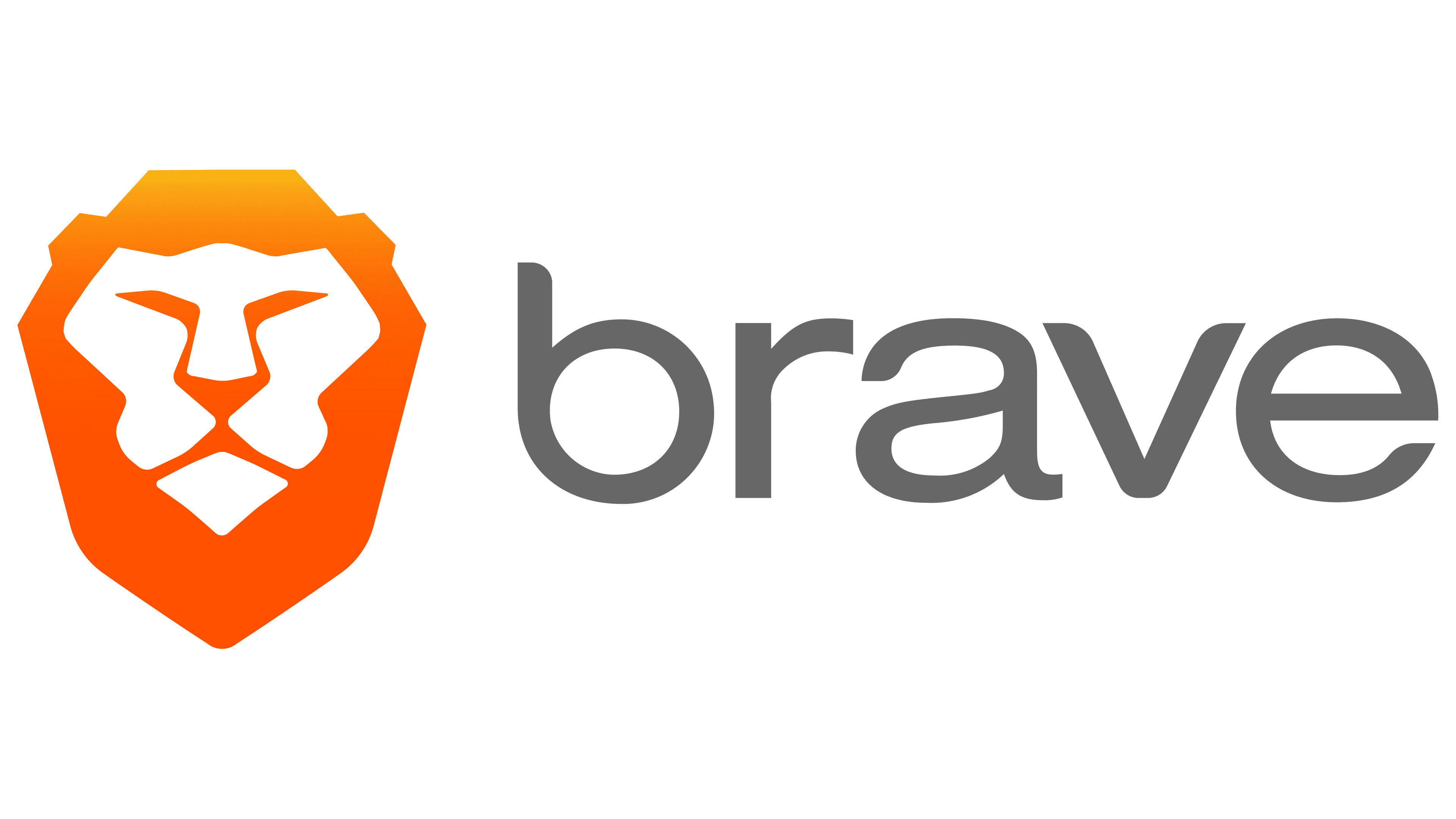
When Brendan Eich left Mozilla to found Brave Software Inc., he aimed to create a product with a fundamentally different approach to privacy and user data protection. The browser’s visual identity was developed in parallel with the launch and intended to convey the company’s core values through a recognizable symbol.
The composition was based on a lion’s head set within a shield shape. The construction referred to the brand name and expressed the idea of protection. The silhouette was built on strict geometric principles, with sharp, angular lines. The inner white fragments formed a simple yet recognizable image of eyes, nose, and mouth, giving the mark expressiveness and ensuring easy recognition at any scale.
The brand name was placed to the right of the symbol. It was written in lowercase letters in a modern sans-serif typeface, similar to Museo Sans Rounded. The typeface had a soft, rounded character, making the symbol less formal and more friendly. The gray text color served as a visual counterbalance to the bright symbol, creating a balanced perception of the composition.
The bright orange gradient added energy and dynamism, and the transition from a saturated tone to a lighter one emphasized the product’s technological and active character.
The Brave logo conveyed several layers of meaning. The lion symbolized courage and protection, the shield reinforced the idea of security, and the bright gradient emphasized innovation and energy. Together, the elements convey Brave’s mission to provide users with a tool that puts privacy and data control at its core.
2017 – 2018
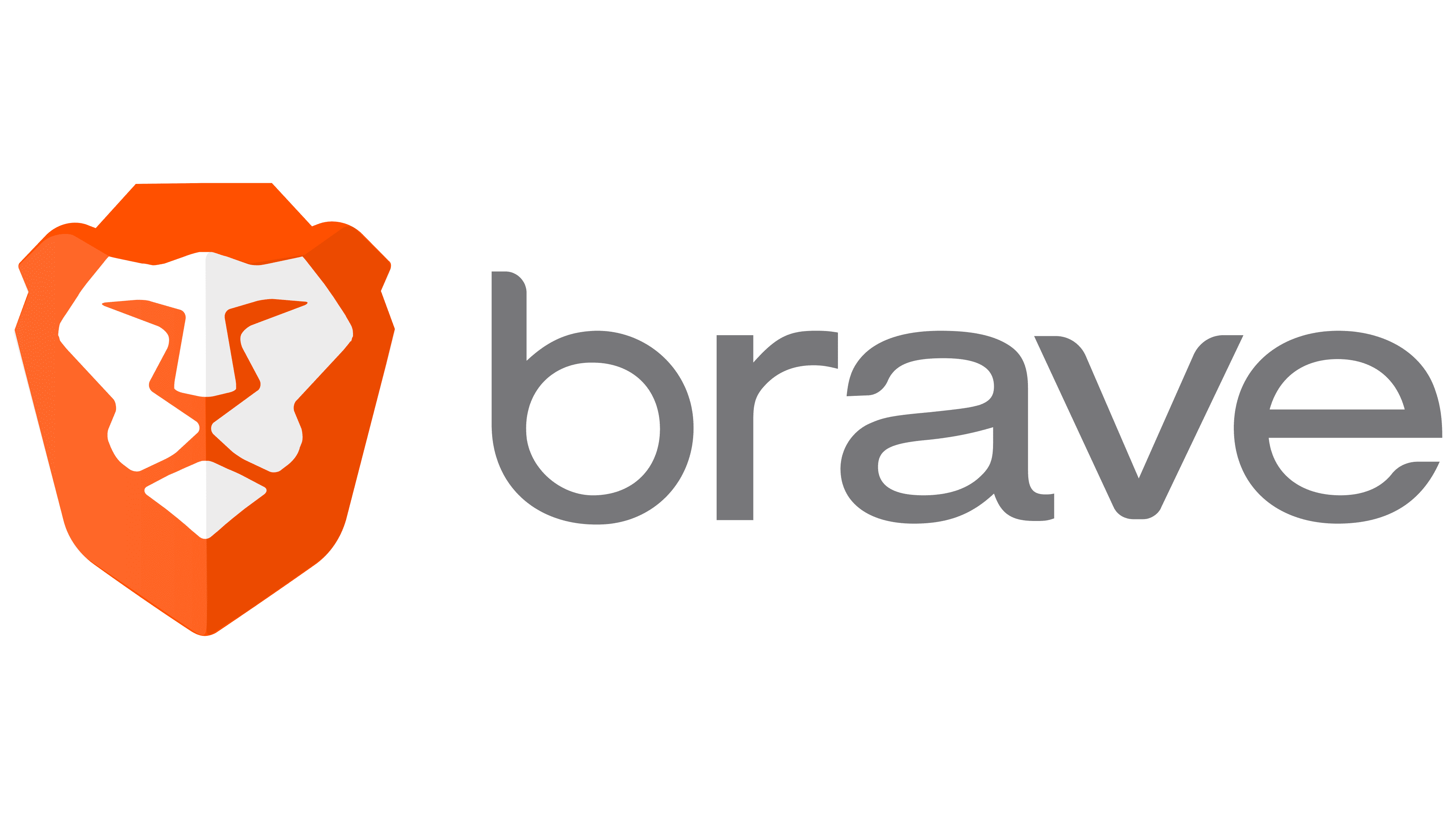
The Brave redesign in 2017 marked the browser’s first launch and aimed to strengthen the brand’s visual identity in the digital environment. The lion symbol was preserved but reworked into a more symmetrical shape, aligned along strict geometric axes. The central fold visually divided the face into two halves, creating a neat sense of volume. The left side appeared slightly lighter, while the right had a deeper orange tone. The facial features were complemented by soft gray, making the image appear multilayered and complete.
The word “brave” in the text part retained its original form but was adjusted to fit the new icon block. A modern sans-serif font with rounded outlines, close to Comfortaa, was used. The typeface featured smooth lines and balanced spacing, creating harmony with the updated lion symbol. The text color remained gray but slightly lighter.
The update was created by designer Jimmy Haas, who worked on the Brave team. The premiere took place on October 30, 2017, on the company blog, where the reasons for the changes were explained in detail. The primary goal was to maintain the recognizability of the lion icon while enhancing symmetry and scalability.
2018 – today
Changes to the Brave logo, introduced after the 2017 version, focused not on the mark’s structure but on emotional expressiveness and color saturation. The lion’s form retained a shield-shaped contour with the same proportions and symmetry, but the addition of new shades enhanced the symbol’s visual energy.
The main difference was in the updated palette. The icon features a rich gradient that transitions from scarlet to bright orange. The transition created a sense of depth and added extra volume to the emblem. The red tone evoked associations of strength and aggressive protection, while the orange continued to convey dynamism and a technological focus. The combination of tones was perceived as bold and determined, underscoring the browser’s positioning as a tool ready to defend against privacy threats.
The typographic part retained its rounded and modern character. The brand name’s text was set in a sans-serif typeface, with soft lines and balanced spacing. The color scheme changed, and instead of light gray, a dark gray close to graphite was used. The shade created a stronger contrast with the bright icon, giving the name more weight.
The redesign was once again authored by Jimmy Haas, who also worked on the previous version. The gradient lion mask, combined with dark gray text, creates a cohesive image that embodies energy and reliability. The logo reflected Brave’s intention to emphasize the browser’s role as a defender of digital freedom and privacy. It is one of the company’s current identities.
2024 – today
The evolution of Brave in recent years has led to an updated logo that retains the familiar image while changing its visual presentation. The lion, serving as the brand’s hallmark, retained its shape and remained within a shield-like frame. The lines and proportions were refined, symmetry was enhanced, and the contrast of the inner facets became more pronounced.
The main changes concerned the text. Instead of the previous typeface, a new font appeared, visually close to Work Sans or an adapted Neo Grotesk. The letters became denser and more massive, and their stroke thickness became uniform. Their shape became more geometric, retaining slight roundings but emphasizing technical precision. The black inscription enhanced the contrast with the emblem, lending the text a sense of solidity and depth.

The change in text color has a conceptual basis. While earlier versions used gray, the transition to black signaled stricter brand positioning. It reflected maturity and professionalism combined with a focus on technological solutions. The overall visual composition reflects Brave’s movement toward integration with Web3 and cryptographic protocols.
The introduction of the new version was gradual. Starting with release 1.63, the Brave logo began appearing in browser updates and was fully established in March 2024. The brand preserved the lion image, reinforced visual strictness, and connected the emotional elements of previous iterations with the technological and innovative aspects of the current stage.