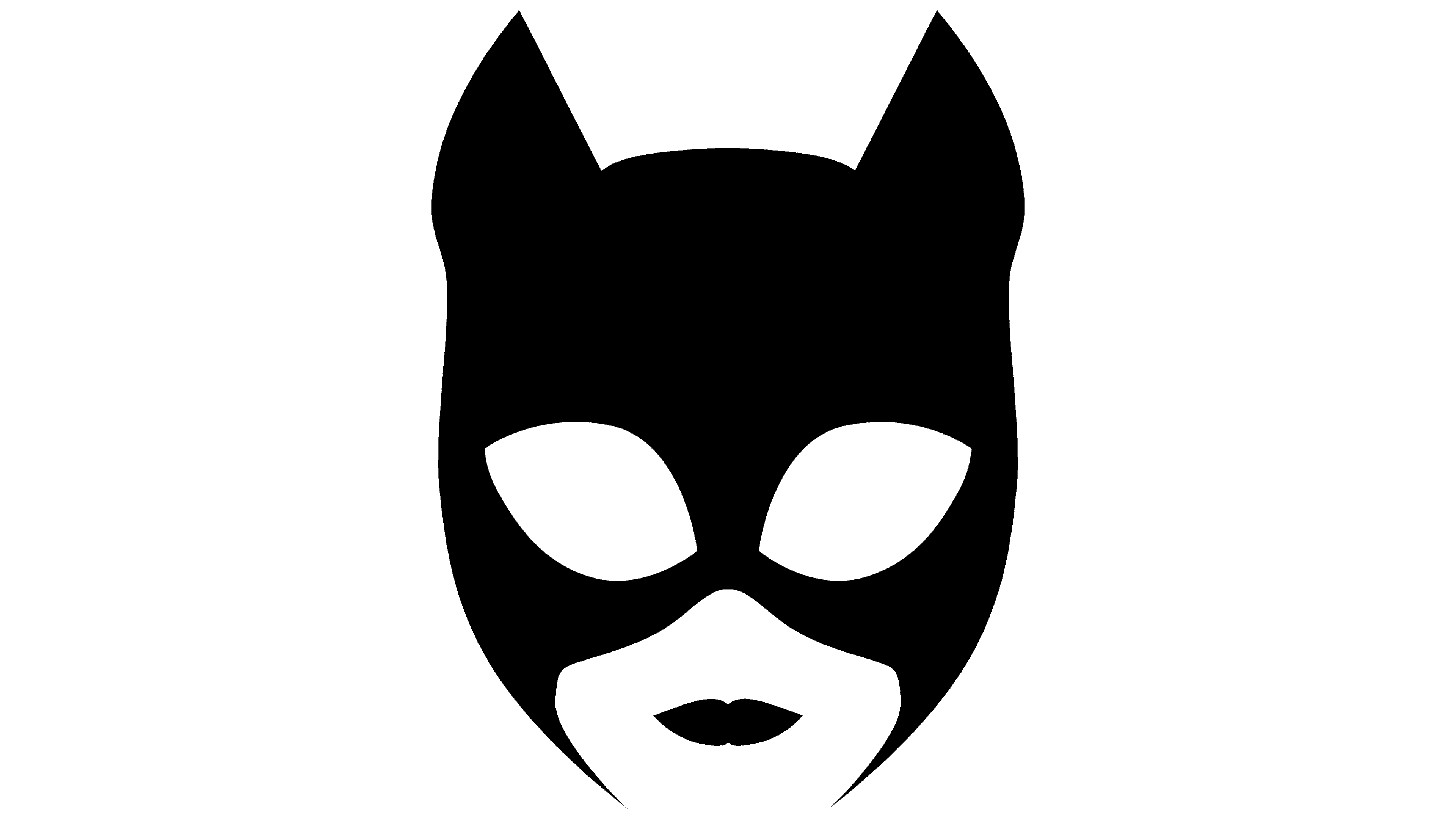
Catwoman Logo PNG
The Catwoman logo embodies a heroine who follows her own path, balancing independence with danger. Her image blends elegance, predatory instinct, and unpredictability, making her a mysterious, captivating figure in any story.
Catwoman first appeared as “The Cat” in Batman #1 (1940), created by Bill Finger and Bob Kane for DC Comics. Originally introduced as Selina Kyle, a jewel thief disguised as an elderly woman, she soon became closely linked with Batman as an adversary with complicated motives.
By 1942, her identity evolved with the debut of a feline-inspired costume. However, her popularity declined in the 1950s because the Comics Code Authority enforced strict censorship. Catwoman’s revival came in the 1960s, with Julie Newmar and Eartha Kitt portraying her in the Batman TV series, restoring her cultural prominence.
The 1970s and 1980s deepened Selina Kyle’s character, shifting her role from mere villainy to a complex anti-hero. Michelle Pfeiffer’s memorable performance in Batman Returns (1992) significantly shaped her image.
From 2002 to 2008, Catwoman starred in her own comic series, allowing for a deeper exploration of her personal conflicts. A 2004 standalone film starring Halle Berry notably departed from DC Comics’ original depiction. Anne Hathaway brought a more grounded portrayal to Selina Kyle in The Dark Knight Rises (2012).
In 2022, Zoë Kravitz portrayed her in The Batman, reintroducing Catwoman to modern audiences. As of 2024, Catwoman remains a central character in DC Comics, appearing frequently across comics and media and demonstrating ongoing adaptability and influence.
Meaning and History

What is Catwoman?
This comic book character is renowned for her cunning, agility, and ability to escape even the most challenging situations. A skilled thief and protector of the weak, she follows her own rules and refuses to conform to the law or the criminal underworld. Her signature look features an elegant suit adorned with cat ears and claws, and she has a complicated relationship with the city’s legendary protector. Catwoman has become an integral part of pop culture, appearing in films, TV series, and video games, remaining one of the most charismatic figures in her universe.
Old

Warner Bros. developed the visual identity for the Catwoman film, starring Halle Berry, in collaboration with DC Entertainment. The team created a symbol that reflects the heroine’s aggressive, predatory nature, emphasizes her connection to the feline world, and conveys the aesthetics of an anti-heroine who stands in opposition to familiar DC comic characters.
The Catwoman logo design was based on a single expressive mark. Three torn lines form the letter “W.” They resemble a panther’s claw marks, placing the viewer in the context of wildness and independence. The symbol is read as a metaphor of strength, danger, and aggression. It emphasizes the character’s transformation from an ordinary woman into a warrior heroine.
For the “claw” strokes, red was applied to express passion, cruelty, and unpredictability. It contrasts with dark backgrounds, making the mark feel like a warning and heightening emotional tension. The limited color system does not weaken the composition; instead, it makes the accent harsher and more concentrated.
Typography played a secondary role and did not seek to compete with the symbol. The font belonged to the sans-serif grotesque category, closely resembling Gotham or Helvetica Neue in form. Its geometry was minimalist, and its neutrality kept the composition balanced while letting the “W” symbol take the lead.
The aggressive graphic style and torn contours matched the film’s overall artistic direction. However, because audiences and critics disliked the picture, Warner Bros. and DC later abandoned this approach in projects featuring the Catwoman heroine.
New

In the updated Catwoman logo, the key focus was integrating a new symbol into the wordmark. The inscription is stretched horizontally, and the lower line of the composition is slightly concave. The concavity elongates the outer letters “C” and “N”, giving the central symbols a more compact, refined appearance.
The typographic base relies on a strict, geometric sans-serif. The letter lines are thin, with evenly thick strokes. Smooth curves and elongated proportions make the inscription’s silhouette elegant while conveying a hidden energy that echoes the heroine’s image, combining grace and strength.

Inside the letter “O” in the center of the word, a new symbol appeared. It is a diamond enclosed in a circle. The symbol works as a semantic accent. It evokes Catwoman as a skillful thief associated with jewels and luxury.
The coloring is kept in a monochrome palette. The dominant black shade emphasizes the composition’s restraint and rigor. Using a single color creates a premium feel and heightens the character’s mystery.
The diamond in the inscription links the visual concept to the heroine’s character and storyline. It reflects Catwoman’s features and symbolizes seduction, luxury, and hidden strength.