


 Dayton Dragons Logo PNG
The Dayton Dragons logo reflects the athletic and energetic character of the baseball club. Dragon imagery showcases the team’s strength and dynamism, underscoring its prominent position within the region’s sports community.
The Dayton Dragons originated as the Rockford Reds, a Midwest League affiliate of the Cincinnati Reds that averaged about 1,000 spectators per game in 1999. Mandalay Baseball Properties moved the franchise to Dayton, Ohio, a city without professional baseball for nearly 50 years. The Dragons name was announced on May 3, 1999, after 13-year-old Richard Bourke won a naming contest.
Construction of the $22.7 million Fifth Third Field began on April 26, 1999. When ticket sales opened on March 18, 2000, the Dragons became the first Minor League Baseball club to sell out an entire season before its opening game. The home debut followed on April 27, with Magic Johnson and Johnny Bench in attendance as Dayton defeated the Cedar Rapids Kernels 4-3.
Adam Dunn and Sean Casey passed through the roster in the first season, followed in later years by Joey Votto, Jay Bruce and Billy Hamilton, all future MLB players. Hamilton set an organizational record for stolen bases in 2011. Meanwhile, every home game remained sold out. In 2008, the streak passed the Chicago Bulls’ run of 610 sellouts. On July 9, 2011, the Dragons reached 815 consecutive sellouts, passing the Portland Trail Blazers for a professional sports record.
The run reached 1,000 games on May 10, 2014, and 1,500 by August 2023. Fifth Third Field became Day Air Ballpark in 2020 under a new naming agreement. In March 2025, the club marked its 25th anniversary with an exhibition against its major-league parent in front of nearly 9,000 spectators.
Meaning and History
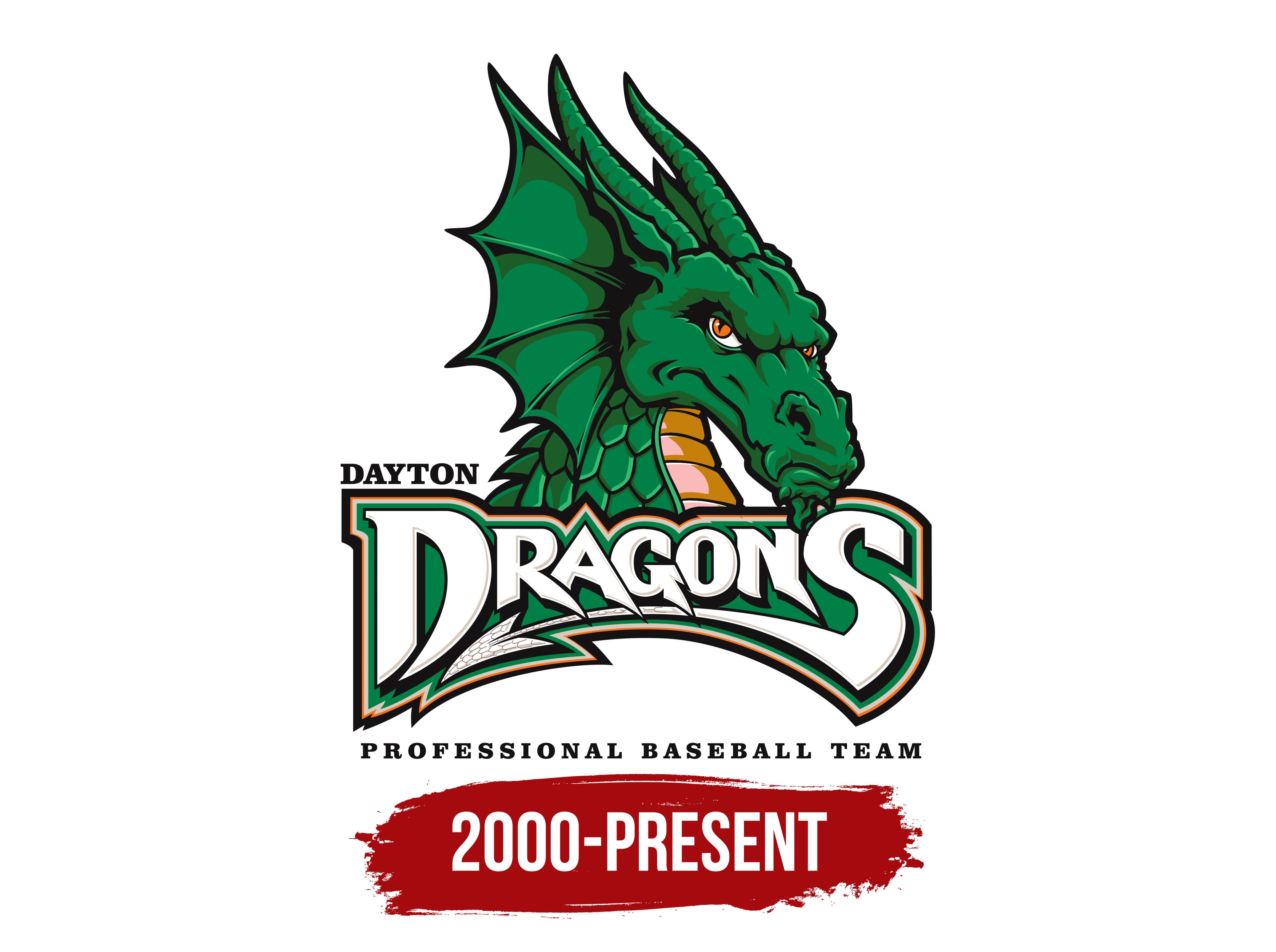
What is Dayton Dragons?
It is a High-A baseball team from Dayton, Ohio, playing in the Midwest League as the Cincinnati Reds’ farm team. The team holds the record for the longest consecutive sell-out streak among professional sports teams in North America. Home games are played at Day Air Ballpark in downtown Dayton, almost always filled.
2000 – today

Studio Simon, a Louisville-based sports design specialist, created the Dayton Dragons logo. The author, studio founder Dan Simon, had previously worked on graphics for the Los Angeles Dodgers. The logo was developed specifically for the new Dayton, Ohio, team, which replaced the Rockford franchise and became an affiliate of the Cincinnati Reds.
The visual composition is dominated by a detailed and expressive dragon rendered in a realistic style. The creature is depicted with a serious, even menacing expression, deep-set orange eyes, and pronounced facial features. Its head is adorned with horns, membranous wings, and textured scales, creating a sense of strength and motion.
The typographic portion of the logo features a large “DRAGONS” wordmark in a custom gothic typeface with medieval elements. The letters have sharp points resembling claws and spikes, and the “S” is visually stylized as a dragon’s tail. Above the main wordmark is the city name, “DAYTON,” set in a compact sans-serif font, and at the bottom is the phrase “PROFESSIONAL BASEBALL TEAM” in a small neutral typeface, adding formality to the composition.
The color palette features dark green, black, white, and golden sand tones. The dragon’s green color symbolizes the team’s power and energy, while orange accents on the eyes and chest intensify the emotional impact, evoking a combative spirit. Black outlines and white details create a strong contrast, enhancing legibility across scales.
This graphic mark was originally intended as a serious and convincing image, avoiding the humorous motifs often found in Minor League Baseball.
Cap emblem

The alternate Dayton Dragons emblem is a compact, impactful mark designed specifically for use on baseball caps and in limited spaces on merchandise and digital products.
The emblem features a stylized “D” that represents the city of Dayton and serves as a visual extension of the dragon mascot. The letter is drawn in a bold, decorative style with Gothic influences. Its main vertical stroke is outlined in black and white, adding depth and emphasizing graphic contrast.
A distinctive feature of the design is the lower part of the “D,” which transitions smoothly into a dragon’s tail with detailed green scales and a pointed tip. This adds motion, energy, and a sense of life to the composition while embodying the brand’s mythical character. The green shade reinforces the team’s core visual identity, symbolizes strength and energy, and provides confident contrast on both light and dark backgrounds.
The emblem is a strong, memorable symbol that blends sports aesthetics with fantasy imagery, making it popular among the team’s fans.