


 Nashville Sounds Logo PNG
The Nashville Sounds logo symbolizes the baseball team’s close connection to Nashville’s musical heritage. The emblem’s design reflects the region’s cultural legacy, highlighting the harmony between sports and traditional musical genres.
Nashville Sounds began in 1978 as a Minor League Baseball franchise linked to the Cincinnati Reds. The name came from the “Nashville Sound,” a country music style developed in the city during the 1950s and 1960s. The team played home games at Herschel Greer Stadium, built quickly for the opening season and used for decades despite its hillside location and limited facilities.
The club changed partners several times within Major League Baseball. Its affiliations included the New York Yankees, Detroit Tigers, Chicago White Sox, and Pittsburgh Pirates. During the Pirates period, Nashville set an attendance record in 1990, showing that local support remained strong despite repeated changes in player development systems.
In 2005, while serving as the top farm club of the Milwaukee Brewers, the Sounds won the Pacific Coast League championship. Later agreements with the Oakland Athletics and the Texas Rangers brought new prospects, coaches, and development plans to Nashville, reflecting the regular movement of minor-league affiliations.
The team later left Greer Stadium for First Horizon Park, built on the former site of “Sulphur Dell”, one of the oldest baseball grounds in the American South. The new venue offered modern facilities and returned professional baseball to a historic city location. The relocation ended the long Greer Stadium era. In 2023, Nashville renewed its partnership with Milwaukee, restoring the affiliation under which it won the 2005 championship.
Meaning and History
What is Nashville Sounds?
It is a Triple-A baseball team based in Nashville that competes in the International League. Throughout its history, the club served as a farm team for the New York Yankees, Milwaukee Brewers, and Texas Rangers. Its name references Nashville’s musical heritage as the country music capital of the U.S. Home games are played at First Horizon Park. Notable former players include Don Mattingly, Ryan Braun, and Prince Fielder.
1985

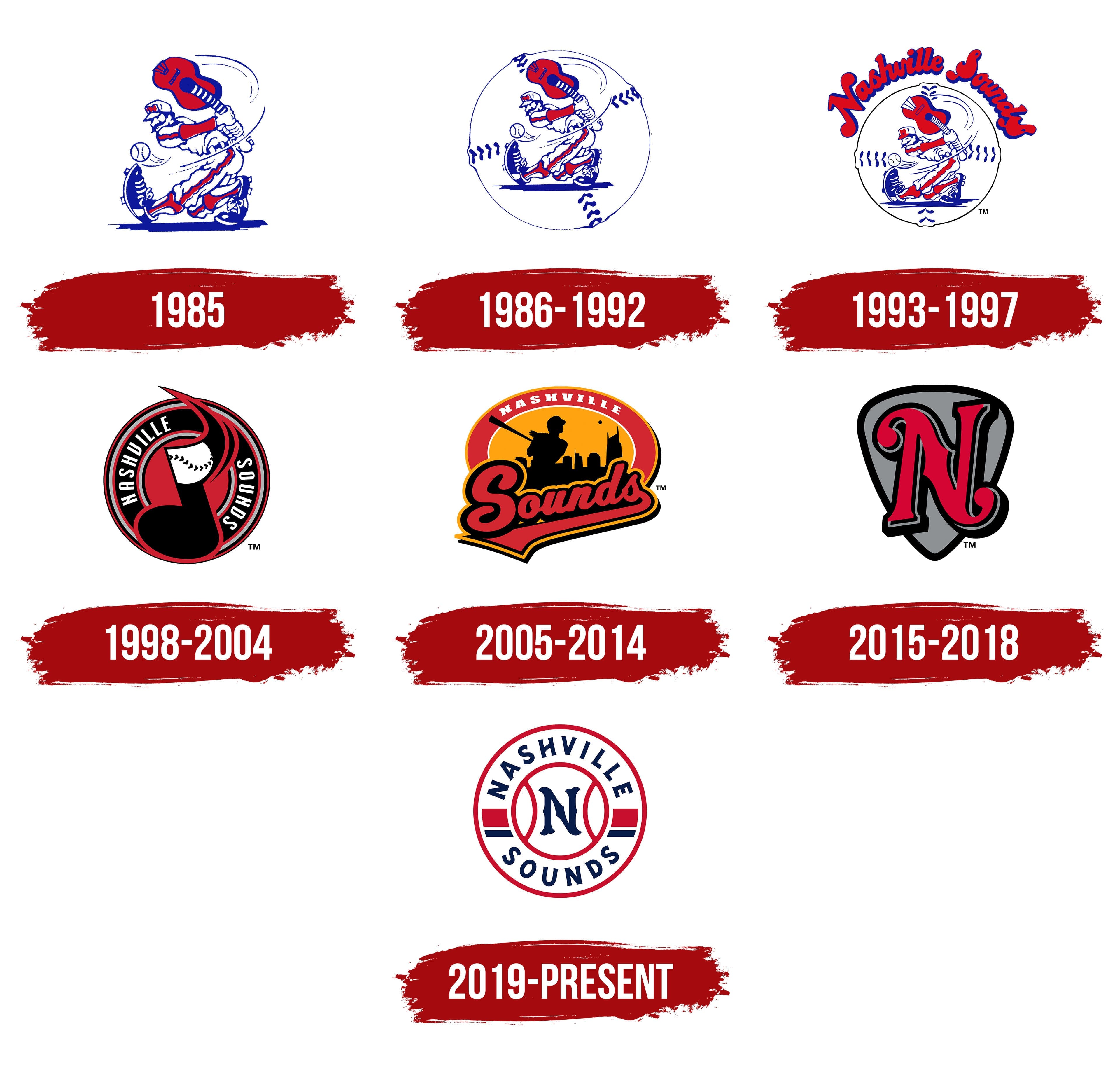
The image of a baseball player named “Slugger,” presented in the 1985 Nashville Sounds logo, depicts a sports character combined with the city’s musical symbolism. The color palette is limited to red and blue, which contrast and are emphasized by a neutral white background, devoid of decorative elements or frames.
The character is stylized as a mustached baseball player, swinging not a traditional wooden bat but a deep red acoustic guitar. This replacement of sports equipment with a musical instrument metaphorically reflects Nashville’s identity as a recognized center of country culture. The guitar symbolizes the city’s musical identity, and its integration into a baseball context creates a vivid visual pun, highlighting the connection between sports and music in local culture.
1986 – 1992

After the Nashville Sounds transitioned from a partnership with the Cincinnati Reds to one with the Detroit Tigers in 1986, the club decided to refresh its style by developing and complicating its previous symbol. Keeping the key motif of the baseball player with a guitar instead of a bat, the updated emblem acquired a more complex structure and additional symbolic depth.
The player is shown in a pose suggesting a swing before hitting the ball. The visual metaphor lies in replacing sports equipment with a guitar, emphasizing Nashville’s uniqueness as the capital of country music. The character is placed inside a new compositional element: an oval contour stylized as a baseball. The contour is drawn with thin blue lines turning into stitches. These are heavy V-shaped seams resembling arrowheads. Such elements draw attention to the athlete’s figure, enhancing the dynamism of the overall composition.
The introduction of the baseball framing had a dual symbolic meaning. First, it reflected the team’s association with baseball; second, it strengthened the club’s identity connection to Nashville’s cultural character. The emblem became a kind of illustration, figuratively conveying the blend of the city’s musical and sporting spirit, marking the first openly musical visualization in the history of Nashville Sounds branding.
The logo’s color scheme was minimalist, featuring deep blue on a white background with red accents. The blue shade on the ball’s stitches and outline gave the image a sense of neatness and balance.
1993 – 1997

The updated 1993 Nashville Sounds emblem, associated with the club’s transition from the Detroit Tigers to the Chicago White Sox as its partner, evolved from the previous version, adding several elements that made the overall composition more complex. At the center remained the familiar image of a baseball player who, bordering on caricature, energetically swung a bright guitar instead of a standard bat. The character was placed over a circular shape resembling a baseball. Still, unlike the earlier minimal version, it was executed in a decorative style. The ball’s stitches became more elaborate, enriching the emblem’s details and giving it a festive character.
A fundamental change was the inclusion of a typographic element, the inscription “Nashville Sounds.” Executed in large red italic type with a deep blue shadow, the inscription was integrated into the upper part of the composition. The font evoked the retro aesthetics of the mid-20th century, reminiscent of signs in American concert halls or of theatrical posters from that era. Characteristic smooth curves, emphasized by serifs, reinforced the logo’s connection to Nashville’s cultural and historical context.
The logo’s color palette became richer through the interplay of red and blue shades against a white background. The contrasting relationship of colors made the overall composition more dynamic. At the same time, the figure of the player with the guitar received additional emphasis from the volumetric typography above it.
1998 – 2004

After signing a partnership agreement with the Pittsburgh Pirates in 1998, the Nashville Sounds revised the visual style of their emblem, abandoning the illustrative character of previous years. The new design featured an abstract symbol: a musical eighth note combined with a baseball image. The baseball shape was integrated into the note, and its stitches, drawn neatly and symmetrically, reinforced the connection to the sports theme.
The logo was executed in a minimalist and geometric style characteristic of sports identity. The overall structure was strict and symmetrical, placed inside a double circle that visually focused attention on the main symbol. The club’s name was split into two halves and positioned along the circumference of the circle. For the lettering, a grotesque industrial sans-serif font with elongated proportions was chosen.
The color palette was narrowed to a strict combination of black, white, and red, emphasizing the business-like direction of the new identity. The palette shifted away from earlier playfulness, highlighting the seriousness and universality of the club’s image.
Plan B Branding (later Brandiose) created the new logo. The shift in visual style reflected the team’s evolution toward minimalism and abstraction while maintaining its traditional musical heritage. The eighth note with a baseball became a symbolic union of sports and music, but in a new form better suited to the digital age and simplified visual formats.
2005 – 2014

The Nashville Sounds’ move to the new First Tennessee Park (formerly Greer Stadium) in 2005 was accompanied by an update of the club’s brand and a shift in its visual concept. After the abstract forms of 1998, the club returned to figurative symbolism, using the image of a baseball player for the first time in seven years, albeit without any cartoon exaggerations.
The player is depicted as a black silhouette captured at the moment of completing a powerful swing. His figure is set against the Nashville city skyline, rendered in black and white. One of the most recognizable elements of the skyline is the famous AT&T tower, locally known as the “Batman Building.” The city silhouette, set against a bright orange background, symbolizes a sunset sky, evoking a light nostalgia and lending the logo emotional warmth.
The new visual composition was built around an oval shield, with the upper part featuring the word “Nashville.” The text was written in white capital letters in a sans-serif display font that referenced mid-20th-century baseball tradition through its geometric simplicity and clarity of form. In the foreground, across the oval, was the word “Sounds,” executed in large red italics with a dimensional outline. From the final letter “s”, an extended decorative line was added, creating an effect of motion and continuity of sound that metaphorically emphasizes the team’s name.
The black-and-orange palette created visual contrast, highlighting the club’s professional character. The player’s restrained silhouette made the emblem more universal, suitable for use not only in sports but also in corporate contexts.
The emblem was created by Rickabaugh Graphics, a studio renowned for its close collaboration with Minor League Baseball teams and for identity work that focuses on fans and the retail market. This period of the Nashville Sounds’ visual history lasted almost ten years. It became significant in reflecting the club’s connection with the city, combining sports symbolism with recognizable local landmarks.
2015 – 2018

In 2015, with the opening of the new First Tennessee Park, the Nashville Sounds reintroduced a musical theme in their branding, unveiling a redesigned logo developed by Brandiose of San Diego. The new emblem was built around the symbolism of a guitar pick, with its recognizable smooth shape, gray tone, and restrained contouring. This form avoided clichés, such as traditional instrument imagery, and instead created a refined musical image.
In the center of the pick was a detailed letter N, forming the core of the composition. The letter was executed in a custom decorative style, incorporating elements of late 19th and early 20th-century typographic aesthetics. The style of the symbol echoed slab-serif and poster fonts of the American West, with flourishes, contrasting stroke thicknesses, and a striking shadow outline that gave the logo depth and a retro character.
The mark’s palette was minimalist, consisting only of red, gray, and black. Red in the letter design symbolized the team’s energy and dynamism, while the gray background emphasized the industrial motifs of the modern urban landscape.
Brandiose designers conducted research in Nashville, immersing themselves in the local culture and gathering characteristic visual elements to reflect the city’s spirit and style in the final emblem. As a result, the logo became an autonomous symbol that functioned effectively across different formats: from caps and uniforms to tickets and souvenirs. Stylistically, the emblem evoked associations with vintage tobacco cards and classic signs, underscoring the baseball club’s historical continuity and cultural significance in Nashville.
2019 – today

In 2019, the Nashville Sounds once again revised the visual concept of their identity, transitioning from illustrative solutions to a concise heraldic style that reflected their sporting tradition and local character. The new emblem, developed by Brandiose, introduced updated typography and structure, united in a single circular mark with a restrained color palette: the classic combination of dark blue, red, and white.
The main accent of the composition is the letter N, executed in a Gothic style that references American typography of the late 19th century, characteristic of posters, theatrical playbills, and music club signs in the southern states. Decorative strokes, elongated forms, and the distinctive plasticity of the glyph reinforce associations with circus posters and retro signage, adding additional cultural meaning to the symbol. The letter is placed inside a central field outlined with the stylized contour of a baseball, creating a direct connection with the sport.
Around the perimeter of the central field runs another circle with two horizontal segments in red and blue, between which the club name is written in uppercase sans-serif type along the curve. The contrast between the decorative central letter and the simple surrounding text enhances visual depth.
The choice of a limited palette dominated by national colors was intended to highlight the traditional character of American baseball culture and the patriotic undertone typical of many team identities. The emblem can function as a complete form resembling a classic badge or crest. It can also be transformed into a standalone letter N, increasing its versatility and enabling use in a wide variety of contexts.
