 ESET Logo PNG
The ESET logo conveys the company’s reliability and professionalism. Its concise design highlights the effectiveness of protective solutions and the brand’s technical expertise.
ESET began in Bratislava in 1987, when programmers Miroslav Trnka and Peter Paško investigated the Vienna computer virus after being asked to help with a malware problem at a Slovak nuclear power plant. They created NOD, short for “Nemocnica na Okraji Disku,” a name inspired by a local television series. They distributed early copies on floppy disks because private business was restricted in communist Czechoslovakia.
On January 1, 1992, Trnka, Paško, and Rudolf Hrubý formally established ESET, spol. s r.o. The name referred to the Egyptian goddess Isis, rendered as Eset in Slovak. NOD became its first commercial antivirus for MS-DOS, while STOPVIR had already been sold in Austria. In 1998, ESET introduced NOD32 for Windows and entered Virus Bulletin testing, earning its first VB100 award with full detection and no false positives.
By 2005, ESET products were sold in more than 100 countries. ThreatSense.Net, later renamed ESET LiveGrid, arrived in 2007 and used anonymous data to identify emerging threats. In 2011, Richard Marko replaced Trnka as CEO, while the company expanded into Mac OS and mobile security and created the ESET Foundation.
ESET launched the WeLiveSecurity research blog in 2013 and later worked with Europol and Microsoft against major botnets. In 2019, it joined the Google App Defense Alliance to help protect Google Play users. In March 2022, ESET ended operations in Russia and Belarus following events in Ukraine.
Meaning and History
What is ESET?
It is a Slovak company that develops software for digital security against malware and cyber threats. Its products are known for their fast performance and minimal system load. The company was the first to implement behavioral analysis for threat detection.
1988 – 2002

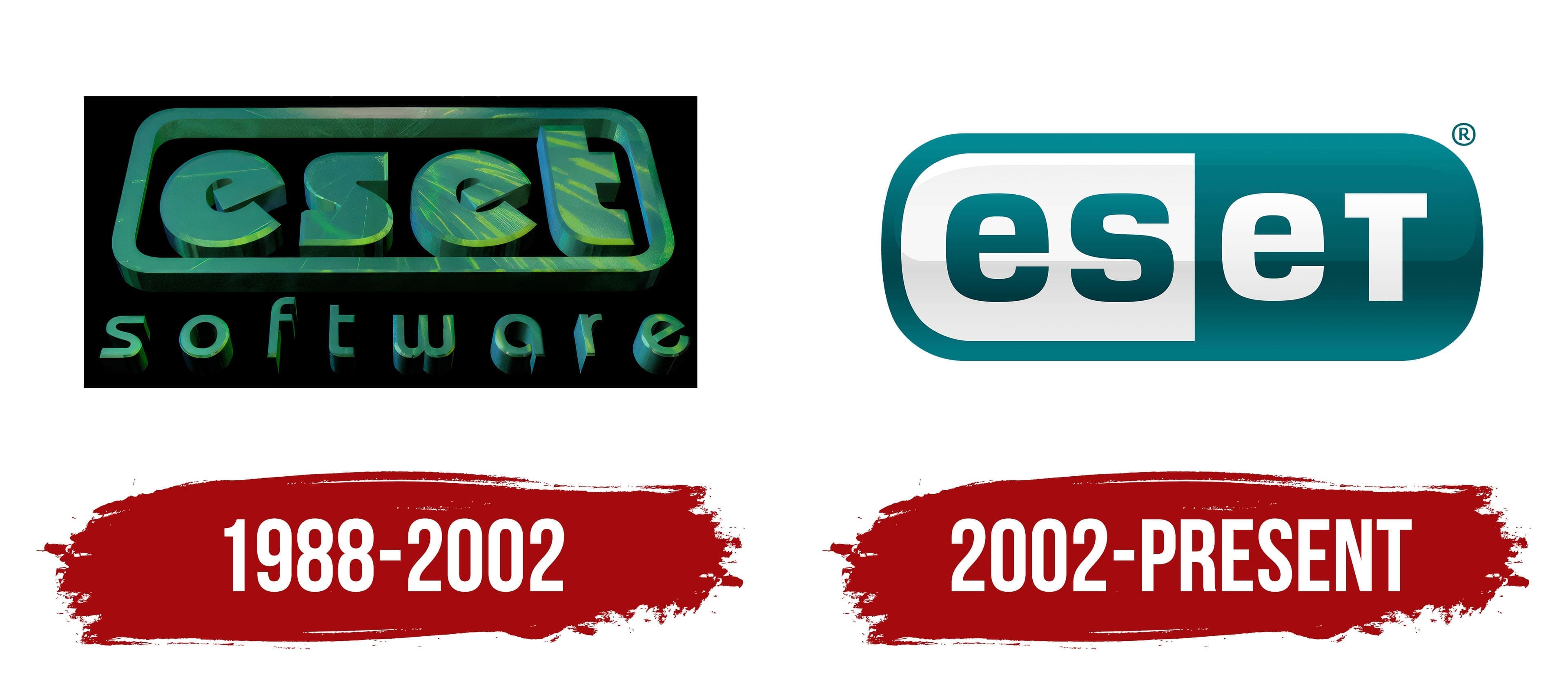
The ESET company logo emerged in the late 1980s, coinciding with the brand’s establishment in the digital security and antivirus software market. Voluminous, high-tech forms characterized the visual style of this period, and ESET’s first emblem reflects this aesthetic.
Structurally, the logo consists of two levels. The upper block contains the name “eset” placed inside a rectangular frame with smoothly rounded corners. The lowercase letters are rendered in a three-dimensional style with a metallic texture and glossy highlights, visually conveying reliability and technological superiority. The character outlines are neatly rounded, geometrically precise, and slightly forward-slanted, adding a sense of dynamism and progress to the composition.
The second level features the word “software,” executed in a similarly stylized font. Letter spacing is increased, and the characters are evenly arranged as separate three-dimensional elements. This part complements the main block and highlights the company’s affiliation with the software segment.
The color palette features green and bluish shades, with gradient transitions that mimic the appearance of glass or translucent plastic. Green has historically been associated with protection and safety, aligning with the company’s antivirus and digital security offerings.
The typography is a technological sans-serif font, similar to Eurostile and Microgramma, both characteristic of late 20th-century graphic design. The elongated proportions and smooth yet slightly faceted letter surfaces make the emblem typical of the era’s high-tech visual language.
2002 – today

The updated ESET logo was introduced to mark the company’s entry into the international market. It marked a shift toward minimalism and a universal graphic style designed for the digital environment.
The composition is based on a horizontally elongated rectangle with smooth, rounded corners that visually resembles a capsule. The shape is divided exactly in half vertically, creating mirrored color sections. The left side features a white background with turquoise “es” letters, while the right side displays a deep turquoise shade with white “et” letters.
The turquoise tone includes a subtle glossy gradient. This palette was chosen deliberately, as turquoise is associated with safety, reliability, and technological sophistication, aligning with the company’s profile in information security and cybersecurity.
The logo’s font is a custom geometric sans serif, reminiscent of Neo Sans and Myriad. Its smooth, wide letterforms feature balanced proportions and thicker strokes, ensuring excellent legibility at any scale. Symmetrical character rounding enhances visual comfort. At the same time, the interplay between lowercase and uppercase elements, particularly the “es” and “et,” introduces a clear hierarchy and a sense of internal dynamism.
The brand’s visual concept references digital buttons and interfaces, highlighting ESET’s software and technological nature. The “capsule” metaphor conveys protection and reliability, analogous to the digital barrier the company creates for its users.
This logo is integrated into ESET’s corporate identity system. It is used across all communication channels, from digital products and the website to printed materials and advertising. Thanks to its graphic simplicity and well-considered typography, the ESET emblem is well-received in the international market. It is recognized as a symbol of digital protection.