 Krungthai Bank Logo PNG
Financial transactions in Thailand include payments, accounts, loans, and business services that are processed through banks integrated into the state system. These institutions handle a wide range of tasks, from everyday transactions to working with government programs. The Krungthai Bank logo represents a bank that provides financial services to private clients, government employees, and entrepreneurs, participating in the country’s economy at various levels.
Krungthai Bank was founded on March 14, 1966, by a decision of the Government of Thailand. It was established through the merger of Kaset Bank and Monton Bank. The Ministry of Finance subordinated the institution, and its symbol became the mythological bird Vayupaksa. The bank opened its first branch on Yaowarat Road in Bangkok.
In 1982, the bank expanded internationally and opened an office in New York. By 1988, the network included 288 branches. The 1987 acquisition of Asia Trust Bank allowed Krungthai to rank second among Thai banks by assets.
On August 2, 1989, Krungthai Bank became the first state enterprise to list its shares on the Stock Exchange of Thailand. In 1994, the bank became a public company.
The 1997 financial crisis seriously affected the bank’s operations. By 1999, Krungthai had acquired the assets of bankrupt institutions and reorganized. In 2001, Islamic banking began. In 2003, the bank became the first commercial institution to resume dividend payments.
In 2007, the bank launched mobile banking. By 2010, the bank completed integrating its information systems. In 2011 and 2012, the bank participated in financing infrastructure projects.
In 2013 and 2014, the bank developed investment services. In 2015, Krungthai Bank ranked among the top three banks in the country. In 2016 and 2017, the bank introduced digital platforms and mobile applications.
In 2018 and 2019, the bank participated in the economy’s digital transformation. It developed blockchain and artificial intelligence technologies. By the end of 2019, the network included 850 branches.
In 2020 and 2021, Krungthai Bank supported the economy by providing preferential loans and developing international services. In 2022, total assets reached 3.325 trillion baht. During this period, the bank opened branches in Cambodia, Laos, and Myanmar.
In 2023, the bank served more than 24 million clients. It had 920 branches and 7,000 ATMs. In 2024, assets totaled 3.776 trillion baht, profit reached 43.85 billion, and the customer base grew to 24.5 million.
Krungthai Bank is preparing to launch a virtual bank. It is also considering a merger with TTB Bank to create a major Asian financial center.
Meaning and History
What is Krungthai Bank?
The second-largest commercial bank in Thailand, headquartered in Bangkok, was created by the government to serve public-sector employees. The Ministry of Finance controls it and owns more than half of the shares. After the 1990s crisis, the government bought back problematic assets to maintain stability. The network includes over 1,000 branches and representative offices in China, the United States, India, and Cambodia. Assets exceed 3 trillion baht. The bank was the first in the country to establish an ATM network, develop the KTB Netbank platform, and offer Islamic financial products in cooperation with AXA.
1966 – 2011
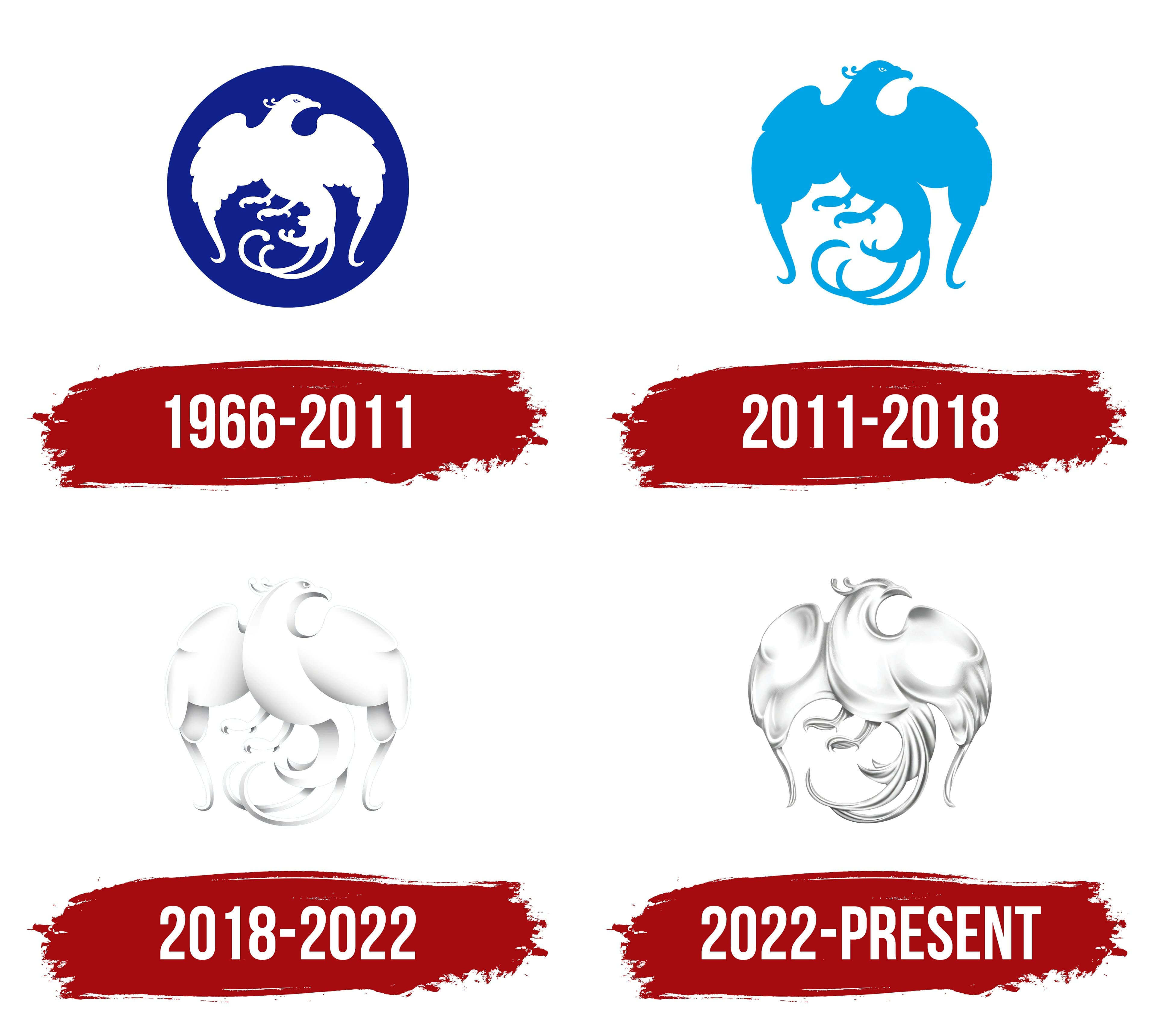
Vayupak adopted Krungthai Bank’s identity, including the emblem of Thailand’s Ministry of Finance. The new institution began operations on March 14, 1966, following the merger of Kaset Bank and Monthon Bank. The bank adopted the Ministry of Finance symbol featuring the mythical bird. It reflected the organization’s origins and government-owned status. The Vayupak continued to represent the bank in later years.
After the merger, the institution became Krung Thai Bank Limited. Its first branch opened on Yaowarat Road in Bangkok. The Thai word กรุง is pronounced “krung” and means “city,” “capital,” or “metropolis.” “Thai” refers to Thailand. The name linked the bank to the country, while Vayupak indicated its affiliation with the Ministry of Finance.
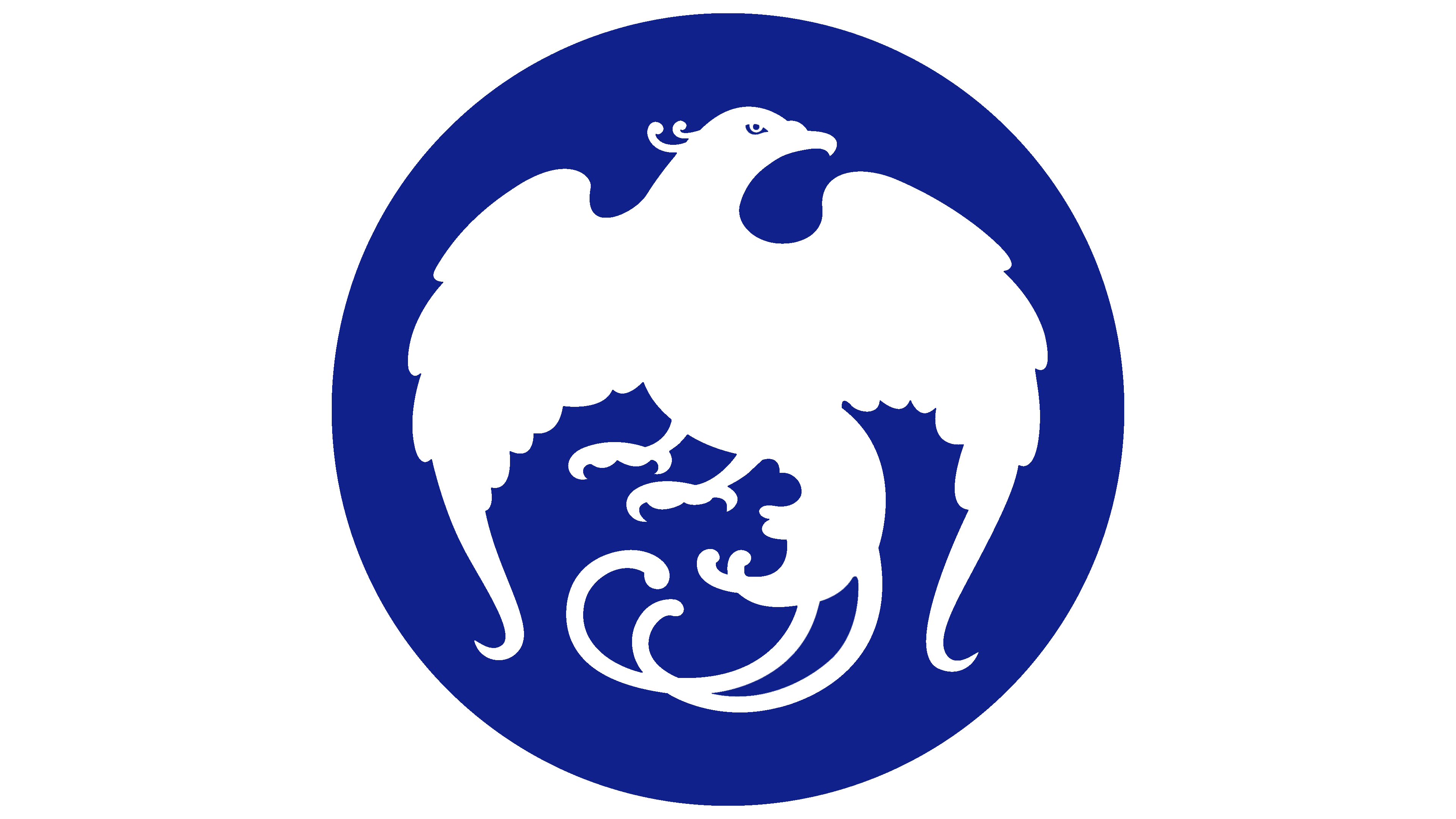
A dark blue circle formed the basis of the 1966 composition. Inside it was a stylized white bird with outstretched wings. The rounded edges of the wings extended outward, while long feathers pointed downward. A curled tail composed of several elongated twisting lines appeared beneath the body. The dark circle provided a background for the detailed white ornament.
The Vayupak’s head appeared in profile. Its curved beak pointed downward, while the eye faced forward. A curl resembling feathers or a crest appeared above the beak. The hind legs and claws were curved, with decorative terminals. Lines forming the mane, tail, wings, and limbs created a detailed depiction of the mythical creature from Thai tradition.
In some applications, the circular emblem appeared alongside the bank’s name in Thai and English. The bird represented Krungthai Bank’s connection with the Ministry of Finance and preserved the government origins of its corporate identity. Thai mythology describes the Vayupak as a creature that feeds on wind.
2011 – 2018
In 2011, the Vayupak was removed from the dark blue circle that had served as the previous emblem’s background. A freely positioned light blue figure replaced the circular enclosure. Krungthai Bank associated the open structure with free flight and flexibility. Moving away from the enclosed form became part of the updated concept.
The silhouette retained broad symmetrical wings extending upward and outward. Their rounded edges flowed into soft curves, creating a streamlined upper section with eagle-like features. The bird’s head appeared in profile, with its curved beak pointing downward. A light dot formed the eye. A small decorative curl appeared near the back of the head.
Two curved hind legs with large claws formed the lower section. The long tail consisted of several lines ending in large rounded curls. In the open composition, the wings, legs, and tail were positioned freely without a background. The Vayupak’s structure became more visible, placing the mythical bird at the center of the identity.
The dark blue of the previous logo was replaced by a lighter shade called Sky Blue. Krungthai Bank associated it with modernity, freedom, energy, development, convenience, and friendly customer service. The blue figure appeared lighter than the white bird enclosed within the dark circle. At the same time, the new shade continued the bank’s established corporate color tradition.
The lettering combined even strokes with soft curves. Its structure echoed the rounded lines of the wings and tail, connecting the bank’s name with the Vayupak image. The mythical bird continued to represent Krungthai Bank’s historical relationship with Thailand’s public financial system.
2018 – 2022
In 2018, white, gray, and silver transitions changed the Vayupak’s appearance. The solid blue silhouette became a three-dimensional figure with shadows, highlights, and fewer small details. The bird retained its outstretched wings, profile head, curved beak, and spiral tail. The revision continued Krungthai Bank’s historic visual tradition.
Thai studios Cadson Demak and Samatapaph developed the project. Design director Thanochot Sapruangnam helped create the brand system. Cadson Demak handled the typography. The work covered the bank’s corporate and marketing materials, including coordination of Thai and Latin scripts with the logo lettering.
Vayupak’s body faces forward, while its head turns right and appears in profile. The beak curves downward, a dark line forms the eye, and a curl near the back of the head represents part of the plumage. Symmetrical wings extend upward and outward. Their rounded tips soften the silhouette, while subtle shadows convey the curvature of the feathers.
The lower body transitions into two three-toed legs with large claws. A long tail made of three broad coils appears behind them. The overlapping sections resemble interwoven ribbons. Flowing lines connect the wings, body, and tail in a unified shape. Transitions from white to gray, silver surfaces, and soft highlights create a raised three-dimensional effect.
Krungthai Bank associated the Vayupak with modernity, freedom, enthusiasm, and future development. The bird was linked with knowledge, convenience, and friendly customer service. At the April 2018 shareholders’ meeting, a proposal called for enlarging the Vayupak image on bank cards.
2022 – today
In May 2022, Krungthai Bank’s updated emblem was named “Iron Vayupak.” The Thai name ปักษาวายุภักษ์เหล็ก appeared as part of the communication program “ติดปีกให้ชีวิตคนไทย,” translated as “Giving Wings to Thai People’s Lives.” The bird gained a metallic appearance that developed into the light silver version introduced in 2018.
The flat, light coloring was replaced with rich silver-gray surfaces and smooth transitions between light and shadow. Highlights strengthened the relief, while the body, wings, head, and tail gained distinct detailing. More visible elements gave the bird a sculptural form. The established silhouette with outstretched wings, a curved beak, and a spiral tail remained intact.
Krungthai associated the metallic figure with strength and a commitment to supporting people’s development through financial technology and digital services. The program’s name continued the theme of wings connected with the Vayupak. The three-dimensional treatment expressed the idea through a solid metallic form while preserving the bird’s mythological origins.
The 2022 version continued the emblem’s history, which the bank adopted in 1966. The Vayupak belongs to a class of mythical creatures believed to feed on wind and is used by Thailand’s Ministry of Finance. Its presence in Krungthai’s identity reflects the bank’s relationship with the public sector. The bird represents the entire organization in corporate materials.
Brand guidelines distinguish between Vayupak’s use in corporate settings and on digital products. The Krungthai NEXT application uses the historic bird and maintains a connection with the bank’s broader identity. Paotang has a separate wallet-shaped emblem. The different images distinguish products within the Krungthai system.