 Maine Mariners Logo PNG
The Maine Mariners logo reflects the hockey team’s revival in Portland, Maine. The design emphasizes the club’s maritime themes and regional features, highlighting its connection to local history and the fan community.
The Maine Mariners were established in 2017 after Comcast Spectacor, owner of the Philadelphia Flyers, acquired an ECHL franchise to return professional hockey to Portland. Local supporters chose the Mariners name in a public vote, reviving the identity of the former Portland club that won three Calder Cups. Riley Armstrong became the team’s first head coach.
The Mariners debuted on October 13, 2018, with a loss to the Adirondack Thunder, then earned their first victory a week later against the Newfoundland Growlers. Goaltender François Brassard scored the first goal in franchise history, a rare event in hockey. Maine-born brothers Ted and Brian Hart were among the players who strengthened the team’s local connection.
The club initially served as an affiliate of the NHL’s New York Rangers, receiving prospects from their development system. It later partnered with the Boston Bruins, a geographically closer organization with a large following across New England. Within its division, Maine regularly faced regional opponents including the Reading Royals and Worcester Railers.
In the 2021-22 season, the Mariners reached the Kelly Cup playoffs for the first time. They hosted postseason hockey at Cross Insurance Arena. Former captain Terrence Wallin later became head coach, maintaining continuity between the playing roster and staff. The affiliation with Boston continued through 2025 as the Portland franchise kept developing in minor-league hockey.
Meaning and History
What is Maine Mariners?
It is a hockey club based in Portland, Maine, competing in the ECHL as the Boston Bruins’ farm team. It formed after the Alaska Aces franchise relocated. The name references earlier teams from the city that competed in the AHL and won several championships. Home games are played at the Cross Insurance Arena.
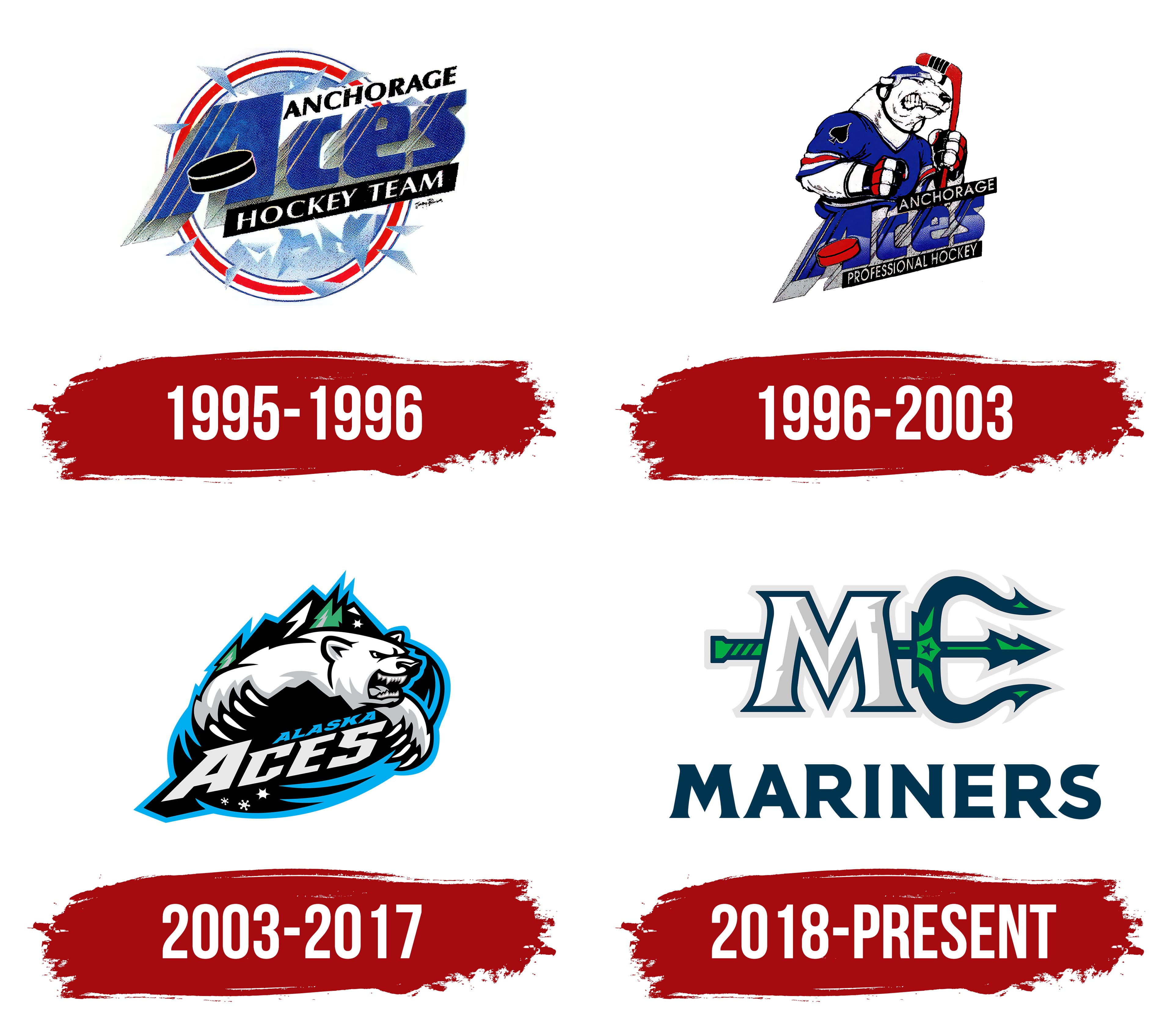
1995 – 1996

The Anchorage Aces logo appeared with the team’s debut in the professional West Coast Hockey League (WCHL). By that time, the club had developed a distinct visual identity, expressed through a palette of four signature colors: black, glacier blue, silver, and white. The choice of these shades symbolically emphasized the brand’s connection to Alaska’s cold climate and the icy nature of hockey, giving the logo a confident presence in the sports environment and a clear association with the region.
The design structure is based on a circle, stylized to resemble an icy surface through gradient transitions of glacier blue tones. The edge of the circle is framed with a double border in red and white, visually reminiscent of a hockey puck or rink markings, reinforcing the emotional link between the logo and the game. A diagonal “Aces” inscription crosses the main circle from above, rendered in extra-bold sans-serif type, adding a sense of athletic dynamism and strength.
A distinctive feature of the typography is replacing the horizontal bar in the letter “A” with a black hockey puck, symbolizing the primary piece of equipment and reinforcing the club’s visual connection to hockey. Additional text elements are placed around the central word “Aces”: above it, “Anchorage” appears in a strict geometric black typeface; below, the phrase “Hockey Team” is set in white uppercase letters on a black panel. This arrangement creates a clear informational hierarchy that states the club’s name and its sport.
The lettering of “Aces” is complemented by thin diagonal silver strokes that imitate the speed of a puck gliding across the ice or skates moving over the arena surface. This gives the logo’s design a sense of motion and high-speed gameplay, evoking associations with sports.
The overall composition reflects the spirit of mid-1990s sports branding, with a focus on visual impact and recognizability on uniforms, banners, and merchandise. The use of saturated, contrasting colors, along with strict typography that combines strength and dynamism, conveys the Anchorage Aces’ ambition and professionalism at the start of their professional hockey history.
1996 – 2003

The Anchorage Aces logo debuted after the club’s first season in the West Coast Hockey League (WCHL) and became an iconic mark for the team until the team joined the ECHL and changed its name to the Alaska Aces in 2003. The new emblem features an aggressive polar bear, visually conveying the team’s athletic character and highlighting its regional identity, which is closely tied to Alaska.
The main visual element is a white bear wearing a blue hockey uniform with red-and-white sleeve accents and a blue hockey helmet. The character is shown in an active attacking stance, holding a red hockey stick. The bear’s figure is drawn with sharp, powerful strokes that enhance the sense of physical strength and aggression. An open mouth with fangs and tense musculature creates an emotional impression, symbolizing the team’s fighting spirit and determination on the ice.
A distinctive feature of this logo was its main character, nicknamed “Boomer,” who became the official team mascot and an important marketing tool. The bear was featured in promotional materials, helping shape the Anchorage Aces’ image in fans’ minds.
The typographic part of the emblem features the club’s name in a straightforward, bold sans-serif font, underscoring the logo’s athletic nature. The word “Aces” is placed diagonally below the bear, in blue with silver strokes that create an effect of speed and movement over ice. Inside the letter “A” is a red hockey puck, adding a bright color accent. Above and below the main inscription are the words “Anchorage” and “Professional Hockey,” both rendered in plain white on a contrasting black background to ensure text clarity.
The logo’s color palette includes rich blue, white, red, and silver, visually evoking ice and the region’s cold climate. The combination of blue and red conveys the energy and dynamism of athletic competition, while white and silver highlight the cool, aesthetic qualities of northern hockey.
This visual design laid the foundation for the team’s identity for years to come.
2003 – 2017

In 2003, after the Anchorage Aces joined the ECHL and changed their name to the Alaska Aces, the club introduced a redesigned logo that reflected the team’s new status and its regional identity. The updated emblem is a complex composition that combines text elements with a symbolic depiction of an aggressive polar bear.
The bear is depicted in a bold, expressive style, with sharp, contrasting lines that emphasize the animal’s strength and energy. Shown in profile with bared fangs and extended claws, it symbolizes the danger and uncompromising nature of hockey battles. The figure is integrated into a hockey-puck-like shape, accented with stylized geometric bursts that evoke a dynamic sense of icy motion.
At the top of the logo are geometric elements depicting mountain and tree silhouettes, highlighting the club’s connection to Alaska and its natural landscape. The inclusion of snowflakes and stars further associates the design with winter and a northern theme, reinforcing its link to local identity.
The typography is arranged in two levels: the upper level, “ALASKA,” appears in a small italic font colored bright glacier blue, emphasizing the regional identity; the lower level, “ACES,” is presented in large, stylized lettering with angular sans-serif glyphs in a silver-white shade. Sharp lines and geometric dynamism characterize the font, visually conveying the speed and energy of hockey.
The logo’s color palette includes glacier blue, black, white, silver, and green. The dominant blue tone evokes ice and cold, underscoring hockey’s nature and the local climate. Black adds visual contrast and strength, while white and silver symbolize ice surfaces and the northern environment. Small green accents represent Alaska’s forests and mountain landscapes.
A notable moment in the club’s history during this period was the arrival of NHL star Scott Gomez in the 2004 season. During the NHL lockout, he joined the Alaska Aces, where he became the ECHL’s top scorer and earned the league MVP award, significantly boosting the team’s recognition and reputation.
The logo became a symbol of a new era for the club, visually reflecting the combination of power, aggressive playing style, and the unique northern character of the Alaska Aces.
2018 – today
The Maine Mariners hockey club logo was unveiled in November 2017 by the Portland-based studio Big Room Studios, marking the revival of the historic brand following the team’s relocation and return to the ECHL for the 2018–19 season. Designer Justin Ververakis developed the visual concept, proposing an original combination of typography and Maine state symbolism.
The logo’s structure combines two elements: the letter “M” and a stylized trident, forming the abbreviation “ME,” the official postal code for the state of Maine. The lettering is set in a custom typeface inspired by a geometric grotesque, featuring characteristics typical of traditional baseball typography: bold strokes, striking proportions, and clear contours. The exact type specification is undisclosed, but its uniqueness and exclusive development for the club are emphasized.
Special attention is given to symbolic details. The central prong of the trident is shaped like a stylized pine tree, representing the region’s nickname, “The Pine Tree State.” The tip of the trident bears the Dirigo star, featured on Maine’s state flag and symbolizing the state motto, “I Lead.” The letter “M” incorporates the outline of a lighthouse, highlighted in silver, referencing the historic lighthouses along the coastline.
The emblem’s palette includes blue, green, and silver, each with a thematic meaning. Blue reflects Maine’s maritime identity, rich coastline, and ocean heritage. Green represents the state’s vast forests, emphasizing its natural environment. Silver is used in the lighthouse and letter outlines, creating visual contrast and evoking hockey’s icy nature.
Despite the historic legacy of the “Maine Mariners” name, the club’s visual concept was reimagined for the first time in decades. The logo contains no direct visual references to the team’s former NHL affiliates, signaling its independence from the new identity. At the same time, the team honors its history and regional culture by placing an adapted emblem of the original AHL club (1977–1992) on the jersey’s shoulders, along with a map of Maine featuring elements from the earlier logo.
This design reflects the club’s intention to strengthen ties with the local community and to create a new visual language that blends sports dynamism with regional symbols. The team’s mascot, Beacon the penguin, was also developed in collaboration with Big Room Studios, complementing the brand’s overall style and enhancing its emotional connection with fans.