 Autodesk Maya Logo PNG
The Maya logo demonstrates the technological and creative orientation of the 3D modeling and animation software. Its strict, modern design reflects professionalism, performance, and the software’s high standards.
Maya began in 1995, when Silicon Graphics merged Alias and Wavefront to create one system for 3D modeling and animation. Its name came from the Sanskrit word for “illusion.” The first version arrived in 1998 with a node-based architecture, allowing artists and technical teams to control scene elements, parameters, and animation through connected structures.
The software gained attention in film production after its use on Disney’s Dinosaur in 2000. It later contributed to The Lord of the Rings, Spider-Man, and Guardians of the Galaxy, where studios needed digital characters, virtual environments, and visual effects integrated with live footage. Maya competed with 3ds Max from Discreet and appeared in Complete and Unlimited editions. The latter added tools for fur, cloth, and simulation. In 2003, the program received a technical Academy Award for its contribution to filmmaking.
A major change came in 2005, when Autodesk acquired the product and placed it within its design and visualization portfolio. Support across Mac, Windows, and Linux widened access for studios, game developers, and independent artists. Integration with the Arnold renderer later strengthened the pipeline for final rendering.
During the 2010s, Maya moved to a subscription model and ended perpetual-license sales. The change drew criticism over recurring costs, while regular updates continued. The software remained in use across visual effects, animation, and game production decades after its 1998 release.
Meaning and History
What is Maya?
It is professional software for creating 3D graphics and complex animations. It is widely used in the film and top-tier game industries. The software creates realistic characters, environments, and destruction effects, and simulates fluids, fire, and cloth. Despite its complexity, Maya allows precise adjustments and process automation through built-in scripts. Its node-based architecture supports customized solutions and functional expansion.
1998 – 2005
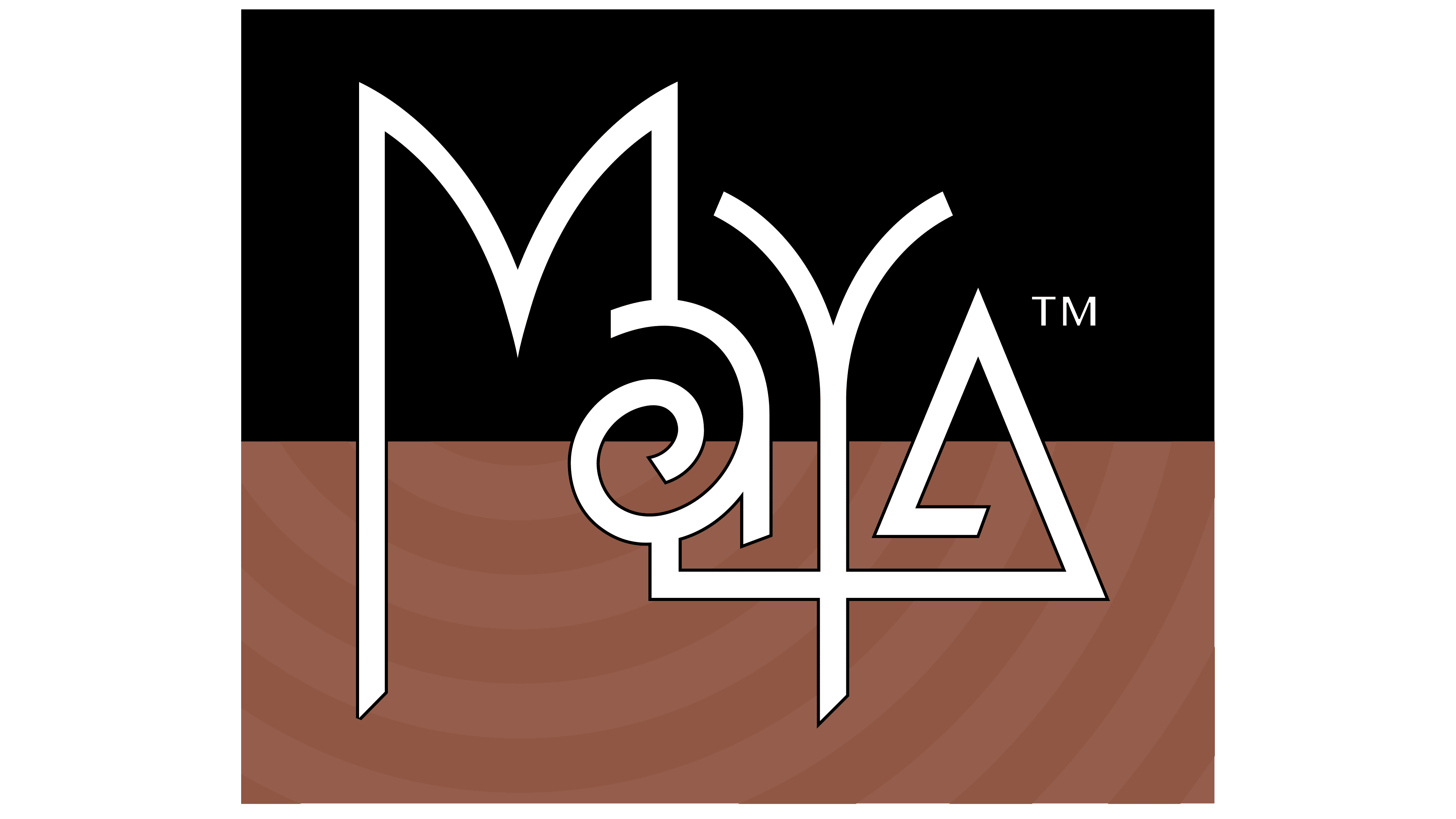
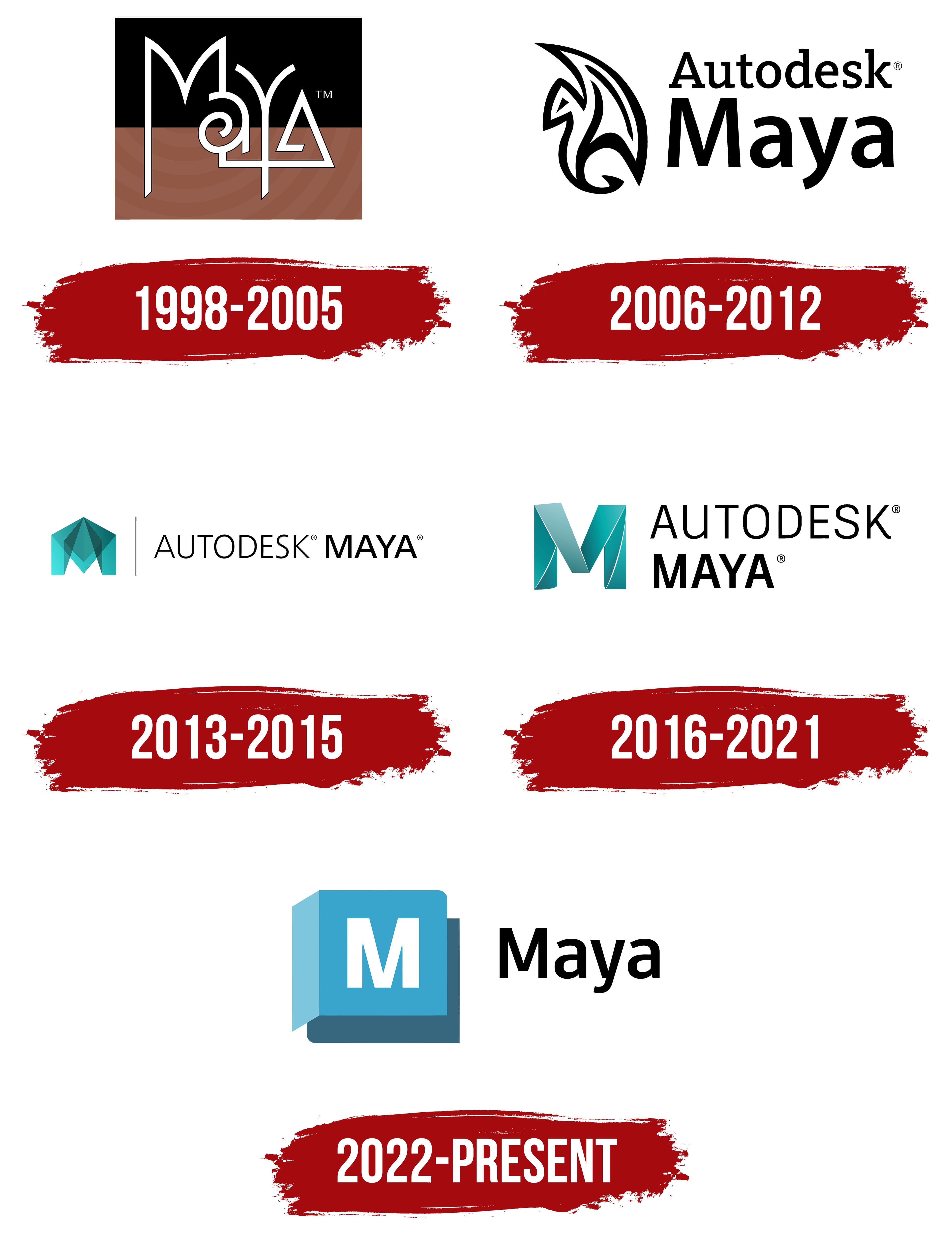
The Maya emblem from Alias|Wavefront, later renamed Alias, exemplifies the integration of ancient cultural allusions with the digital aesthetics characteristic of the computer graphics industry of that time. The visual composition was based on Mesoamerican symbolic motifs, rendered in a technological style through sharp spiral lines and geometric letter stylization. The logo was set against a background with a black upper half and brown tones in the lower half, enhancing thematic immersion in the Maya historical context and emphasizing mystery and depth.
The letters, composed of white strokes with clear, rigid contours, visually resemble stone carvings associated with the traditional writing elements of the Maya civilization. The form of the mark incorporated geometric constructions and concentric circles, resulting in the lower part of the composition resembling a stylized landform or ritual drawing, thereby emphasizing the archaeological roots of the name. This combination of ancient symbolism and technological forms reflected the Maya software’s purpose as a specialized tool for creating digital effects, animation, and 3D content.
Despite Alias| Wavefront’s renaming to Alias in 2003, the visual design of the Maya emblem remained unchanged until Autodesk acquired the brand in 2005. Retaining the original logo emphasized the product’s stability and its perception as a standard in the professional community, where reliability and recognizability took precedence over frequent visual changes.
2006 – 2012
With Maya’s transition to Autodesk in 2006, the program’s visual language underwent a radical revision, marking a departure from its previous ethnic style. In the new version, the logo acquired a neutral and universal character. It was included in the company’s unified identity system for its products, which also included 3ds Max and AutoCAD. The Maya logo became an expression of integration into the Autodesk ecosystem, with stylistic consistency evident across Softimage, Mudbox, and MotionBuilder.
The design featured an abstract emblem composed of smoothly curving lines that formed a silhouette resembling a vertically oriented, wyvern-like dragon. The elongated proportions of the mark and the curves of the lines created an asymmetrical, dynamic composition that conveyed a sense of constant motion. This organically aligned with the product’s functional purpose as an advanced tool for 3D animation and digital effects, where dynamics and transformation lie at the core of workflows.
The typographic element was represented by lowercase sans-serif letters with smooth, slightly rounded contours that reinforced visual unity with the symbol. The inscription “Autodesk Maya” was not always used. In the program interface and on icons, the abstract symbol alone was more commonly encountered, as it could represent the software independently due to the expressiveness of its form.
2013 – 2016
After Autodesk’s rebranding in 2013, Maya received a new mark as part of the company’s overall unification of its identity, which also applied to 3ds Max, Mudbox, and Softimage. The project was overseen by the Autodesk team, in collaboration with Brand Union, an external agency responsible for the global implementation of the updated style. The primary objective of the redesign was to ensure a unified visual perception of Autodesk products and their recognizability across both digital and physical environments.
The emblem was executed as an abstract letter “M” composed of geometric shapes, mainly triangles and polygons, layered over one another in a semi-transparent, multi-layered effect. The palette combined shades of turquoise and green, creating an illusion of volume and spatial perspective. The perception of the element was shaped by three-dimensional modeling processes and the program’s multifaceted functionality, which specializes in working with space and digital depth.
Stylistically, the emblem demonstrated a balance of asymmetry and structural harmony, conveying the architectonics of digital forms and dynamic motion, which are central to Autodesk Maya. The turquoise-green tones were associated with technology, freshness, and innovation, corresponding to the nature of the industry in which Autodesk operates.
Next to the volumetric mark was the product name “Autodesk Maya,” set in a sans-serif typeface with geometric and restrained forms. To highlight the word “Maya,” the letters were given greater weight compared to “Autodesk,” emphasizing the significance of the program’s name against the backdrop of the corporate brand.
2016 – 2021
The updated Maya logo of 2016 emerged from Autodesk’s initiative to create a coherent, functional, and adaptive identity for its digital products, including Revit, Fusion 360, and 3ds Max. The development process involved the international agency Wolff Olins, working closely with Autodesk’s internal design teams to create a unified logo structure. The letter-symbol became the basic unit of the system, highlighting the individuality of each program within the company’s unified style.
The new Maya symbol was presented as a three-dimensional letter “M,” formed by overlapping broad ribbons that bend and intersect. Through the deliberate interplay of light and shadow, the visual concept effectively echoes digital modeling, which plays a fundamental role in the program. The turquoise-green palette was inherited from the previous logo. Still, the gradients were smoothed, the transitions became more delicate and refined, and the silhouette acquired compactness and simplicity of form.
The typographic component was modified: the inscription “Autodesk Maya” was positioned to the right of the emblem and formatted into two lines. The company name was written at the top in a thinner version of the corporate typeface, similar in form to Neue Haas Grotesk and Avenir. The word “Maya” was placed below in a bolder weight, giving the composition a clear hierarchy and emphasizing the brand’s product name.
Compared to previous versions, the mark gained greater confidence and simplicity, visually conveying a sense of technological reliability and professional strength.
2022 – today
In March 2022, Maya received a new mark, for the first time without the mention of Autodesk, highlighting the completion of the program’s transition to the modern digital environment and cloud platform. The restyling affected the entire company’s product line and was carried out by Autodesk’s internal Brand Experience group, supported by external experts in user interface and user experience.
The updated symbol is a blue volumetric letter “M” placed within a square that opens in perspective, resembling an open window or the pages of a book. The three-dimensional effect is achieved with minimal means, without shadows, highlights, or gradients, relying instead on a simple combination of lines and perspective. This gave the emblem maximum adaptability for various interfaces and mobile environments, aligning with the requirements of the Autodesk AEC Collection and Media & Entertainment Collection digital ecosystems.
The typographic part features the inscription “Maya” with an uppercase first letter and lowercase others, set in a strict corporate grotesque style similar to Roboto and Helvetica Neue, characterized by simplicity of form and geometric clarity. The typeface emphasizes the program’s utilitarian character, designed for professional use in digital modeling, animation, and visualization. The color of the emblem was standardized in a gray-blue tone, ensuring stylistic unity and recognizability alongside other Autodesk applications, which differ only by color coding.
Removing “Autodesk” from the logo represents a step by the company toward minimalism and standardized user perception, ensuring quick visual contact and easy readability of the program name.