


 MGM Resorts Logo PNG
The MGM Resorts logo embodies the brand’s premium status and its range of hospitality, entertainment, and leisure services. Its strict, concise design emphasizes corporate reliability and a high level of customer service.
MGM Resorts International grew from Kirk Kerkorian’s use of the Metro-Goldwyn-Mayer name beyond film. After acquiring the studio in 1969, he opened the first MGM Grand Hotel in Las Vegas in 1973. The 2,000-room property was then the world’s largest hotel and competed with Caesars Palace and Hilton Hotels. A fire in November 1980 killed 85 people. Bally’s later bought the building, while Kerkorian kept the MGM Grand trademark.
MGM Grand, Inc. was formed in 1986, and a new MGM Grand opened on the Strip in 1993 with more than 5,000 rooms, a theme park, an arena, and a 17,000-square-meter casino. Expansion accelerated in 2000 with the $6.4 billion purchase of Mirage Resorts, adding Bellagio, The Mirage, and Treasure Island. The $7.9 billion acquisition of Mandalay Resort Group followed in 2005, bringing Mandalay Bay, Monte Carlo, and other properties into MGM Mirage.
The company became MGM Resorts International in 2010 as it expanded outside the United States. The name reflected a focus on resorts rather than casino operations. MGM Macau opened in 2011, followed by MGM Cotai in 2018, while planning continued for an Osaka resort. In 2016, MGM Growth Properties was created to hold real estate, allowing the operator to release capital for new projects.
BetMGM launched with Entain in 2018 for sports betting and online casinos. In 2023, a partnership with Marriott connected MGM Rewards with Bonvoy, allowing members to earn points and benefits across both hotel systems.
Meaning and History
What is MGM Resorts?
It is a major international hotel and entertainment company operating casino resorts. It owns famous hotels that have become symbols of gambling cities. Each property includes restaurants, concert halls, sports arenas, and nightclubs. The resorts regularly host high-profile shows, concerts by popular artists, and major sports events. The company develops comprehensive resorts with family-friendly entertainment and exclusive VIP services.
2000 – 2010
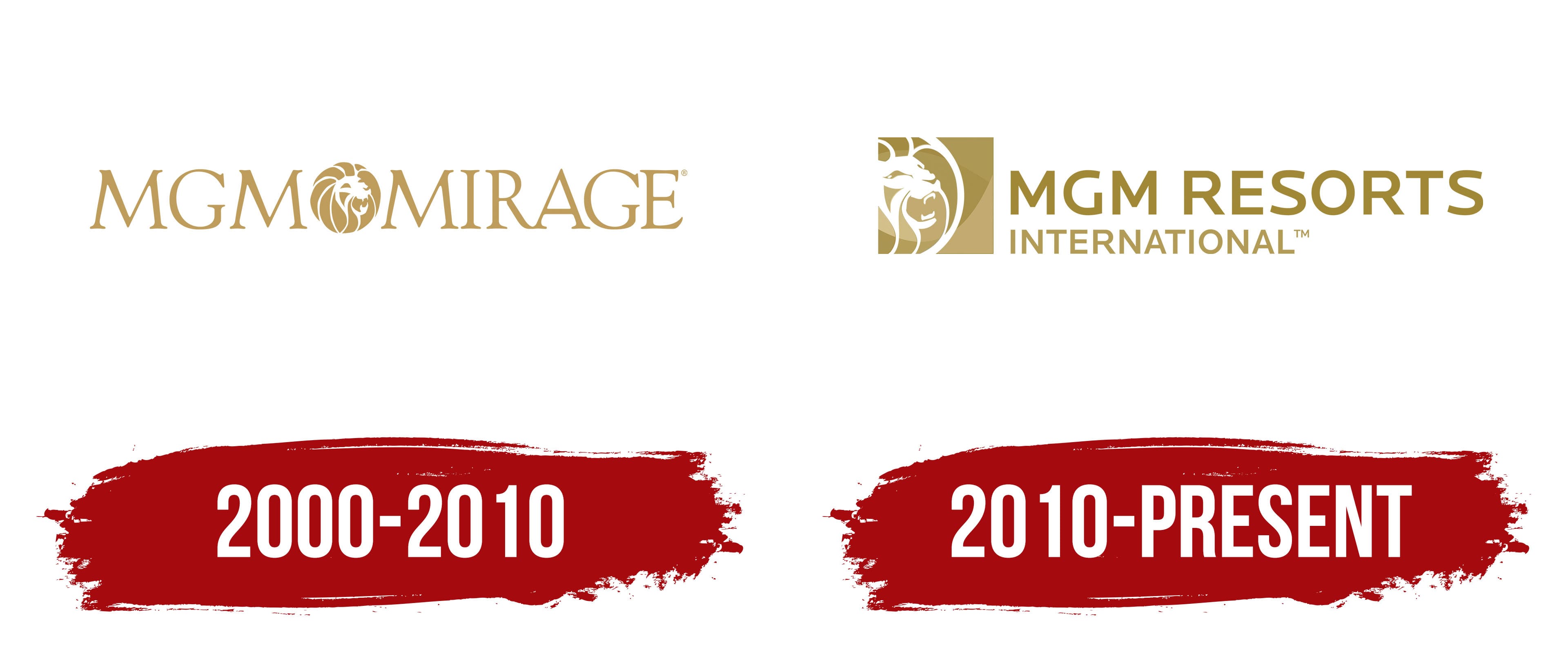
The MGM Mirage emblem appeared after the merger of MGM Grand, Inc. and Mirage Resorts, accompanied by a large-scale rebrand and the introduction of the company’s new name. The new look combined traditional elements with modern styling, symbolizing the company’s transition to a new stage of development.
The words “MGM MIRAGE” were set in uppercase letters in a classic serif typeface similar to Madelin Medium by Creativetacos. The letterforms had balanced proportions, with smooth, elongated serifs that gave them elegance and a refined appearance. Uniform height and consistent stroke weight created a sense of harmony and strength, conveying the grandeur and status of a premium hospitality brand.
The logo’s color was a rich gold, a shade associated with wealth, exclusivity, and high-quality service, qualities that matched the company’s positioning in the luxury services and entertainment market. This palette reinforced the brand’s image as a mark of prestige and authority in the industry.
Between “MGM” and “MIRAGE” was a stylized lion’s head framed by a circle. The lion referenced Metro-Goldwyn-Mayer’s heritage and its iconic Leo the Lion, but in the new design, it was rendered in a flat style with smooth lines and minimal detailing. This interpretation of the lion symbolized the company’s strength and reliability while serving as a metaphor for the brand’s power and majesty. The circular frame also evoked the look of a traditional seal, reinforcing MGM Mirage’s authenticity and strong reputation.
2010 – today

The MGM Resorts International logo was introduced in mid-2010, shortly after the company officially adopted its new name at a shareholder meeting in June of that year, replacing the MGM Mirage logo. The new mark was part of a global rebranding effort, reflecting the company’s international expansion and its strengthened position in the hospitality and entertainment industries.
The visual composition includes a gold square with a stylized lion. The lion’s head, known as Leo the Lion, is rendered in a semi-flat style with smooth lines, clean shapes, and a partially enclosed circular outline. This figure is an evolution of the original Metro-Goldwyn-Mayer studio symbol, adapted first for MGM Mirage and then for MGM Resorts, indicating continuity and heritage tied to the famous film company’s name and history.
The text portion is positioned to the right of the square and arranged in two lines. The top line reads “MGM RESORTS” in a modern, geometric sans-serif typeface, characterized by even stroke widths, clean lines, generous counters, and precise proportions. The bottom line, “INTERNATIONAL,” is in a smaller version of the same sans-serif font, emphasizing the company’s global scale following the rebrand.
The gold color palette continues the brand’s traditional association with prestige and exclusivity, firmly positioning it in the luxury segment of the hospitality and entertainment business. The color underscores the company’s high status, solidity, and reliability while also referencing MGM’s historical roots and legacy.
The lion figure inside the gold square is perceived much like a family crest or emblem, highlighting MGM Resorts’ dominant market position. Visually, it also recalls a corporate seal, strengthening the impression of authority and leadership on the international stage. This design has enabled MGM Resorts International to establish a recognizable and prestigious brand image that aligns with its strategic objectives and global aspirations.
Font and Colors
The typeface in the 2010 MGM Resorts International logo is a geometric sans serif similar to commercial fonts such as Elioth Semi Bold and Locator Medium by Process Type Foundry. Straight, precise strokes, consistent thickness, and wide counters define it. The use of uppercase letters conveys solidity, stability, and confidence, underscoring the company’s high international standing.
The color palette features a saturated gold with a slight bronze undertone. This shade communicates the brand’s key qualities: luxury, prestige, and high service standards. Gold is associated with financial success, prosperity, and achievement, reinforcing MGM Resorts’ reputation as a leader in hospitality and entertainment serving the premium market segment.