 Nippon Steel Logo PNG
Steel underpins construction, mechanical engineering, and transportation, forming the foundation of bridges, buildings, and automotive structures. Metal production involves processing raw materials, smelting, and rolling, where precise parameters and consistent quality are essential. The Nippon Steel logo is associated with a Japanese steel company that produces steel and supplies materials to the industrial, construction, and automotive sectors.
Nippon Steel’s history began in 1897. That year, the state-owned Imperial Steel Works was established in Yawata. German engineers helped build the plant. It became Japan’s first modern steelmaking facility. The enterprise supplied steel to the navy during the Russo-Japanese War.
In 1934, the plant became part of the Japan Iron and Steel conglomerate. This organization controlled most of the country’s steel production. After World War II, the company was divided into two enterprises. One was named Yawata Iron and Steel, the other Fuji Iron and Steel. The division dismantled the industry monopoly.
In the 1950s and 1960s, both companies began actively modernizing production facilities. They built integrated plants along the coast. By the end of the decade, Japan had become the world’s second-largest steel producer.
In 1970, Yawata and Fuji merged. As a result, Nippon Steel Corporation was formed. The new company controlled about one-third of the Japanese market. In 1980, it became the world’s largest steel producer. Annual output reached thirty-two million tons.
In the 1990s, the company reduced excess capacity due to an economic downturn. In 2012, Nippon Steel merged with Sumitomo Metal Industries. The result was a new enterprise named Nippon Steel and Sumitomo Metal Corporation. Annual steel production reached about fifty million tons.
In 2019, the company shortened its name to Nippon Steel Corporation. That same year, the company acquired a stake in India’s Bhushan Steel. In 2020, steel output fell as automotive demand declined.
In 2023, the company announced plans to purchase the American firm U.S. Steel. The deal was valued at approximately $14.9 billion. In January 2025, the U.S. government blocked the acquisition.
The company ranks third worldwide by production volume. It produces about forty-five million tons of steel per year and maintains a global presence in Asia, India, and other regions.
Meaning and History
What is Nippon Steel?
A leading steel producer in Japan and one of the largest in the world, producing about forty-four million tons per year, with almost half of the volume coming from overseas operations. The company manages a network of steel plants and dozens of facilities in Asia, Europe, and the Americas. Its main areas include producing sheets, pipes, profiles, and components, as well as mining iron ore, coal, and niobium. The company also engages in engineering construction, chemical materials, and information technology. It focuses on creating high-strength alloys for the aviation, automotive, shipbuilding, energy, and robotics industries.
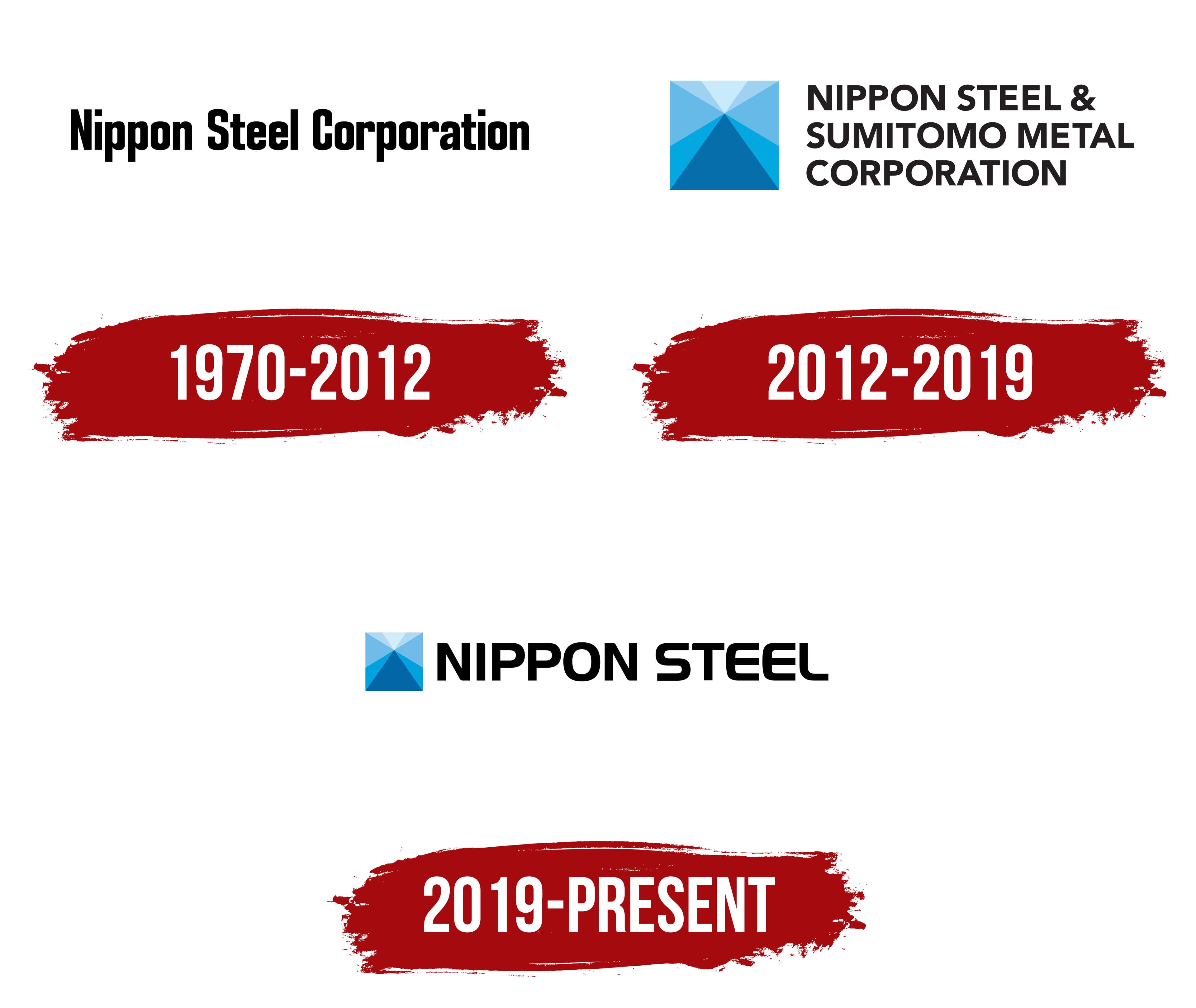
1970 – 2012
From 1970 to 2012, the long name “Nippon Steel Corporation” appeared on a single line and served as the complete corporate signature. The company’s English name formed the entire identity. This format appeared in business documents, production materials, and communications with international partners.
The company was established on March 31, 1970, through the merger of Yawata Iron & Steel and Fuji Iron & Steel. The English name combined “Nippon,” meaning “Japan,” with “Steel.” The Japanese name 新日本製鐵 was pronounced “Shin Nippon Seitetsu” and meant “New Japan Iron and Steel.” The wordmark identified the company’s industry and country of origin.
The merged corporation traced its history to Japan’s late 19th-century steelmaking program. The Ministry of Agriculture and Commerce began building a plant in Yawata in 1897. The government-owned Yawata Steel Works began operations in 1901. In 1934, it joined several other companies within Japan Iron & Steel Co., Ltd. A postwar reorganization divided the corporation in 1950. Yawata Iron & Steel and Fuji Iron & Steel emerged as its successors and reunited 20 years later as Nippon Steel Corporation.
All three words appeared in black with heavy sans-serif lettering. Narrow characters let the long name fit on one continuous horizontal line. The “N” in “Nippon,” “S” in “Steel,” and “C” in “Corporation” were uppercase, while the remaining letters were lowercase. Dense proportions and a consistent letter style created a unified industrial appearance.
Nippon Steel Corporation merged with Sumitomo Metal Industries in 2012. The former corporate name was replaced by the combined company’s identity, ending the use of the 1970 to 2012 wordmark.
2012 – 2019
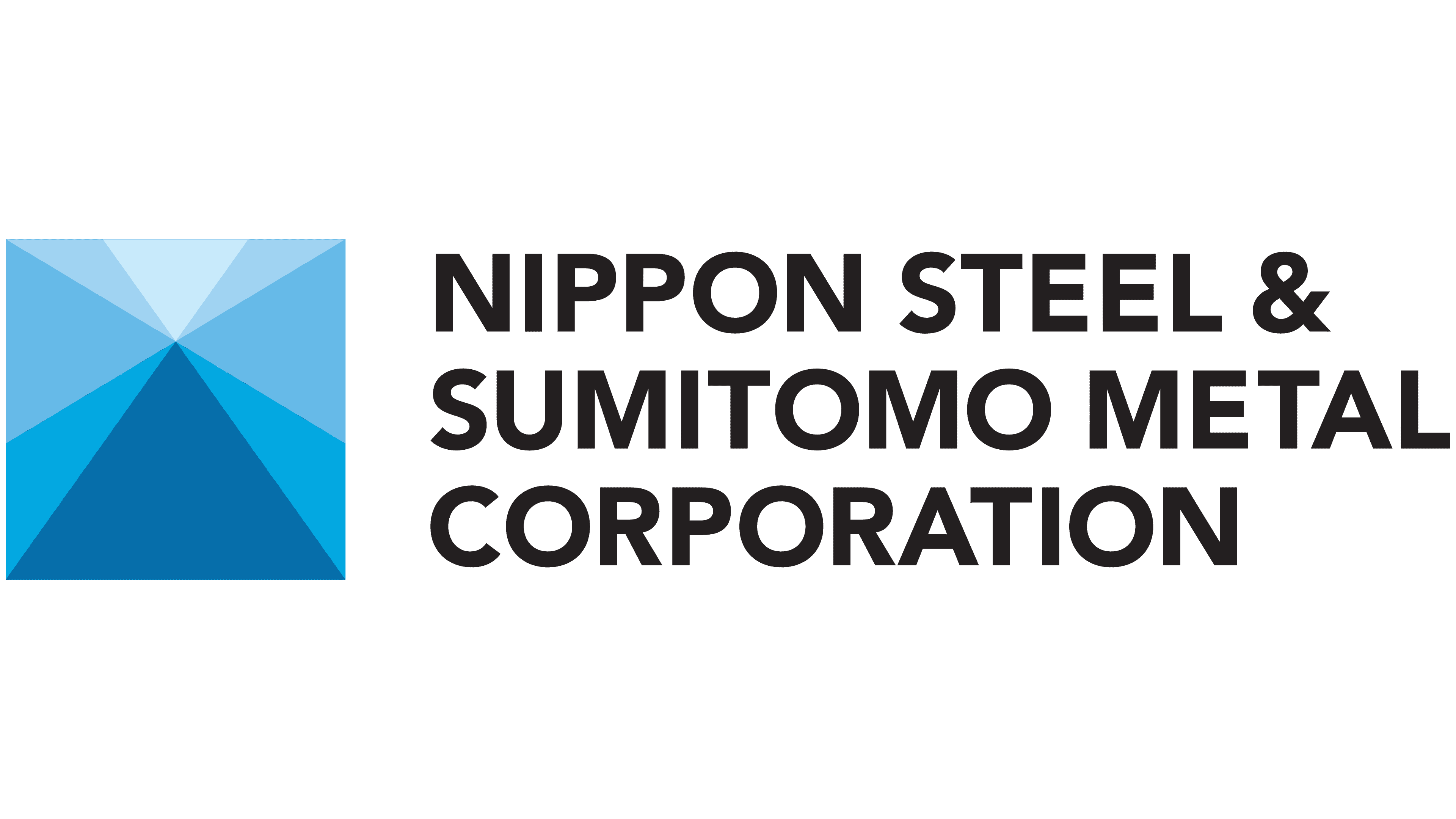
Eight blue triangles converged at one point inside the square emblem of Nippon Steel & Sumitomo Metal Corporation. The new corporate identity was introduced on March 30, 2012, for the future combined company. It brought together two steelmakers with different histories under one identity system.
Preparations for the merger began in February 2011 after Nippon Steel and Sumitomo Metal Industries announced the merger. The new organization began operating as Nippon Steel & Sumitomo Metal Corporation on October 1, 2012. Its Japanese name 新日鐵住金 combined the historic abbreviations of the two companies. The English version included Nippon Steel and Sumitomo Metal, preserving the group’s origins in its full corporate name.
A square appeared to the left of the inscription. Diagonal edges divided it into eight triangular planes. Shades of blue, from cobalt to sky blue, created depth within the figure. A dark triangular area occupied the center. The upper sections converged at one point, while the other surfaces extended toward the square’s edges.
The English name appeared on the right in three lines. The upper line contained “NIPPON STEEL &,” the middle line displayed “SUMITOMO METAL,” and “CORPORATION” occupied the bottom. Heavy rounded sans-serif letters appeared in black and uppercase. The multiline arrangement let the long name fit beside the square while keeping the corporate signature compact.
The company associated the dark triangle with a blast furnace and the people who produce steel. The light blue surfaces represented steel illuminating the surrounding world. The common point carried two meanings. As a peak, it represented the ambition to become the world’s leading steelmaker. As a vanishing point, it represented steel’s future possibilities as a material. Cobalt blue represented advanced technology, while sky blue represented reliability.
2019 – today
Eight blue triangles converged at one point inside the square emblem of Nippon Steel & Sumitomo Metal Corporation. The new corporate identity was introduced on March 30, 2012, for the future combined company. It brought together two steelmakers with different histories under one identity system.
Preparations for the merger began in February 2011 after Nippon Steel and Sumitomo Metal Industries announced the merger. The new organization began operating as Nippon Steel & Sumitomo Metal Corporation on October 1, 2012. Its Japanese name 新日鐵住金 combined the historic abbreviations of the two companies. The English version included Nippon Steel and Sumitomo Metal, preserving the group’s origins in its full corporate name.
A square appeared to the left of the inscription. Diagonal edges divided it into eight triangular planes. Shades of blue, from cobalt to sky blue, created depth within the figure. A dark triangular area occupied the center. The upper sections converged at one point, while the other surfaces extended toward the square’s edges.
The English name appeared on the right in three lines. The upper line contained “NIPPON STEEL &,” the middle line displayed “SUMITOMO METAL,” and “CORPORATION” occupied the bottom. Heavy rounded sans-serif letters appeared in black and uppercase. The multiline arrangement let the long name fit beside the square while keeping the corporate signature compact.
The company associated the dark triangle with a blast furnace and the people who produce steel. The light blue surfaces represented steel illuminating the surrounding world. The common point carried two meanings. As a peak, it represented the ambition to become the world’s leading steelmaker. As a vanishing point, it represented steel’s future possibilities as a material. Cobalt blue represented advanced technology, while sky blue represented reliability.