 Novozymes Logo PNG
Industrial processes increasingly rely on enzymes and microorganisms, enabling gentler processing of raw materials and production of desired substances. Biological mechanisms are used in food production, household chemicals, and other industries where precise transformations and control over results are critical. The Novozymes logo is associated with a company that develops enzymes and biotechnological solutions for industrial use.
Novozymes traces its history back to 1925. That year, Harald and Thorvald Pedersen founded Novo Terapeutisk Laboratorium in Copenhagen. Their main goal was to produce insulin. In 1941, the company began producing industrial enzymes. After World War II, enzymes found applications in detergents, the food industry, and textiles.
By the 1970s, enzyme production had become the company’s main activity. In 1989, Novo merged with Nordisk Gentofte to form the joint venture Novo Nordisk. In 2000, the enzyme business was spun off into a separate public company named Novozymes. Annual revenue was about $1 billion.
Since the early 2000s, the company has invested in developing enzymes for producing bioethanol from corn and sugarcane. Later, it began using plant waste for the same purpose. In 2012, Cellic launched its product line for producing cellulosic biofuel.
In 2014, Novozymes acquired the Brazilian company Organotech Biotecnologia. This expanded its portfolio of biological solutions for agriculture. In 2018, the company began developing enzymes that enable low-temperature washing. In 2020, production increased as detergent demand rose.
In 2021, the company focused on enzymes that improve plant protein properties. This direction supported the development of alternative food sources. In 2023, the company merged with Chr. Hansen. The deal was valued at about $ 13 billion. The merger combined enzymes, microbial cultures, and probiotics.
In 2024, Novozymes implemented artificial intelligence that accelerated the development of new protein structures.
The company remains the world’s largest producer of industrial enzymes. Its production facilities are located in Denmark, the United States, Brazil, China, and other countries. Novozymes supplies solutions for the food, biofuel, textile, and chemical industries.
Meaning and History
What is Novozymes?
Novozymes is a Danish biotechnology corporation and a global leader in producing industrial enzymes and microorganisms. It develops solutions for the food, pharmaceutical, agricultural, and chemical industries, as well as biofuels. The main focus areas include products for the food and medical industries. These include enzymes for detergents, the agricultural sector, and bioenergy, following the merger with Chr. Hansen joined Novozymes and now operates more than 30 facilities worldwide.
2000 – 2010
Novozymes grew out of Novo’s enzyme business, which began with pharmaceutical products. In 1925, brothers Harald and Thorvald Pedersen left Nordisk Insulinlaboratorium and established Novo Terapeutisk Laboratorium. Their first projects involved insulin. The company later entered the enzyme industry, laying the foundation for its future industrial operations.
Novo introduced its first enzyme product in 1941. It was trypsin, used in leather processing. During the 1950s, the company began producing enzymes on an industrial scale through fermentation. The business continued growing and became a major division within Novo Nordisk.
The name Novozymes appeared on January 12, 2000, before the corporate separation was completed. “Novo” maintained the connection with the group, while “zymes” came from “enzymes” and described the new company’s specialization. Shareholders approved the division of Novo Nordisk into the pharmaceutical company Novo Nordisk A/S and the independent enzyme company Novozymes A/S on November 13, 2000.
Along with the new name, Novo Nordisk introduced a corporate system for Novo Nordisk, Novozymes, and Novo A/S. The three related organizations received a shared typeface and blue color. The system maintained a visible relationship among the companies after their legal separation. It helped partners associate the new enzyme business with the Novo group.
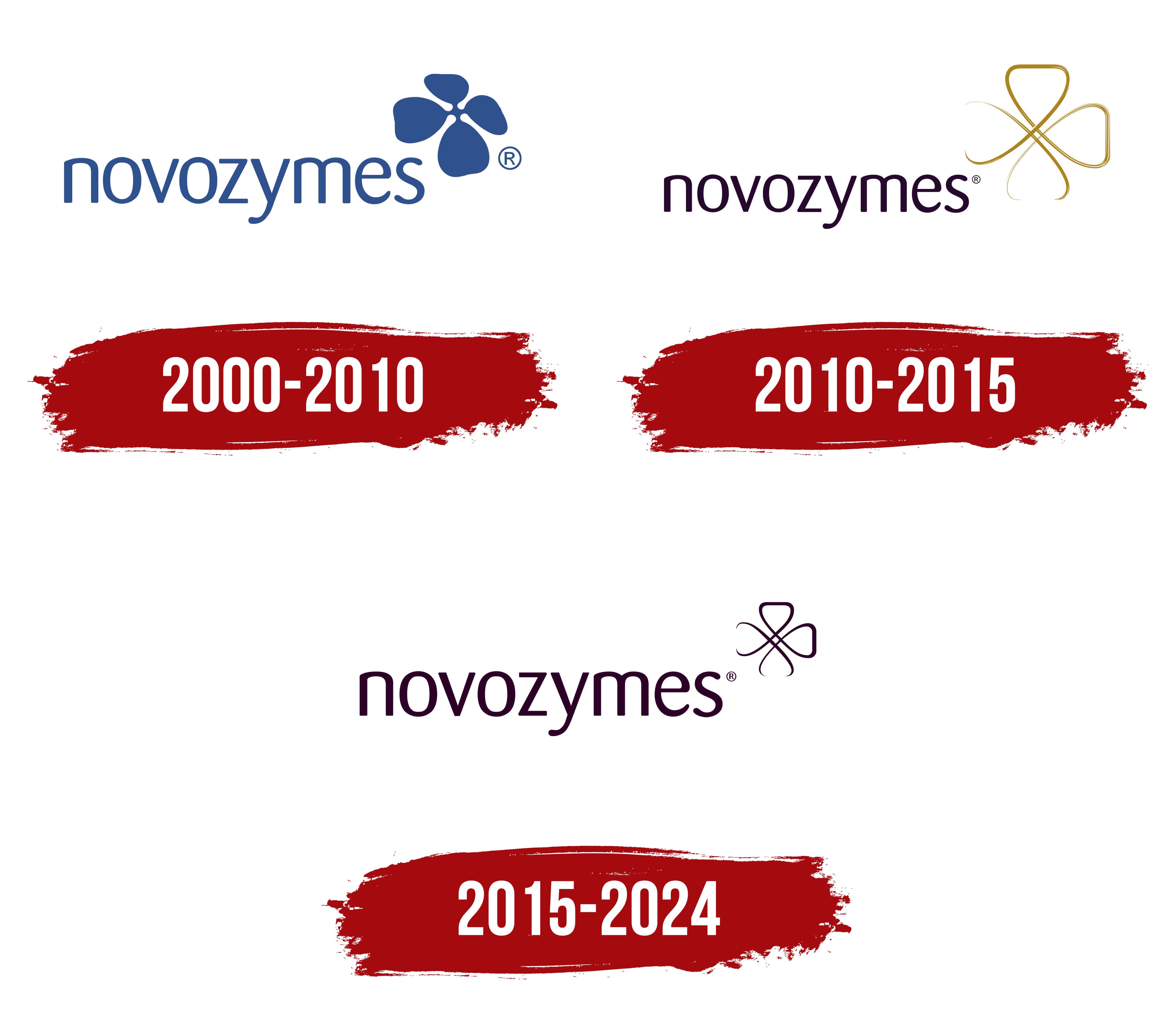
The first Novozymes logo consisted of a blue lowercase wordmark and a four-leaf clover. The word “novozymes” appeared on the left in thin sans-serif letters. Uniform stroke thickness and rounded details created a soft typographic structure. The lettering was developed for the shared Novo Group system.
A blue clover made of four teardrop-shaped leaves appeared above the line on the right. The leaves varied in shape and size, had rounded edges, and surrounded a small opening in the center. Their asymmetry distinguished the emblem from a conventional geometric flower and gave it an organic form.
The company associated the clover with good luck and with enzymes’ ability to connect nature and technology. It represented Novozymes’ specialization and its origins in Novo’s enzyme business.
2010 – 2015
After going public, Novozymes continued developing an independent image as an enzyme company. During the 2000s, its corporate communications used the phrase “Unlocking the magic of nature.” It later replaced it with “Rethink Tomorrow,” introducing a new way to present the brand’s scientific and industrial work.
By the end of the decade, the corporate signature had moved away from the blue Novo Group system and adopted a new color scheme. The name became dark purple, while an outlined gold-brown emblem replaced the solid four-leaf clover. Four leaves remained the basis of the image, but they received freer shapes and an asymmetrical arrangement.
The clover consisted of four curved lines. They crossed near the center, extended outward, and formed elongated loops with open interiors. Their outlines resembled teardrop-shaped leaves of different forms. Thin strokes broadened around the curves, giving the impression of a drawing made in one flowing gesture.
The gold-colored surface conveyed light and a metallic sheen. The brand description connected the clover’s organic form to nature, the sans-serif typography to technology, and the free-flowing stroke to the human contribution to scientific work. Together, the elements represented enzymes’ natural origins, their industrial applications, and the role of researchers.
The lowercase word “novozymes” appeared to the left of the emblem. Its dark purple sans-serif letters had narrow proportions and uniform stroke thickness. The color contrast separated the wordmark from the gold clover while keeping them within one horizontal signature. The name continued to refer to enzymes, while the four-leaf emblem maintained continuity with the company’s first logo.
2015 – 2024
During the final years before its combination with Chr. Hansen, Novozymes continued developing a brand built around a name associated with enzymes. The corporate identity used biological forms, a lowercase wordmark, and a four-leaf clover. By the mid-2010s, the complete signature had adopted a uniform dark purple color.
In the 2015 version, “novozymes” retained its lowercase spelling and narrow sans-serif letters. A smaller four-leaf clover appeared beside it. Dark purple, matching the wordmark, replaced the former emblem’s gold-brown color. The lines grew thinner, and the outline took up less space relative to the name. One color united the wordmark and clover in a cohesive horizontal signature.
By 2015, corporate materials used the Bioscript typeface. Novozymes identified it as a company-owned font derived from the logo’s letterforms. The typeface repeated the shapes of the lowercase “novozymes” wordmark and carried elements of the corporate lettering into written materials.
The company updated its identity for digital products in 2022 while retaining the primary name and four-leaf emblem. UI designer Souli Vera worked with Novozymes’ internal brand team. An external brand designer developed the new system, while the creative director and company specialists handled its digital adaptation. The dark purple logo remained in use until it was combined with Chr. Hansen was completed.
The name Novonesis was introduced for the future group on December 13, 2023. It drew on the Greek word “genesis,” meaning “origin” or “beginning.” The company interpreted Novonesis as “a new beginning.” The name represented the combined biological technology business. It covered its full range of operations, while Novozymes had been specifically associated with enzymes.
The merger of Novozymes and Chr. Hansen was completed on January 29, 2024. The combined company adopted the Novonesis brand, replacing the dark purple Novozymes signature with a new corporate identity.