


 Powerade Logo PNG
The Powerade logo is like a fully charged battery. The emblem’s slender symbols inspire confidence and restore strength through a balanced mineral complex. The sign contains nothing superfluous, like water’s optimal composition.
Coca-Cola launched Powerade in 1988 as an isotonic sports drink it developed, produced, distributed, and owned. Its base formula combined water with four minerals, meant to help restore energy balance after intense physical activity. The company produced the main product in the United States. At the same time, manufacturing subsidiaries in other countries helped bring the drink closer to local markets.
The brand was tied to the 1988 Olympic Games, where its owner served as an official sponsor. Powerade was created as a themed sports drink for athletes and active consumers. From the start, it was placed in the same category as Gatorade, the leading rival in the sports beverage market, which PepsiCo also owns.
The formula and range changed over time. In 2001, Powerade received an updated composition with B vitamins 3, 6, and 12, presented as part of the drink’s recovery function after heavy exercise. In 2002, the company introduced a low-calorie version made with corn syrup, sucralose, fructose, and acesulfame potassium for consumers who wanted to limit sugar intake.
That same year, the company updated the standard bottle with an ergonomic grip and revised the label and logo style. By 2022, the Powerade range included 16 branded products and six low-calorie energy drinks. In 2009, the owner acquired Glacéau, strengthening its position in non-alcoholic beverages and keeping Powerade under closer control through the acquired company.
Meaning and History
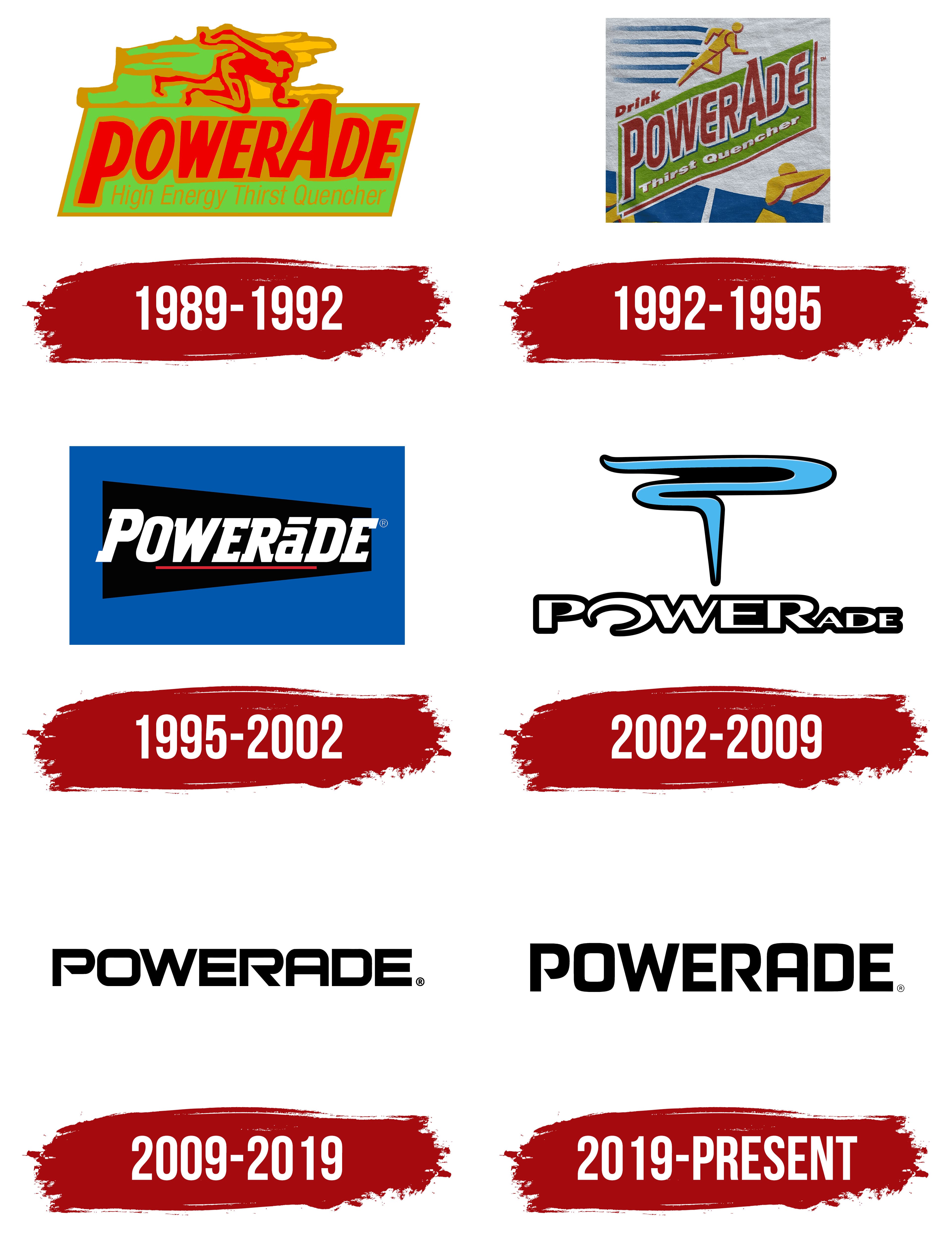
For Powerade, the logo is one of the main advertising tools. The company enters into agreements with various professional athletes and sports organizations to use its products. Each bottle of isotonic drink features a label that displays a memorable brand logo.
Once, this sign was colorful, complex, and multi-component. But as it evolved, it became a laconic black-and-white inscription: “POWERADE.” The word conveys inner strength and energy. This is an allegorical reflection on the energy people feel after drinking isotonic drinks.
What is Powerade?
Powerade is a popular isotonic drink that replenishes lost salt, water, and glucose. Athletes use these drinks to replenish their energy after intense training. The American food company Coca-Cola owns the brand.
1989 – 1992
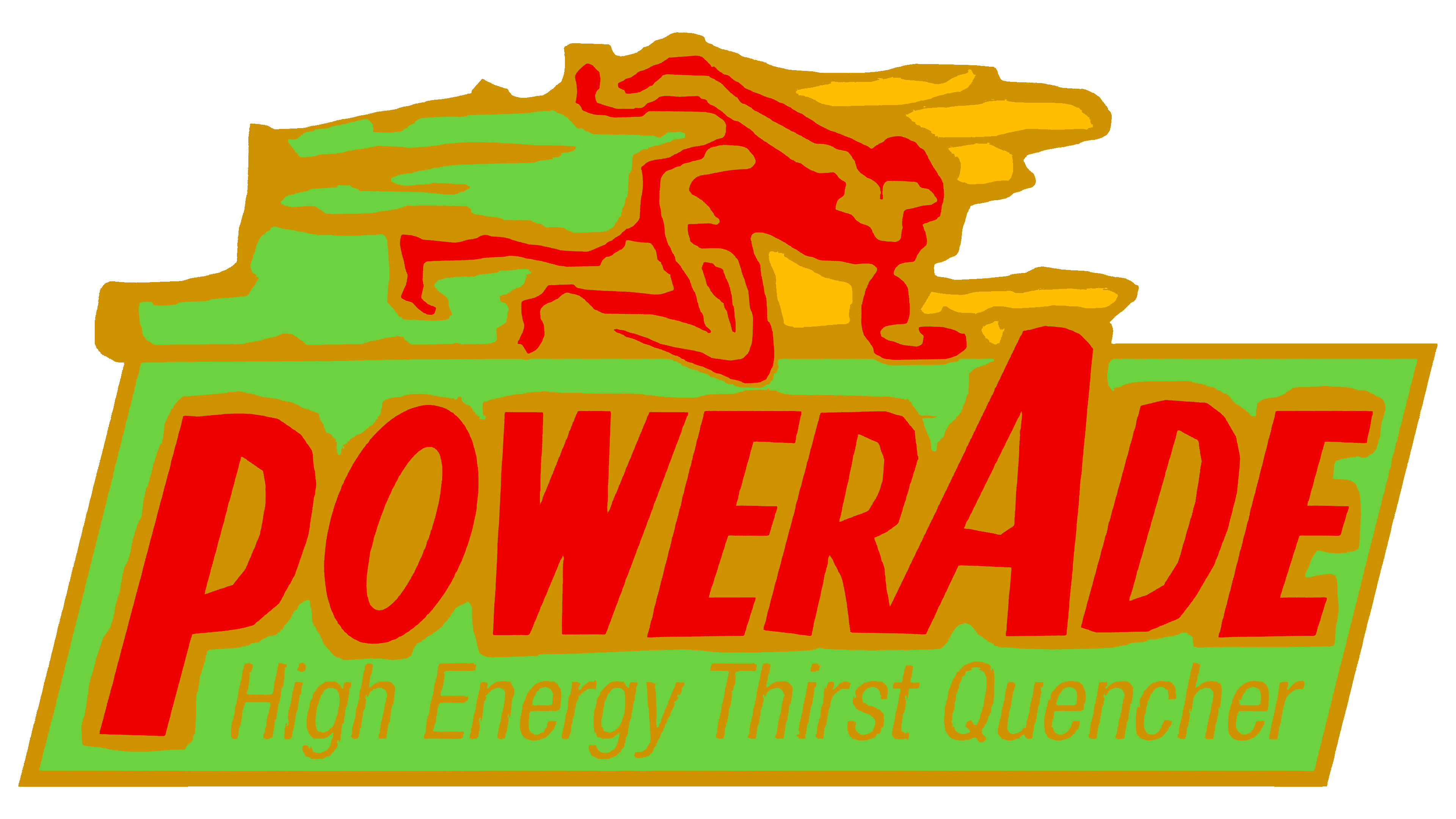
The debut logo had a completely different design from all subsequent variants. It stood out for its colors and components. Life-affirming colors red, blue, yellow, and green stood for dynamism, the sky, the sun, and the lawn. The emblem depicted a running man racing across the hilly terrain. Stripes appeared next to the athlete, and the rectangle slanting behind the energy drink’s name was clear. The lettering was bold and grotesque, with accented “P’s” and “A’s.” The former had a stalk going down, while the latter had a point going up, towering over the other letters.
1992 – 1995
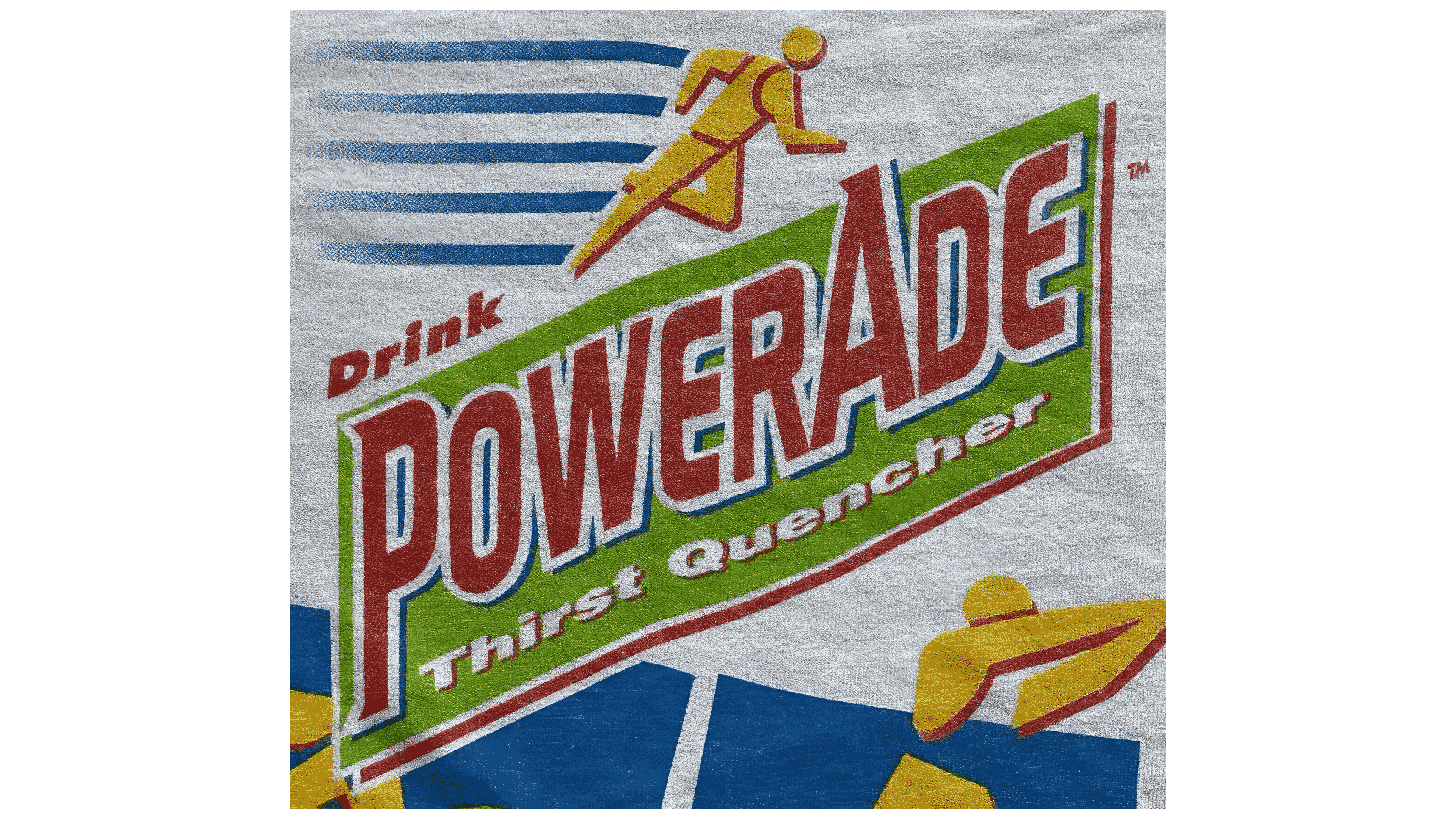
This variant featured “POWERADE” in dark red, with enlarged “P” and “A,” the only letters with triangular serifs. The text used a massive, bold font. Each glyph had a wide white outline and was further embellished with blue shadows. Beneath the brand name was the white phrase “Thirst Quencher” with the capital “T” and “Q.”
The background for the inscriptions was a large, light-green parallelogram, raised at about 30 degrees. Because of this arrangement, the elements inside seemed to fly upward. This symbolizes development, perseverance, energy recovery, and movement.
Above “POWERADE” was the red word “Drink,” left-aligned. It was in bold italic sans-serif. In addition to the main logo, the label featured abstract athletes. The orange figures did not stand still; the artists depicted them in motion, complemented by blue speed lines.
1995 – 2002
For a long time, the brand used a text-only logo with minimal elements. The designers turned the slanted rectangle (almost a parallelogram) into a trapezoid with different widths at the opposite ends. The lettering changed: it gained geometric serifs, italics, and a white color. In addition, the name was converted to uppercase, except for the letter “a,” above which a short stripe appeared. The developers placed a long line below, as an underline in the middle of the word “Powerade.” The background was a bright blue rectangle.
2002 – 2009
The 2002 redesign brought a major overhaul. The emblem had just one line, curly like a ribbon, representing internal energy. At the same time, it resembled a question mark stretched out to the sides. The name of the sports drink was set in a modern geometric typeface, with uneven letter spacing that combined sections of different widths. The main focus was the “P”: it had a single line with pointed ends, left open.
2009 – 2019
In 2009, the designers proposed a minimalist Powerade logo. They removed the graphic element, leaving only the brand name. It was massive, strict lettering, in black characters on a white background. The font was square, bold, and chopped. Some letters had enclosed outlines; in particular, the “P” and the “R” had narrow gaps where the curved line met the vertical foot. Although “O,” “A,” and “D” had rounded corners, they looked more like slices, which added to the text’s seriousness.
2019 – today
The modern version of the emblem reflects masculinity and inner energy. The developers used a bold font with stretched uppercase letters to achieve this. Now they convey the ability to withstand difficulties and to fully recover strength, as the symbols seem to overflow with hidden dynamics.
Font and Colors
The evolution of this brand’s logo is conventionally divided into two periods: before 1994 and after. At that time, a decisive breakthrough was observed in its stylistics: it moved from a non-permanent to a permanent design. This is due to the emergence of a concept that harmoniously represents the energy drink. Inner fullness, restoring strength, maintaining balance, a sense of determination, and strength- this is what is most important for those who constantly experience high physical exertion. Minimalistic logo, as if to proclaim: this is a serious drink for serious people in serious circumstances.

The text in the Powerade logo is in Gears of Peace, powerful and bold, with half-cut corners that are slightly rounded. The two letters have no joints, so they have a pointed inner line. The color palette is monochrome. But the brand did not go black-and-white right away: first, it tried bright colors like red, green, yellow, and blue.