


 PSG Logo PNG
The club’s style, the football team’s logo, reflects its history and the story of its glorious victories. The modern emblem symbolizes the team’s commitment to its city and its desire to continually improve its achievements and meet the expectations of its fans.
Paris Saint-Germain was created on August 12, 1970, after the merger of FC Paris and Stade Saint-Germain. Paris had long lacked a major club while Saint-Étienne, Nantes, and Marseille dominated French football.
PSG quickly reached the top division but faced financial issues. Relegation came in 1974, followed by a return soon after. Stability improved under Daniel Hechter.
The first trophy arrived in 1982 with the Coupe de France. A year later, PSG reached the Cup Winners’ Cup final, losing to Aberdeen under Alex Ferguson, but confirmed its European potential.
A major shift came in 1991 when Canal+ became the main shareholder. The club won Ligue 1 in 1994 and the Cup Winners’ Cup in 1996, beating Barcelona en route and Rapid Wien 1:0 in the final.
After Canal+ left in 1998, PSG entered a difficult period marked by weak results and constant change. By 2010, the club was close to relegation.
In 2011, Qatar Sports Investments took control. Transfers included Zlatan Ibrahimović, Thiago Silva, and Edinson Cavani. PSG won four league titles from 2013 to 2016.
In 2017, Neymar joined from Barcelona for €222 million, followed by Kylian Mbappé from Monaco. The club reached the Champions League final in 2020 but lost to Bayern München.
Lionel Messi arrived in 2021, yet European success did not follow. Mbappé renewed in 2022 and left for Real Madrid in 2023.
Meaning and History
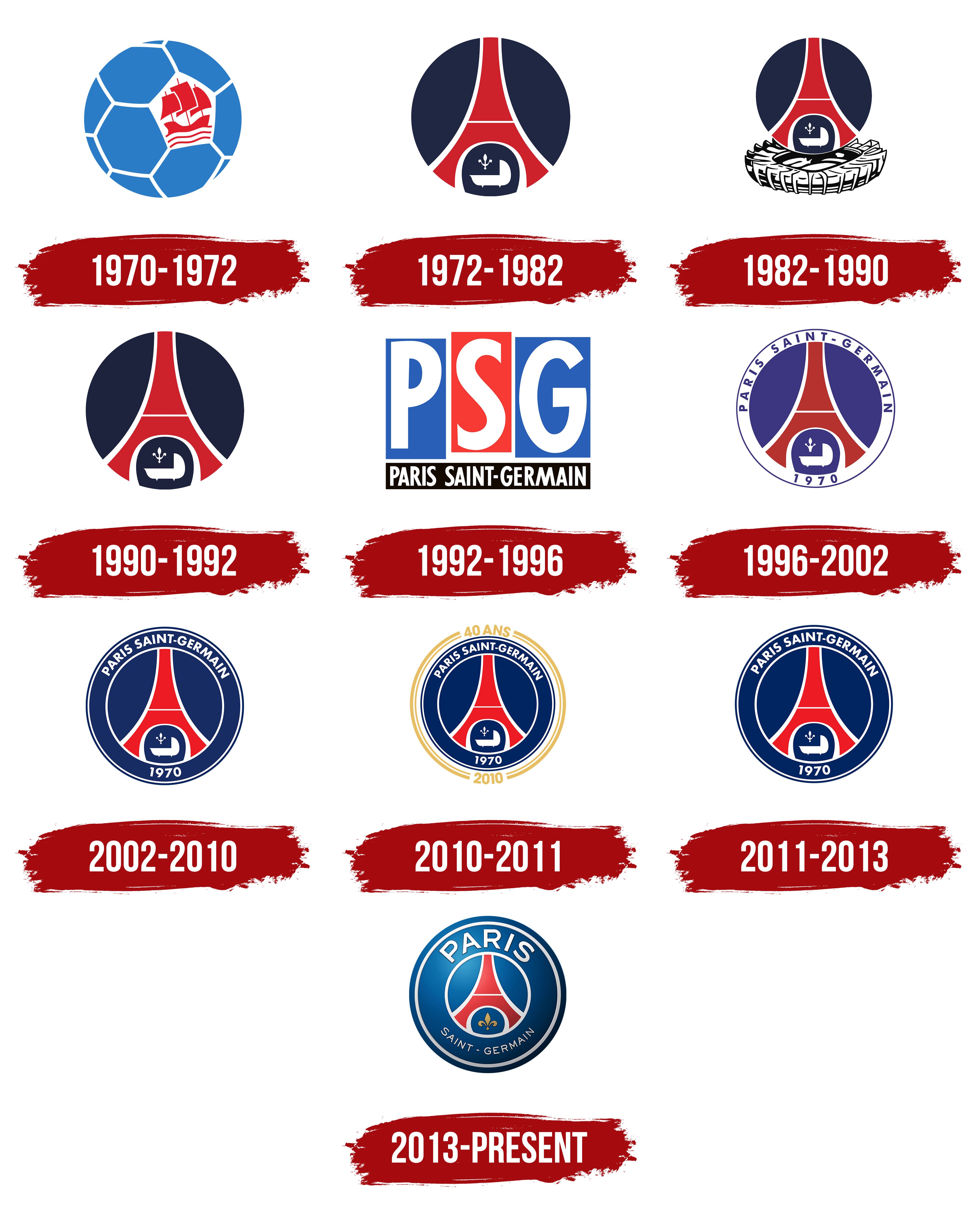
Paris Saint-Germain F.C. seems like a teenager compared to other famous football clubs: it is only 50 years old. But during this time, it radically changed its image, adopting a modern, three-dimensional logo featuring the Eiffel Tower within a blue circle. This iconic structure symbolizes Paris. At its base proudly stands a golden fleur-de-lis borrowed from the coat of arms of Saint-Germain-en-Laye. It used to be combined with a cradle, hinting that King Louis XIV was born in this city. That is, PSG’s visual identity goes beyond football: the emblem resembles a ball in shape, but in meaning, it is connected to the team’s historical heritage.
What is PSG?
PSG (short for “Paris Saint-Germain”) is a professional football club from France that competes in Ligue 1. Founded in 1970, the team gradually became a leader in domestic football. The most successful team in the country has earned over 40 prestigious awards and numerous titles. The team plays its home matches at the Parc des Princes stadium.
1970 – 1972

A blue ball and a red boat, a symbol of Paris, placed on one of the hexagons, represented PSG’s first emblem from 1970 to 1972. Also, under the ball was the inscription “Paris St. Germain Football Club,” executed in large red letters.
1972 – 1982
In 1972, the Paris FK club retained the first version, transferring only the lower inscription. “Paris Saint-Germain” developed a new emblem, which can now be considered historical.
The emblem’s design featured a red Eiffel Tower on a blue background, framed in white. Moreover, a cradle with a lily was placed at the base of the tower, a sign of the team’s origin from Saint-Germain-en-Laye, where the castle is located. The mansion often served as a residence for French monarchs, where young heirs to the royal throne lived and were raised. This emblem version lasted until 1982 and reappeared in 1990-1992.
1982 – 1990

From 1982 to 1990, the “Parc des Princes” emblem was used. Artists presented the club’s football stadium as a large black-and-white ring with protrusions, attempting to convey the building’s actual shape. Meanwhile, the iconic red-blue badge with the Eiffel Tower did not disappear; it hung right above the stadium, hinting at the superiority of Paris Saint-Germain F.C.
1990 – 1992
The PSG emblem, created in 1972, was returned in the early 1990s. This version was identical to the original, but the developers removed Parc des Princes.
1992 – 1996
In 1992, the emblem was radically changed. Stripped of all previous attributes, it became three rectangles, with the letters P, S, and G inserted. The decryption of “Paris Saint-Germain” is shown below.
Such a risky change of emblem was a bold PR move by the club’s management and Canal+, which owned the club at the time. Influenced by fans’ dissatisfaction, the PSG emblem soon lost its official status, though it was still used in advertising.
1996 – 2002
The public did not receive the emblem created by Etienne Robial in 1992. In the mid-1990s, protesting fans got their way: the football club restored the iconic badge with the Eiffel Tower, fleur-de-lis, and cradle, symbolizing the birth of King Louis XIV in Saint-Germain-en-Laye. At the same time, designers went even further, adding a wide white ring with a blue contour and the inscription “PARIS SAINT-GERMAIN.” The form of an arch occupied the phrase’s upper half, and at the very bottom was written PSG’s founding year: 1970. In the version used until 2002, the colors had a purplish hue.
2002 – 2010
In 2002, the logo was updated, and the palette was revised: blue became darker and more saturated, and red acquired a bright scarlet hue. At the same time, the outlines and inscriptions were repainted in white. The designers had to make the ring frame blue so the text readability would not deteriorate. Reducing the distance between the letters increased the compactness of the phrase “PARIS SAINT-GERMAIN.” But the font remained virtually unchanged: the football club’s name and its founding year continued to use bold geometric serifs. However, artists improved the shape of the fleur-de-lis, giving it a refined appearance.
2010 – 2011
In 2010, PSG turned 40. To celebrate this event, the sports organization complemented its iconic logo with a golden border of four semi-circles on the right and left, two on each side. Each pair’s outer arc was wide, and the inner one was narrow. The semicircle at the top bore the “40 ANS” inscription, indicating the club’s age. At the bottom, “2010” appeared, the year FC Paris Saint-Germain reached its fortieth anniversary.
2011 – 2013
2011 marked the return of the old emblem, which was used until the temporary jubilee version of the logo was introduced. But in less than two years, the football organization updated its identity.
2013 – today
The word “Paris” on the current PSG logo (officially formed in 2013) is set in a much larger font. Saint-Germain, keeping the old format, moved the logo to the bottom. The reason is the desire of PSG’s Qatari owners (who bought the controlling stake in May 2011) to emphasize the club’s capital nature and minimize its connection to Saint-Germain-en-Laye.
In addition to recreating the French flag’s color palette, the PSG logo also evokes the colors of the clubs that merged to form PSG. Blue and red are the colors of the city of Paris’s flag and “Paris FC.” White is the color of the “Stade Saint-Germain” club’s shirts from Saint-Germain-en-Laye, north of the capital.
The main element of the logo is a stylized image of the famous Eiffel Tower. The new version has a three-dimensional effect that, by design, should be associated with a pulsating red heart.
The heraldic image of the lily (fleur-de-lis) symbolizes royal power in France. In the new club version, the flower became larger and was painted not white but golden. A few months later, with it, PSG won the French championship “gold” for the first time in 19 years.
In the new version of the PSG emblem, there was no place for the previously constant cradle, considered a city symbol of Saint-Germain-en-Laye, where the famous “sun king” Louis XIV was born. The club’s founding date (1970) is no longer depicted on the emblem. It’s explained this way: “PSG is a trend without a measure of time.”
Font and Colors
In 2013, designers changed the font to highlight the separate word “PARIS” and position the PSG sports club as a global brand. It’s written in large, bold letters with clear angles and smooth curves. For “SAINT-GERMAIN,” on the contrary, a thin font of a reduced size was chosen. Both parts of the inscription unite the upper case and the absence of serifs.
The emblem uses the national colors of France: red, white, and blue. They appeared during the French Revolution of 1789-1799 and are now depicted on the country’s official flag. Designers adorned the PSG graphic sign with a radial gradient to make it look voluminous and colorful. Meanwhile, its light center is shifted to the top-left corner, making the logo appear more dynamic. The only element that stands out from the general palette is the golden fleur-de-lis. Artists made the fleur-de-lis so noticeable because it’s an important symbol of Saint-Germain-en-Laye.