


 Amica Logo PNG
The Amica logo conveys the reliability and professionalism of a company that has become a trusted partner in the insurance industry. Since its founding, the brand has built strong client relationships, offering thoughtful solutions to protect property and life in an increasingly security-conscious world.
The Automobile Mutual Insurance Company of America (AMICA) was founded in Providence, Rhode Island, in 1907, in response to the increased demand for auto insurance during the early automotive boom. Structured as a mutual company, the insurer made policyholders direct owners, fostering conservative underwriting and prudent investments.
By the 1920s, AMICA expanded beyond Rhode Island and opened branches throughout New England. In 1941, it moved its headquarters to Lincoln, Rhode Island, to support ongoing operational growth. In the 1950s, AMICA added homeowners’ insurance to meet customer demand for broader protection.
Technological innovation defined AMICA in the 1960s, as it became one of the industry’s early adopters of computerized claims processing. In 1970, the brand modernized by shortening its name to Amica to align with nationwide expansion. The 1980s brought further customer-focused advances, including launching round-the-clock claims services.
Entering the life insurance market in the 1990s through Amica Life Insurance Company broadened its market presence. The 2000s and 2010s saw a shift toward digital technology, including online policy management, mobile apps, and social media engagement.
As of 2024, Amica remains among America’s largest mutual insurers, known for financial strength and sustained customer satisfaction.
Meaning and History
What is Amica?
This insurance company offers a range of insurance plans for individuals and families. Its key distinction is its mutual insurance model, where policyholders are clients, not shareholders. It offers retirement, life, home, auto, and personal property coverage. The company is known for high-quality customer service and consistently receives positive client feedback. It offers affordable rates and reliable protection through a careful approach to insurance and personalized service.
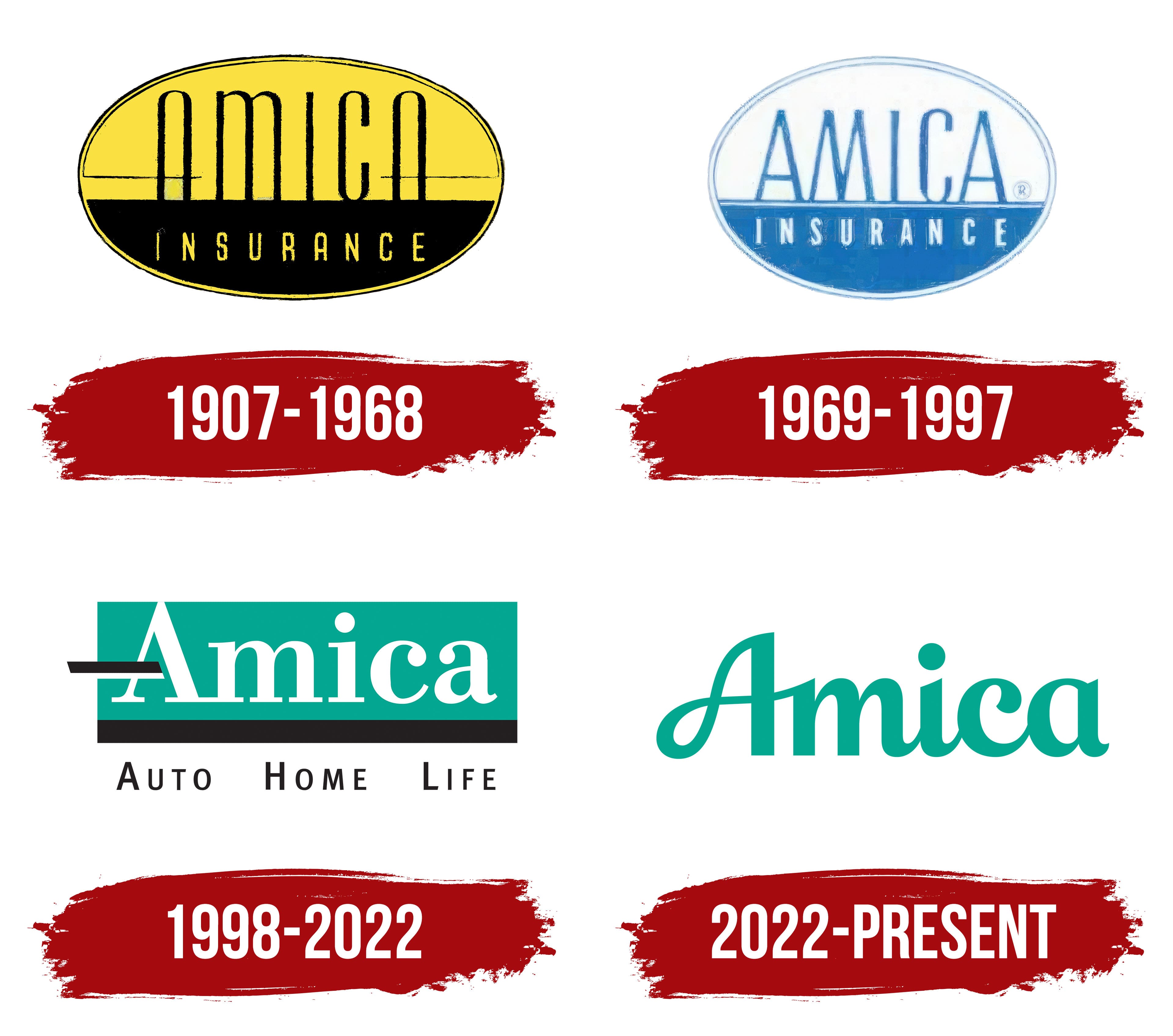
1907 – 1968

The company’s initial steps into the market were accompanied by a mark that visually referenced the United States’ corporate aesthetic from the 1930s to the 1950s. The Amica Insurance logo is associated with industrial signage, auto services, and banking offices of that time.
The upper half of the oval was done in warm yellow and contained the word “AMICA.” The letters were vertically stretched, sans serif, with a strict industrial character and an Art Deco influence. The strokes were thin; height prevailed over width, and the symbols stood at equal intervals. The first and last letter A were connected by a thin black arc running above the entire word, which visually united the composition and created an upper closure.
In the lower part of the oval was the word “INSURANCE.” It was set with proportions balanced in height and width. The capital letters were smaller and set in a black field. Their color echoed the yellow of the upper segment, creating a unified hierarchy.
The two parts were proportioned so the light upper part dominated in area while the dark lower part served as support. The double outline of the oval strengthened the shape and gave it a sense of completeness. The negative space between the elongated strokes of “AMICA” was perceived as a light gap, emphasizing the verticals.
1969 – 1997

Replacing the yellow-and-black emblem with a cold two-color palette marked a significant milestone in Amica Insurance’s development. The company abandoned mid-century industrial associations and introduced a strict white-and-blue scheme. The oval was preserved as the basis, but its outline became lighter, and the double line emphasized the form’s neatness.
The design was built on an even division of the oval. Its upper half was white, and the lower part was filled with blue. At the top, the word “AMICA” was set in an elongated grotesque. The letter lines were straight and dense. The verticals created a rigid rhythm; the spacing between the symbols was reduced, and the composition became compact and symmetrical.
At the bottom of the blue background was the word “INSURANCE.” White capital letters were evenly centered. Compared to the top word, they were less elongated but retained strict geometry and straightness.
The palette was built on the cold contrast of white and blue. White reinforced distance and formality, while blue evoked a businesslike character and a reliable foundation.
The new visual concept reflected the company’s shift toward formalization and a conservative image, aligning with the insurance industry of the second half of the 20th century.
1998 – 2022

The transition to a rectangular, horizontal composition was the most significant change from the previous period’s oval emblem. Amica abandoned the symmetry of the top-and-bottom division and introduced a two-level structure. At the top, a green rectangle (with a wide black line at the base) was accompanied by text below.
Against a green background, the word “Amica” was set in large white letters. The typeface was a rounded serif with smooth transitions between strokes. The proportions were balanced, the letters equalized in width and height. The first capital letter, “A,” was unusual. Its crossbar shifted left, intersecting only one leg, and a parallel black duplicate line was added. The lines visually evoked road markings and movement, alluding to auto insurance.
The lower part of the logo consisted of the words “AUTO,” “HOME,” and “LIFE.” They were set in a simple, grotesque, small-scale format, with evenly spaced symbols. Each word was centered and evenly spaced from the others.
The base palette consisted of green, white, and black. The green was close to turquoise, adding expressiveness to the upper block. White was used for the main name, and black united the composition.
The inclusion of the words “AUTO HOME LIFE” established the company’s product line. The logo moved away from the universal oval form to a more linear, segmented style.
2022 – today

The 2022 update to the Amica logo was accompanied by a shift in approach to visual identity. The company invited the studio Mother Design and, in October, presented a new logo in which the typography was developed individually. Abandoning the rectangular composition with a black base and product line for a pure text mark was a fundamental transformation.
The composition was simplified. The word “Amica” was placed horizontally without additional geometric frames. The typeface was designed in a script style reminiscent of handwriting, but without a slant. The letter “A” featured a long, curved line extending to the left, which added a decorative accent to the symbol. The enlarged, rounded dot above the “i” balanced the word.
The typeface features smooth curves, moderate stroke thickness, and a neutral italic slant. It reads as calligraphic but remains static, serving as a corporate identity element. The visual language was based on the Amica Rhymes and Aperçu typefaces, designed to provide clarity and focused perception.
The palette introduced a new tone called Teal Centric, a muted green reminiscent of a sea wave. This color contrasted with the red and blue typically associated with the industry, allowing the company to stand out and highlight its individuality. The monotone effect reinforced focus on the letterforms rather than on the division of areas.
The script style conveys a personal service and brings the brand closer to the client. The decorative “A” subtly alludes to the infinity sign, hinting at long-term relationships and ongoing support.
