


 Flutterwave Logo PNG
The Flutterwave logo symbolizes the fintech company’s reliability and efficiency in providing payment solutions. Its design highlights accuracy, speed, and the service’s technological nature, facilitating seamless financial transactions.
Nigerian entrepreneurs Olugbenga Agboola and Iyinoluwa Aboyeji founded Flutterwave in 2016. Agboola had worked at PayPal and Google, while Aboyeji had co-founded Andela, an African developer-training company. The startup targeted Africa’s fragmented system of currencies, banks, regulations and payment methods.
Its first product, Moneywave, allowed businesses to process several forms of payment through one interface. Mastercard and Visa became early investors. In 2018, Flutterwave raised $20 million to expand its staff, obtain licenses in new countries and develop its technology. A further $35 million round followed in 2020 as the platform attracted thousands of African businesses and international clients.
In 2021, a $170 million Series C valued Flutterwave above $1 billion. The company raised another $250 million in 2022 at a $3 billion valuation, placing it ahead of rival Paystack, which Stripe acquired for $200 million in 2020. Flutterwave added the consumer transfer service Send and obtained payment licenses in Nigeria, Ghana and Uganda. Nigerian musician Wizkid later became a brand ambassador.
Rapid expansion brought regulatory difficulties. Kenyan authorities restricted Flutterwave’s operations during a dispute over its legal status, raising questions about the pace of its regional growth. By the mid-2020s, the company was processing payments across several African markets and considering an IPO as its next stage of development.
Meaning and History
What is Flutterwave?
It is a payment platform based in Nigeria, designed to simplify international financial transactions in Africa. The service addresses fragmented banking systems across the continent, enabling businesses to process payments in multiple currencies through a unified interface. The platform handles billions of dollars in daily transactions, serving both local companies and global corporations.
2016 – 2022

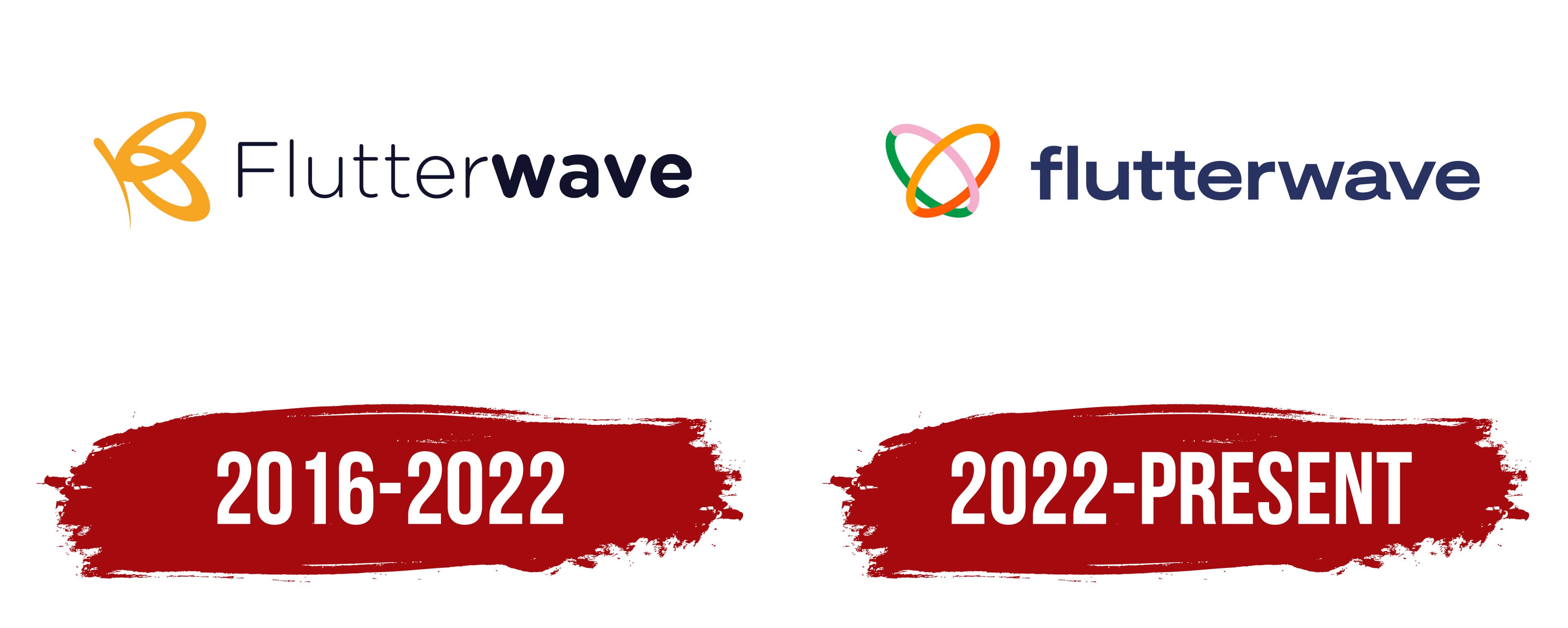
The Flutterwave logo consists of two main elements: an abstract symbol and the brand’s wordmark, combined into a single, concise composition.
On the left is a figure created as a single, smooth, continuous yellow-orange stroke, forming a shape reminiscent of butterfly wings or the gentle motion of a wave. This visual approach serves as a metaphor for growth, movement, and freedom. The smooth lines and absence of sharp angles emphasize the platform’s flexibility and its focus on simplicity and transaction speed. The symbol represents the flow of money without borders or obstacles, embodying the company’s name, which combines the words “flutter” and “wave.”
On the right is the company name “Flutterwave.” The font is a modern geometric sans serif with neat rounded forms and consistent line thickness. The first letter is capitalized while the rest are lowercase, giving the inscription a visually light and friendly appearance. The dark blue text color was chosen deliberately and is perceived as a symbol of trust, professionalism, and stability, qualities important in the financial sector. A distinctive feature of the design is the division of the name into two parts, with a slight visual contrast: the word “wave” is set in a slightly bolder typeface.
The font has characteristics similar to popular typefaces such as Nunito Sans or Avenir Rounded. Still, it has unique proportions and details tailored specifically to the brand’s needs.
The Flutterwave logo was conceived as a universal visual concept easily adaptable across various communication channels, from web application interfaces to marketing materials and API documentation. Thanks to its expressive simplicity and positive emotional associations, it has become established in users’ minds as the symbol of one of the most successful African technology platforms.
2022 – today

The new Flutterwave logo emerged as part of a large-scale rebranding that accompanied the company’s expansion into international markets. This rebranding reflects Flutterwave’s transformation from an African fintech startup into a full-scale global payment platform with partnerships worldwide.
The intertwining of three colored lines that form the Flutterwave symbol symbolically represents the diversity and unity of the cultures and economies connected by the platform. Orange is associated with energy and innovation, green with growth, and pink conveys accessibility and friendliness. Together, the lines create a shape reminiscent of both a butterfly, symbolizing transformation, and the infinity sign, suggesting unlimited possibilities and the brand’s ongoing development.
The introduction of the new identity was accompanied by a complete update of all brand touchpoints, from websites and digital interfaces to advertising and marketing materials. The logo was integrated into the company’s products, including Flutterwave Store, Send App, and Payment Links, making it easy to identify Flutterwave services across various markets and platforms.
The logo change was not driven by aesthetic goals but by the need to reflect Flutterwave’s shift toward working with corporate clients and global financial institutions, reinforcing its maturity and reliability in the eyes of major international partners.
The font is a strict geometric sans-serif with rounded letterforms, allowing the logo to maintain versatility, modernity, and readability across all digital communication channels.
The introduction of the new emblem coincided with the company’s expansion into the United States and Europe, as well as growth in new African markets, thereby strengthening the brand’s presence and competitiveness on the global stage.
