 Klaviyo Logo PNG
Digital marketing in e-commerce is built on analyzing user behavior and automating communication. Email and SMS campaigns are triggered based on customer actions, enabling data-driven engagement. The Klaviyo logo represents a company that develops a platform for marketing automation and customer data management for online stores.
Klaviyo was founded in 2012 in Boston by Andrew Bialecki and Ed Hallen. The idea emerged when the founders noticed that retail brands and e-commerce companies were collecting large amounts of customer data. However, they lacked the technology to use this data effectively.
In 2013, the company launched its email marketing feature. It enabled businesses to send automated messages and became the foundation for the platform’s further development.
In 2018, Klaviyo introduced marketing attribution and optimization tools. In 2019, the company entered the Forbes Cloud 100 ranking, confirming its status as a leading private cloud solution provider.
In 2021, Klaviyo launched its SMS marketing feature, expanding its communication capabilities with customers. In August 2022, Shopify invested $ 100 million in Klaviyo and designated the company as its recommended partner for Shopify Plus solutions. In the same year, Klaviyo was included among the 500 best employers in the United States and the 50 best in the United Kingdom.
In 2023, the company added the Reviews and Customer Data Platform features, enhancing the platform’s analytical capabilities. In September 2023, it held an initial public offering on the New York Stock Exchange under the ticker KVYO. By that time, the platform had more than 130,000 clients, primarily Shopify merchants.
The company introduced a B2C CRM product that integrated data, marketing, and analytics. Today, more than 176,000 brands worldwide use the platform. The company remains a leading player in the digital marketing market.
Meaning and History
What is Klaviyo?
An American technology company from Boston develops a cloud-based marketing automation platform for e-commerce. The system combines customer data management, email and SMS campaigns, push notifications, and analytics. The platform uses customer behavioral data to personalize experiences, including welcome emails and loyalty programs. It integrates with more than 300 solutions, including Shopify, WooCommerce, Magento, and Salesforce Commerce Cloud. Shopify invested $100 million and recommended the product to Shopify Plus-level clients.
2015 – 2022
Klaviyo was founded in Boston in 2012 by Andrew Bialecki and Ed Hallen. They created a platform for consumer brands that helped collect and analyze customer data and prepare personalized messages. The work began with a customer database. Klaviyo, Inc. was incorporated in Delaware on September 14, 2012, and added email marketing tools in 2013. The company later combined data storage and processing with automated communications through email, SMS, and other digital channels.
Klaviyo is pronounced “CLAY-vee-oh” and comes from the Spanish word clavija. The company associates the word with a climbing hook, or piton, secured in rock for protection. It provides support during a climb and catches a climber during a fall. In the brand’s explanation, it compares customers to climbers. At the same time, the platform helps them move toward the summit and accelerate their ascent. The association grew from Ed Hallen’s interest in outdoor activities. The altered spelling of clavija produced the international name Klaviyo.
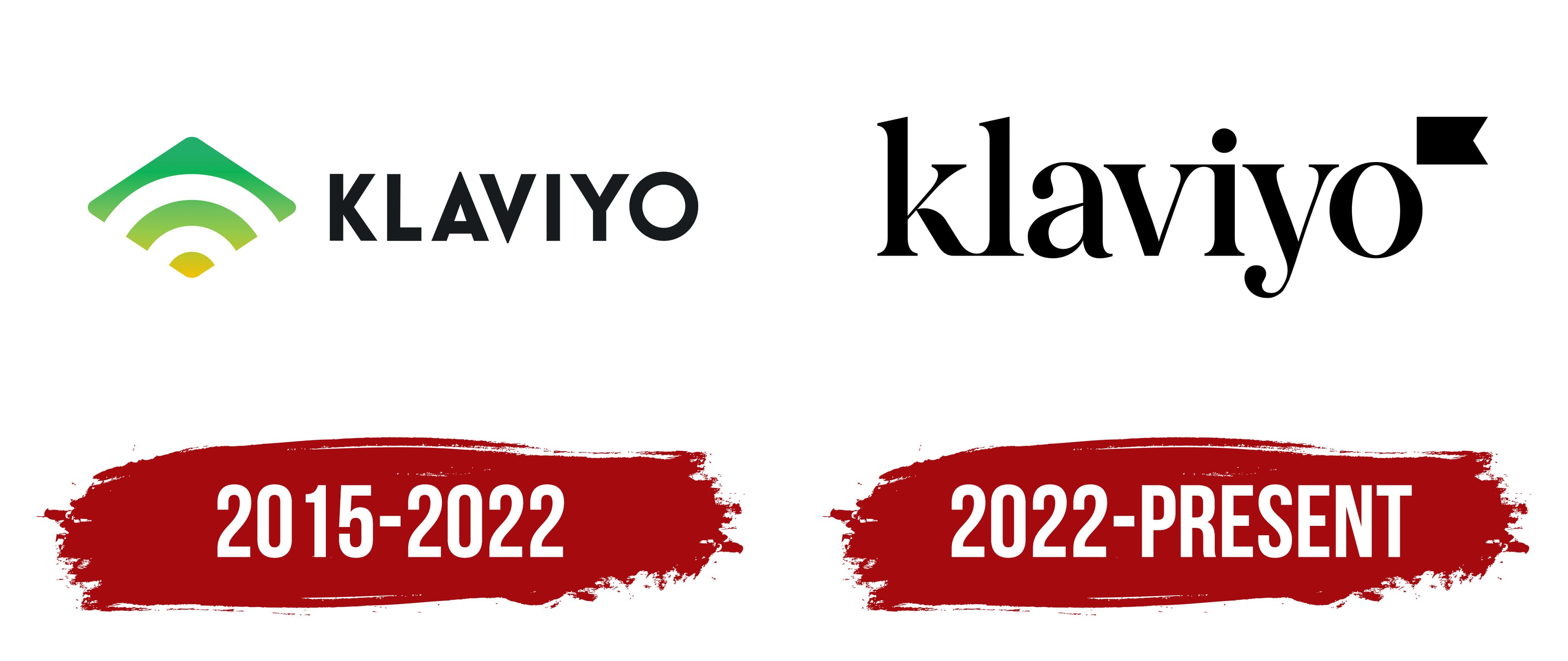
In the early logo, a colored emblem resembling a wireless signal indicator appeared to the left of the black “KLAVIYO” wordmark. Its outer contour formed a horizontally elongated diamond. Two curved openings divided the figure into three sections. The upper and longest section resembled a roof or an inverted check mark. An arc appeared underneath, followed by a short section with rounded sides at the bottom. The curves repeated one another and resembled expanding radio waves.
The color transitioned from green at the top through light green and yellow-green shades to yellow at the lowest point. Against a white background, the open spaces separated the emblem’s sections and made their forms visible. The symbol appeared independently in compact formats. Together with the name, it formed a horizontal logo.
The “KLAVIYO” wordmark was set in black uppercase letters using a sans-serif typeface. All letters had the same height and uniform stroke widths. Wider spacing between the letters complemented the line’s geometric construction. Vertical strokes were combined with angular diagonals. The letter “A” consisted of two diagonal lines, leaving an open triangular space inside. The black name contrasted with the green-and-yellow emblem.
2022 – today
Klaviyo unveiled a new logo on March 23, 2022, as the platform expanded beyond email marketing. The company presented it as a tool for managing customer data and communicating with buyers across channels. The rebrand was based on businesses’ right to control their information, relationships with their audiences, and future development. The statement “Own your data. Own your growth.” connected data ownership with company growth.
The former uppercase sans-serif wordmark was replaced with the black lowercase name “klaviyo.” The green-and-yellow emblem was removed, and a small flag was added to the right of the name. The serif lettering combined heavy primary strokes with thin connecting lines and wedge-shaped serifs. The proportions and spacing between the letters were developed for a complete logo intended to be reproduced as a single unit.
Executive Creative Director John Goodwin described the concept as a modern interpretation of a classic organic serif typeface. This lettering distinguished Klaviyo from technology companies that used similar neutral sans-serif fonts. The typeface change reflected the organization’s growing maturity.
The flag sat to the right of the final “o” and rose above the line like an exponent. The flag has a straight left edge and a triangular cutout on the right. It appears separately from the flagpole. Goodwin explained the flag’s position through the mathematical image of an exponent, representing the platform’s ability to help customers achieve exponential growth.
The founders and brand team associated the symbol with data ownership, the right to shape a business’s future, community building, navigation, speed, and success. Andrew Bialecki discussed how flags mark achievements, bring people together, and provide direction. The image continued the mountaineering theme behind the Klaviyo name, linking it to climbing, support, and reaching the summit. The rebrand added the idea of companies controlling their relationships with customers.
The identity’s development began in 2021 under the internal creative direction of John Goodwin. UX Creative Director Tae Chong led the digital design team and contributed to the rebrand and the identity’s subsequent development. The Chicago studio Someoddpilot later joined the work on applying the system.
The name and flag used the same color. A black version appeared on light backgrounds, while a white version appeared on dark backgrounds. The shared color united the serif letters and geometric flag into a single signature.