MySQL Logo PNG
The MySQL logo symbolizes the reliability and performance of the database management system. The dolphin image represents speed, flexibility, and platform efficiency, highlighting core operational principles and their importance to IT infrastructure.
MySQL grew from UNIREG, a database tool created in 1979 by Swedish programmer Michael Widenius for one company’s internal needs. After roughly fifteen years of development, Widenius founded MySQL AB in 1995 with David Axmark and Allan Larsson. The name combined his daughter My’s name with SQL. They built their product as a faster, less costly alternative to the heavy commercial database systems that dominated the market at the time.
Its reach expanded in 2000 after adoption of the GPL license, which allowed developers to use, study, modify, and distribute the code. MySQL soon became common in web development and supported major platforms including Facebook, YouTube, Wikipedia, and Twitter. Its relatively low operating cost and capacity to process large data volumes helped it compete with Microsoft SQL Server.
A major technical addition was InnoDB, created by the Finnish company Innobase to provide transactions and stronger data integrity. A major database vendor bought Innobase in 2005, placing a key component under the control of a direct corporate rival. The purchase drew concern because InnoDB had become vital to the system.
Sun Microsystems acquired MySQL AB for $1 billion in 2008, turning software from a small Swedish team into a major technology asset. In 2010, Oracle purchased Sun and gained control of the product. Fears over its open-source future led Widenius and other developers to leave and create MariaDB, a compatible fork developed independently from the new owner.
Meaning and History
What is MySQL?
It is a popular, free relational database management system. It stores data in interconnected tables and uses SQL to interact with users. The system is popular due to its speed, ease of use, and compatibility with multiple programming languages and operating systems. It suits both small websites and large projects that handle large volumes of data.
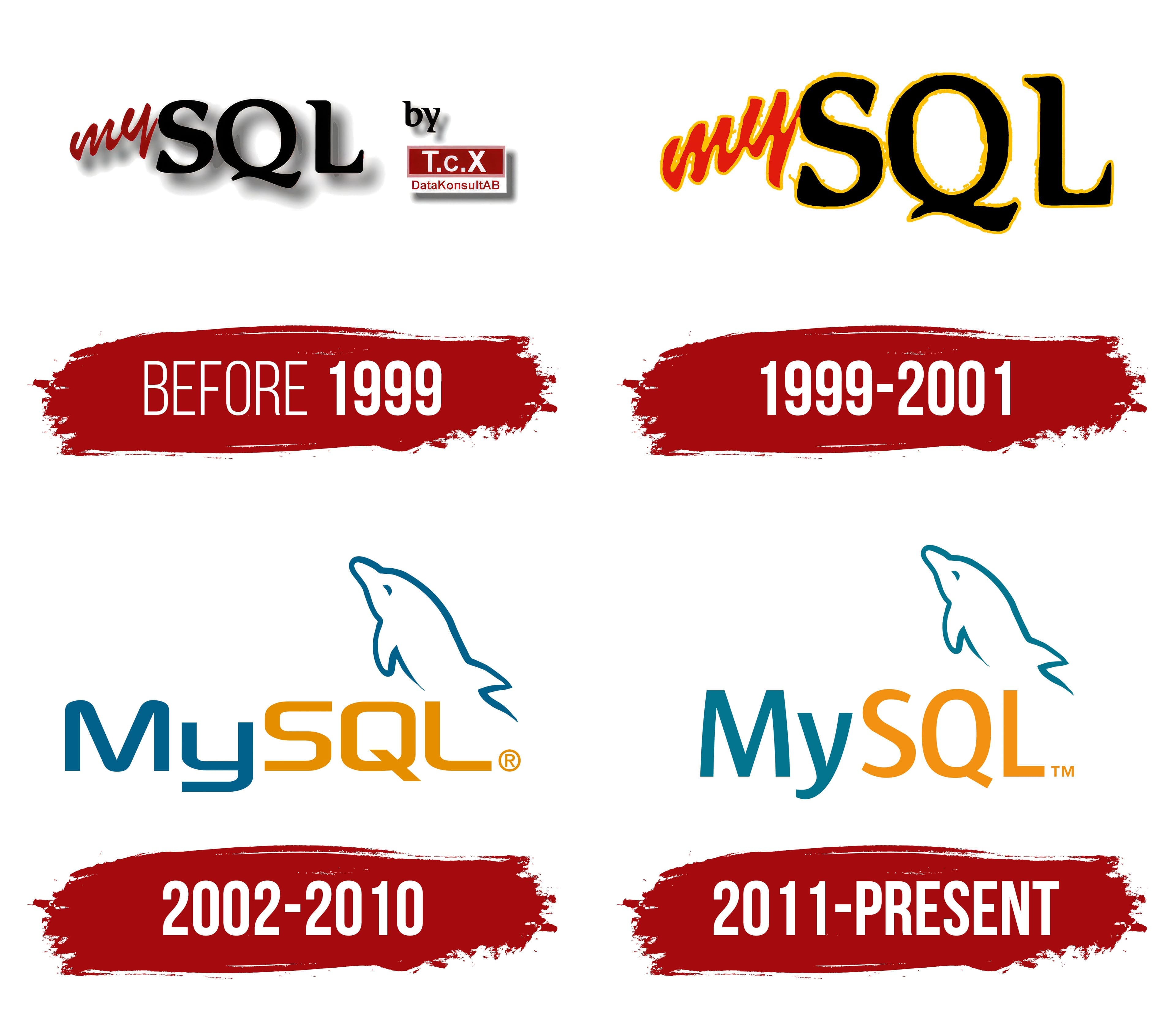
Before 1999

The first MySQL logo dates back to the early stages of the system’s existence, when the project evolved from the mSQL database into an independent product. At this stage, the developers’ focus was on stability and attracting the first users, and the visual identity was primarily utilitarian, built from typography without symbolic elements or complex imagery.
The composition consisted of two blocks contrasting in color, typeface, and emotional perception. The upper part featured the word “My” in dark red, handwritten in italics. The letterforms were uneven and organic, characterized by variable stroke thickness, the absence of serifs, and a lack of strict geometry. This handwriting visually resembled a spontaneous note in the margins, emphasizing the developers’ personal initiative and the freedom of open source.
The lower block contained the uppercase letters “SQL” in a classical serif typeface. The letters had strict proportions, symmetry, and fine serifs. The strokes showed high contrast in thickness, and the forms maintained vertical stability. This choice of typeface reflected the structural nature of the query language, associated with stability, logic, and the product’s technological precision.
The main conceptual focus of the composition was the tension between the emotional freedom of the handwritten “My” and the technological rationality of the block “SQL.” Visually, this combination resembled a sketch on an engineering blueprint, reflecting MySQL’s dual nature as a product created by enthusiast developers and a strict technical tool.
By the end of 1999, an additional red-and-white plaque bearing the text “TcX DataKonsult AB” began appearing alongside the logo. This element was placed separately, like an author’s signature, indicating the system’s Scandinavian engineering origin.
The logo’s color palette was minimal and functional. Red emphasized the team’s personalized, creator-driven approach, while black referred to the software product’s technical stability, structure, and reliability.
Despite its simplicity and lack of symbolic detail, the first MySQL logo accurately conveyed the philosophy of its early development: pragmatism, openness, and a prioritization of engineering over branding. This design can be likened to a basic structural sketch that later became the foundation for the fully developed and recognizable MySQL identity.
1999 – 2001

The redesign of the MySQL logo in 1999 marked the first step toward organizing the system’s visual identity as it integrated into the professional web development environment. Until then, the logo existed as a disjointed composition based on functional designation. The new version was developed in-house at MySQL AB and reflected an attempt to find a balance between recognizability, simplicity, and technical applicability.
The main structure preserved continuity. The “My” element remained handwritten and italic, but was rendered in a richer scarlet and outlined with a thin yellow contour. This outline enhanced visual volume, making the lettering stand out on any medium or background. The strokes of the letters varied in thickness, imitating a live signature and emphasizing the authorial origin. The letterforms were intentionally imperfect, with deviations from geometric norms, preserving a reference to the developer community and the spirit of open source.
The “SQL” component received a reworked structure with a stronger focus on geometry. The uppercase letters were set in a dense serif typeface with clear vertical rhythm and compact proportions. The yellow outline served as a dividing line between the black fill and the background, ensuring legibility and visual stability across environments. The typography conveyed a sense of structure, engineering precision, and technological weight.
The palette was built on three dominant colors: scarlet, black, and yellow. Scarlet served as the emotional accent, drawing attention and referencing initiative. Black symbolized the technological foundation, functionality, and rigor. Yellow unified the elements, provided visual balance, and served as a buffer, making the logo adaptable for scaling and placement across different contexts.
This version was used until the early 2000s and marked a period of growth and active integration of MySQL into the LAMP stack. Despite its minimalism, the logo provided functional identification and was easily applied to documentation, distribution, and interfaces. It was perceived as utilitarian but already assembled and consistent, serving as a transitional stage toward a fully developed identity with a symbolic image that would appear in the next version.
The 1999 redesign served as a temporary stabilization of the visual language, laying the groundwork for further standardization and scaling of the brand within an open, evolving product.
2002 – 2010

The 2002 redesign of the MySQL logo marked a shift away from a purely typographic solution toward a comprehensive visual system, with a metaphorical dolphin image at its centerpiece. This change was significant both in terms of the formal design language and in how the product positioned itself on the international stage. The initiative came from the Helsinki agency Priority Advertising Oy, and Renne Anjellvuo and the team developed the image concept. Implementation began in 2001, and by 2002, the logo had been incorporated into the official brand book.
The dolphin silhouette added new depth to the visual identity. The figure, leaping dynamically to the right, symbolized forward movement, lightness, and latent potential. The dolphin’s outline, thin, continuous, with smooth curves, was perceived as a stream of water transforming into the animal’s shape. This approach created associations with a wave, momentum, and energy. The absence of realistic details emphasized the image’s universality and metaphorical nature, as the dolphin became a symbol rather than a depiction of a specific biological species.
Semantically, the mascot conveyed qualities important for the product: collective intelligence, responsiveness, adaptability, and friendliness. These traits were highly relevant to open-source systems with growing communities. The dolphin image was also tied to the personal beliefs of MySQL co-founder Monty Widenius, who highlighted the dolphin’s ability to cooperate and resist stronger opponents, interpreting it as a direct metaphor for competing with large proprietary database systems. Later, the community gave the mascot the name Sakila, adding a layer of personalization and emotional connection to the brand.
The “MySQL” wordmark was built on contrast. The word “My” was rendered in a cool turquoise, while “SQL” appeared in a saturated orange. This color division improved legibility and symbolized the separation between the project’s personal (individualized) and technological aspects. Turquoise was perceived as rational, calm, and transparent, while orange represented energy, positivity, and accessibility.
The typeface was a geometric grotesque with soft shapes. The absence of sharp corners, rounded apertures, and balanced proportions created the image of a modern, flexible, and intuitively understandable product. The font adapted easily to various scales and media, fitting naturally into the digital environment of the 2000s, which valued simplicity and functionality.
The composition followed a clear hierarchy: the dolphin mark was placed above the text, maintaining spatial balance and avoiding conflict between the elements. The dolphin’s upward and rightward motion guided the viewer’s eye, symbolizing progress, growth, and a forward-looking vision.
This visual system became the foundation of MySQL’s identity for many years. It set a high standard for how the brand is perceived as an open, technologically reliable, community-oriented tool. The dolphin became a symbol of the ecosystem, and the overall visual concept achieved broad recognition and professional respect in the industry.
2011 – today

After Oracle acquired MySQL, the visual system was adopted without disrupting continuity. Instead of a complete rebranding, a targeted redesign was carried out: the composition, typeface, and palette were updated to meet the standards of the corporate environment into which the product had been integrated. The approach aimed to preserve the previously established meanings while increasing the formal consistency of the elements.
The main change concerned spatial arrangement. The dolphin silhouette was relocated to the upper-left corner and positioned separately from the wordmark. The diagonal movement from the upper left to the lower right set the reading direction and reinforced the text’s linear flow. The dolphin’s body line remained streamlined, without sharp breaks, preserving smoothness and dynamism. In this position, the dolphin was perceived more as a component of a coordinate system than as a character, an element of navigation rather than an emotional one.
The typography was also updated. The new typeface was a geometric grotesque with moderate vertical elongation and smooth stroke transitions. All glyphs were balanced in weight, apertures were enlarged, and the rhythm was visually even. This construction reinforced associations with adaptive architecture and engineering precision. The wordmark was perceived as part of an interface: neutral, functional, and easily scalable.
The palette was fixed as a two-component system: blue-turquoise for “My” and orange for “SQL.” These colors were standardized and integrated into Oracle’s corporate system. Turquoise represented transparency, structural clarity, and openness; orange was associated with energy, accessibility, and engagement. The color division reflected the brand’s binary nature: a personalized foundation paired with professional tools.
In the current version, the dolphin symbol evolved from an emotional image into a system marker. It no longer reads as a metaphor or character; instead, it functions as an abstract module applicable in any context, from interfaces to documentation. It serves identification and navigation rather than symbolic storytelling. Its function is now closer to that of a marker or pictogram than to that of a traditional brand emblem.
In this form, MySQL’s identity demonstrates maturity. It has become an integral part of the corporate environment while retaining traces of its original open nature.