


 PPG Industries Logo PNG
A coat of paint on a vehicle body, a coating on a building facade, or a protective film on equipment shapes the appearance while extending the surface’s service life. In such materials, the properties that matter are those that manifest in performance, not on display. The PPG Industries logo is associated with a company that develops and manufactures paints, varnishes, and specialty coatings for transportation, construction, and industry.
PPG Industries was founded in 1883 by John Baptiste Ford and John Pitcairn in Creighton, Pennsylvania. The company was originally called Pittsburgh Plate Glass Company. It was the first to use an industrial method for producing flat glass.
By the end of the 19th century, the company began producing paints to protect glass during transport. This area became the foundation of its future coatings division. By the 1920s, PPG was producing automotive glass. By the 1940s, the company had begun manufacturing fiberglass and had become a leader in that field.
In 1968, the company changed its name to PPG Industries. This reflected the expansion of its activities. In the 1970s and 1980s, it entered foreign markets and opened facilities in Europe and Asia. In 1985, PPG acquired Olympic Stain, a company specializing in wood coatings.
By the end of the 20th century, the company focused on coatings and specialty materials. In 1999, it sold its glass business. In 2008, it acquired SigmaKalon Group for $3 billion.
In 2013, the company acquired AkzoNobel’s North American business. In 2022, it added the Finnish company Tikkurila to its assets. PPG continued expanding in Asia and Latin America, with particular attention to investments in automotive and industrial coatings.
In 2024, the company introduced a mobile app for color selection. The new system improved customer service and simplified interaction with buyers.
The company remains one of the world’s largest coating manufacturers. It supplies architectural, industrial, and automotive paints as well as specialty materials. Production facilities are located in seventy countries. PPG serves the construction, transportation, and aerospace markets.
Meaning and History
What is PPG Industries?
An American corporation that holds leading positions in the global market for paints, coatings, and protective materials. It produces products for industry, construction, transportation, and consumers. The range includes aerospace, automotive, marine, and anti-corrosion coatings, as well as adhesives, sealants, and marking materials. The company also manufactures optical components and materials for the electronics industry. The business is divided into two segments: performance coatings for construction, automotive, and aviation, and industrial solutions for plants and infrastructure. Its divisions operate in more than seventy countries and manage the brands Tikkurila, Sigma, Wörwag, and Comex.
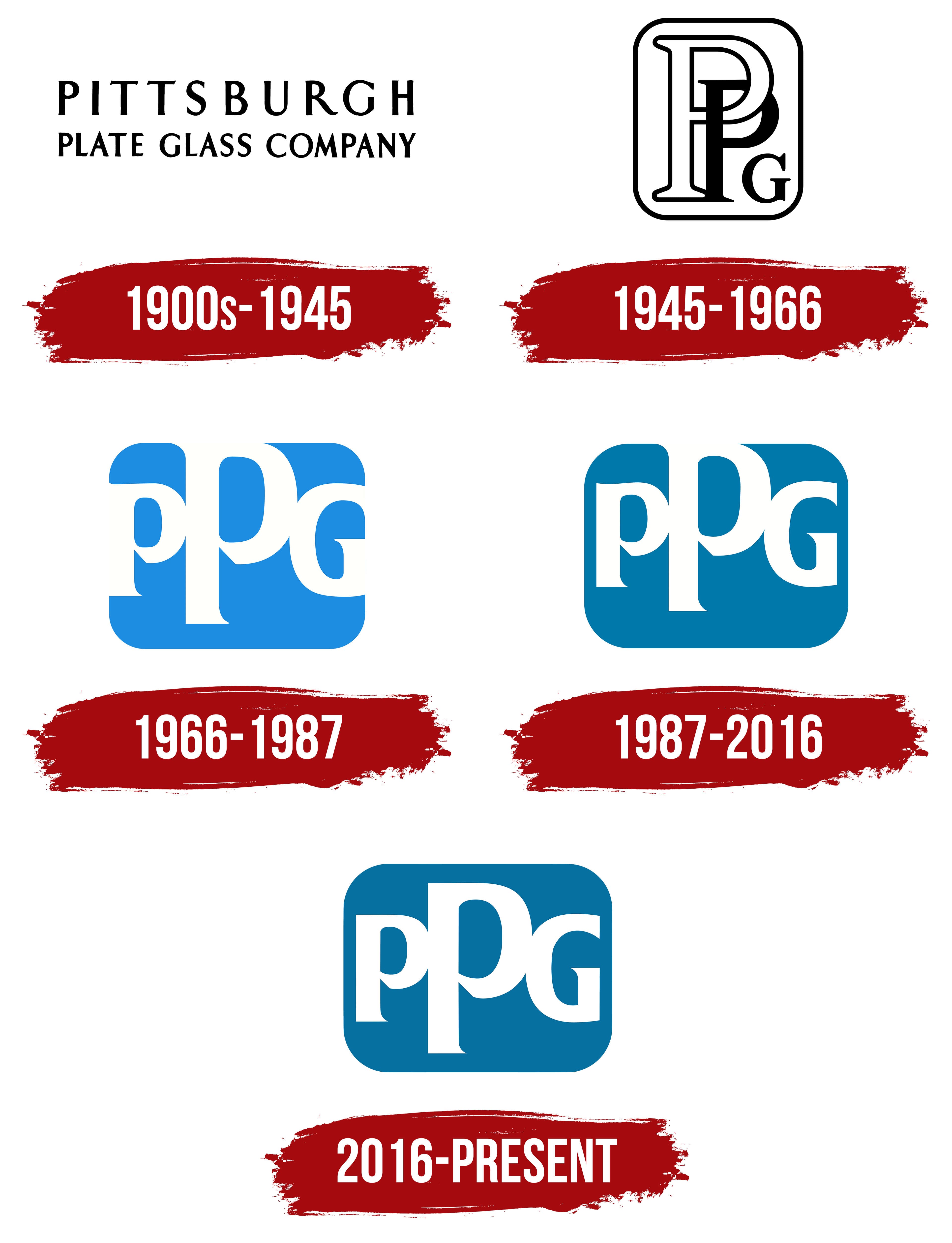
1900s – 1945
Pittsburgh Plate Glass Company began as a manufacturer of large-format polished glass. Captain John Baptist Ford and businessman John Pitcairn Jr. founded the business in Creighton, Pennsylvania, in 1883. Initially called New York City Plate Glass Company, it adopted a name associated with Pittsburgh, where the company was managed, on August 17, 1883.
The words “plate glass” referred to thick, flat glass with ground and polished surfaces. The plant became the first commercially successful American producer of high-quality glass made through rolling and grinding. It was the first glass manufacturer to use local natural gas to heat its furnaces, reducing the need for imported fuel. The initial letters of Pittsburgh Plate Glass formed the abbreviation PPG, which later became part of the commercial name.
The early logo consisted of 2 lines. Large “PITTSBURGH” lettering appeared at the top, occupying the full width of the wordmark. The tall, narrow letters had small serifs and were spaced apart. “PLATE GLASS COMPANY” appeared below. The lower line used small, heavy letters with tight spacing. The geographic name held the leading position, while the wording beneath it explained the company’s product and organizational status.
Both lines used black uppercase letters. Size, proportions, and spacing helped distinguish the 2 parts of the name despite their shared color. The spacious upper line paired with the dense lower line gave the full name the form of a compact text block.
By the early 20th century, the company had expanded its range to include paints, varnishes, brushes, chemical ingredients, and glass products. In 1900, it acquired a stake in Milwaukee’s Patton Paint Company. It then began producing alkali for glass manufacturing and opened its first European plant in Belgium. As new businesses developed, the historic name continued to be used alongside PPG, which gradually became a shared identifier for the diversified company.
1945 – 1966
By the mid-1940s, PPG was using a monogram of 3 intertwined letters as an abbreviated product identifier. It appeared on glass, paint cans, metal nameplates, vehicles, and technical materials. In some versions, the full name Pittsburgh Plate Glass Company appeared alongside it to identify the manufacturer.
A vertically elongated frame with strongly rounded corners surrounded the monogram. The first “P” was drawn as an outline extending almost the full height of the interior. A smaller, solid black second “P” overlapped it at the upper right. An even smaller “G” appeared at the lower right, slightly apart from the 2 upper letters. The progressive decrease in size created a diagonal from the large “P” toward the lower corner.
All 3 letters had serifs and combined thick and thin strokes, resembling traditional book typefaces. The “G” had small internal serifs. The light interior of the first “P” made its contour easier to follow where it intersected with the second letter. The 2 solid forms occupied less space, balancing the large outlined section.
The outer border matched the line weight of the first “P” and brought the letters together in a shared block. Light gaps remained between the frame and monogram, separating the thin strokes from the outer boundary. The black-and-white treatment allowed the emblem to be reproduced on different materials while preserving the distinction between the outlined “P” and the 2 solid letters.
1966 – 1987
By the 1960s, PPG had become a diversified company with overseas operations and a billion dollars in sales. It produced glass, chemicals, paints and coatings, fiberglass, and optical products. The name Pittsburgh Plate Glass Company still reflected its original specialty. Glass manufacturing was also changing, with polishing giving way to the float process. As its activities expanded, it adopted an updated emblem and, later, a new full name.
PPG introduced the new logo on October 24, 1966. Raphael Boguslav of Lippincott & Margulies designed it. He replaced the intertwined monogram with 3 adjacent PPG letters. They were placed on a light blue field with strongly rounded corners. The white lettering occupied almost the entire interior and resembled cutouts in the colored base.
The central “P” rose above the neighboring letters and touched the field’s upper edge. The left “P” and right “G” were equal in height and extended close to the side edges. The large middle letter stood out between the 2 smaller ones, forming the wordmark’s raised center. Serifs and similar stroke construction united the 3 letters, while their close contact brought them together in a dense horizontal group.
In 1968, Pittsburgh Plate Glass Company was renamed PPG Industries, Inc. The abbreviation preserved the connection to the company’s history, while “Industries” encompassed its different manufacturing sectors. By the time of the name change, the emblem with the shortened PPG had already been in use for 2 years.
1987 – 2016
In the late 1980s, PPG updated the emblem while retaining the letter arrangement from the 1960s version. The colored field was widened slightly, and its corners were rounded. The letters were reduced slightly in size. The left “P” and right “G” moved toward the center, increasing the side margins.
The central “P” continued to rise above the neighboring letters. The size difference maintained a connection to the earlier monogram. Additional open space appeared around the letter group, so the wordmark filled the background less tightly.
Dark turquoise blue replaced the light blue. The updated emblem appeared on factory signs, vehicles, and packaging. The full name PPG Industries continued to appear alongside it. However, the shortened PPG increasingly represented the company in commercial communications.
2016 – today
By 2016, customers knew the Glidden, Olympic, Pittsburgh Paints, and Porter brands better than PPG, the company behind them. Paints and coatings were already the core of the business, so the corporate name needed to connect to its many product brands. In March, PPG introduced a shared brand system developed with Interbrand. The project followed the acquisition of AkzoNobel’s North American architectural coatings business and covered industrial, automotive, aerospace, and architectural operations.
In audience communications, PPG Industries became PPG. The endorsement “by PPG” appeared on subsidiary brand packaging to identify the manufacturer. The corporate emblem was given greater prominence on paint cans and industrial coatings packaging. Customers could connect familiar products to a shared company operating under one name across different countries.
The logo retained its white monogram on a blue field with rounded corners. Letters of different heights touched closely and occupied almost the entire background. The group was shifted downward and centered between the side edges. The outer boundary became continuous. The upper corners were softened slightly, while the lower corners received larger curves.
The primary shade, PPG Blue, became darker. The white letters stood apart from the saturated background while preserving the monogram’s existing construction. Doremus prepared black-and-white versions for single-color printing, allowing the logo to work under different reproduction conditions.
Doremus developed the international campaign. The phrase “We protect and beautify the world” replaced the previous “Bringing innovation to the surface.” The promise of protecting and beautifying the world explained the purpose of coatings and accompanied the shortened PPG name.
In October 2016, the company acquired naming rights to the Pittsburgh Penguins’ hockey arena. The venue became PPG Paints Arena. The word “PAINTS” appeared beside the monogram on its facade, identifying the paints and coatings business.