Drupal Logo PNG
The Drupal logo reflects the technical flexibility and reliability of the content management system. Its simple graphic design emphasizes practicality, usability, and the platform’s open nature, making it popular among web developers.
Drupal began in 2000 in a student dormitory at Ghent University, where computer science student Dries Buytaert built a small message system for classmates using a wireless network. When he later opened it to a wider audience, he intended to register dorp.org, using the Dutch word for “village,” but typed drop.org instead. The final name came from the Dutch word “druppel,” meaning “drop.”
In 2001, Buytaert released Drupal 1.0 as open-source software. Developers could inspect the code, modify it, and create modules, allowing a volunteer community to expand the platform. A major early test came in 2003 with DeanSpace, a network of supporter sites built for Howard Dean’s US presidential primary campaign.
By the mid-2000s, Drupal had become one of the leading content management systems alongside WordPress and Joomla, with a focus on complex websites. In 2007, Buytaert founded Acquia to provide commercial support, hosting, and professional services for organizations using the platform. NASA, Tesla, BBC, and NBC later used Drupal for web projects.
Drupal 8 arrived in 2015 with Symfony components, mobile support, multilingual tools, and newer web-development standards. The release required developers to adapt to a changed architecture. Drupal 9 followed in 2020 with a smoother upgrade path from the previous version, allowing migration over an existing installation. DrupalCon conferences became regular meeting points for the international developer and user community.
Meaning and History
What is Drupal?
It is an open-source web-development platform created by a Belgian programmer. Popular among large organizations for flexibility, extensibility, and reliability. Universities, government websites, and businesses frequently use it. Beginners find the interface complex, while professionals appreciate its powerful capabilities and modular structure.
Old

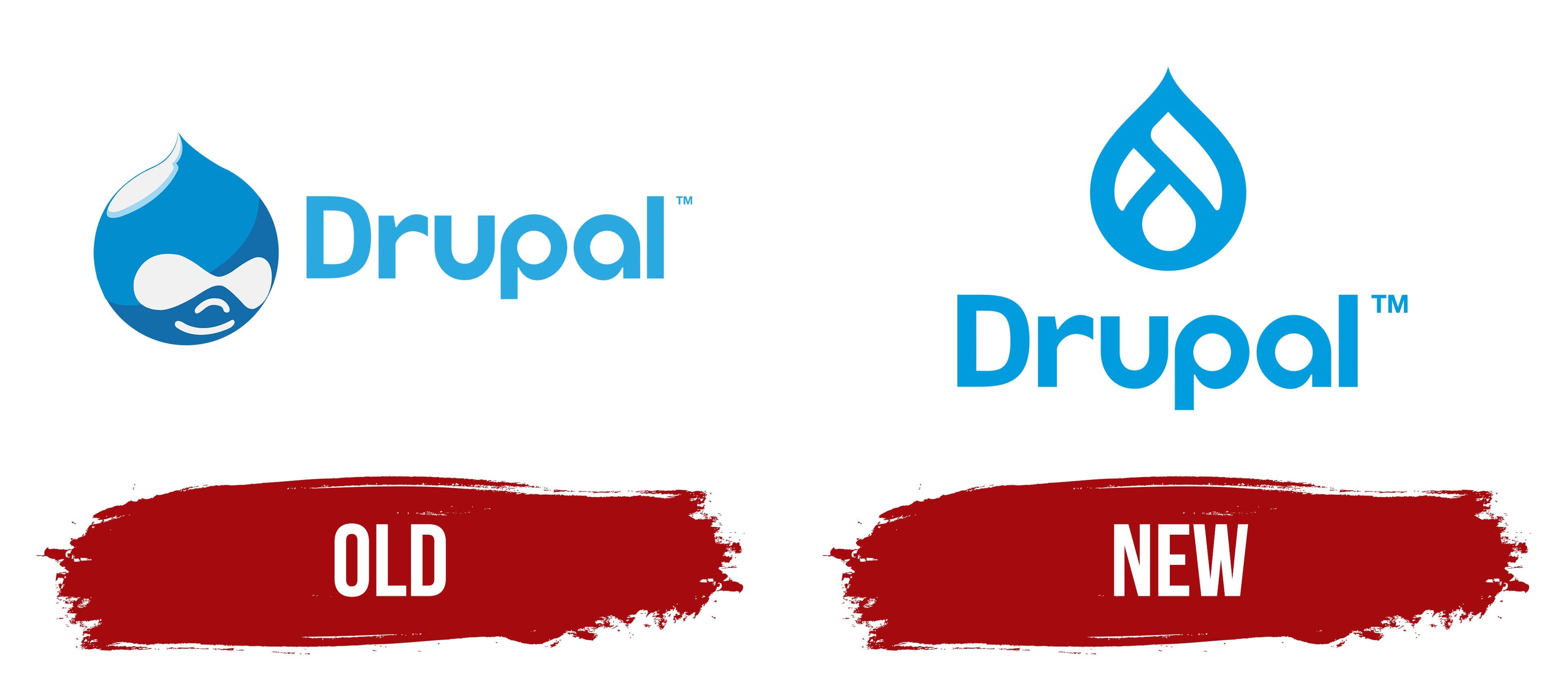
The first Drupal logo appeared when Dries Buytaert launched the Drop.org project and was searching for a name for the new content management system. The initial version of the symbol was created manually by Dries’s nephew, Jeroen Benjam, using the GIMP graphics editor. The image was a pixelated blue drop with no volume or additional elements.
Later, the visual concept was refined when designer Kristjan Jansen suggested adding facial features, eyes, and a smile inside the drop, making the symbol livelier and more emotional. The eyes were shaped like the infinity symbol, representing the system’s limitless possibilities. At the same time, the wide smile conveyed the community’s friendly nature.
The final version of the logo, named Druplicon, was completed by designer Steven Wittens (known as UnConeD). He gave the graphic image volume, gradients, and highlights, resulting in a recognizable three-dimensional appearance. This version served as the platform’s official symbol for an extended period. It was used in the interfaces of Drupal 4, 5, and 6, as well as in its documentation.
Alongside the symbol, a custom sans-serif font with rounded shapes was used. The smooth lines of the characters complemented the soft forms of the logo. The font had small, distinctive details, such as the long descender of the letter “p” and the wide form of the letter “a.” Stylistically, it was close to typefaces like Dax Rounded and VAG Rounded.
The old logo’s color palette featured bright blue and white, reflecting the brand’s purity, openness, and innovation. Blue emphasized the project’s technological and digital nature, while white conveyed the system’s transparency and clarity.
The platform’s name, Drupal, came about by accident. Dries intended to register a site called “Dorp,” meaning “village” in Dutch. However, a typo created the domain Drop.org, and the name Drupal eventually evolved from it.
Druplicon gained popularity within the community and became the project’s mascot. Many unofficial versions of the character appeared in various costumes and styles, representing different countries and cultures. Despite the rebranding that accompanied Drupal 7 and 8, which shifted the design toward a more formal and abstract style, the classic Druplicon has remained a beloved and recognizable symbol within the community.
New
The current Drupal logo was introduced as part of an official rebranding by the Drupal Association, in collaboration with members of the platform’s community. The updated design marked the first fully standardized visual identity for Drupal, created with modern digital branding needs in mind.
The main composition features a stylized blue water drop rendered in a minimalist geometric style. Inside the drop are two internal shapes that form the Latin letter “D,” along with a smaller secondary drop. These shapes reference the word “Drupal,” derived from the Dutch “druppel,” meaning “drop.” Unlike the previous mascot-based version, the current design is geometry-focused, emphasizing the content management system’s modularity and adaptability.
The typography is a geometric sans serif with smooth, rounded contours and consistent stroke width. Stylistically, it is similar to FF Max and Klavika, but customized. The glyphs have neat terminals, symmetrical proportions, and minimal letter spacing, ensuring readability across both digital and print formats at any scale.
Work on this logo and the broader visual identity took place between 2015 and 2016. The result was a comprehensive brand guide that established standards for the use of logos and brand graphics across all Drupal products and services.
The logo’s color shifted to a lighter shade of blue, highlighting the brand’s openness, transparency, and reliability in software and digital technologies. Compared to the deep blue of the old version, the lighter tone feels friendlier and softer. The combination of light blue and white evokes purity, the digital environment, and organized content.
Emotionally, the new Drupal logo conveys a sense of technological sophistication, clarity, and structure. The drop’s geometry, with its nested shapes, visually resembles a modular system, presenting the platform as a product with flexible capabilities and a well-defined internal structure. The abstract design suggests a digital drop of information, reinforcing Drupal’s role in managing and distributing digital content across the global network.