


 Iron Man Logo PNG
A distinctive feature of superhero visualization has become the creation of memorable personal symbols. For instance, the Iron Man logo stands out for its metallic texture and three-dimensional font, reflecting the character’s key traits and symbolizing his restraint and inflexibility.
Marvel Comics created Iron Man in 1963 with writer Stan Lee, illustrator Don Heck, and writer Larry Lieber. The character Tony Stark debuted in Tales of Suspense #39 in March 1963. The superhero developed during the Cold War reflects the era’s focus on technology and the military-industrial complex. Tony Stark, a wealthy, brilliant weapons manufacturer, suffers a life-threatening injury that forces him to rethink his life and build a high-tech suit to fight evil.
Stark’s Vietnam War injury in the early comics forced him to build an electromagnetic chest plate that eventually evolved into the iconic armor. Throughout the 1960s and 1970s, the character’s popularity grew, solidifying his role as a key member of the Avengers. The suit saw several upgrades, each showcasing the latest in technological advancements.
The 1980s brought a deeper exploration of Tony Stark’s character, particularly in the “Demon in a Bottle” storyline, which addressed his alcoholism. This storyline is considered one of the most important in comic book history and adds complexity to the superhero’s persona.
In the 1990s, Tony Stark continued to evolve, introducing new armor versions, such as the “Modular Armor,” and storylines that explored corporate responsibility and the ethics of technology. The 2000s brought a major shift with Warren Ellis’s Extremis miniseries, which updated the hero’s technology and backstory and influenced future adaptations.
The 2008 film Iron Man, starring Robert Downey Jr., cemented the character’s place in popular culture. The movie kicked off the Marvel Cinematic Universe (MCU) and was a huge success, grossing over $585 million globally. Downey Jr.’s portrayal brought Tony Stark to life with charm and wit, making the character iconic.
Following the film’s success, Tony appeared in numerous MCU films, including Iron Man 2 and Iron Man 3. His role in the Avengers movies became central to the MCU’s overarching narrative, particularly his relationship with Captain America.
This superhero’s legacy continued to evolve in the comics alongside his film appearances. New characters like Ironheart (Riri Williams), a young inventor who creates her version of the advanced suit, have carried on his legacy.
Tony Stark’s story in the MCU culminated in Avengers: Endgame (2019), where his character arc concluded with a powerful sacrifice. Despite this, he remains beloved in video games, animated series, and ongoing comic book stories. Over the years, the character has evolved from a straightforward superhero into a complex figure that explores themes of technology, personal responsibility, and redemption.
Meaning and History
The character’s literary prototype is Anthony Edward “Tony” Stark, a genius, scientist, playboy, and business magnate. He hides behind the Iron Man mask he created to uphold justice. When kidnappers attempt to force him to develop weapons of mass destruction, he creates a unique automated armor for himself. With its help, the inventor escapes captivity and hides from enemies. In subsequent comic book and movie versions, Anthony Edward uses the armor to protect the world as Iron Man.
The superhero owes his appearance to the Avengers, of which he was a member. A standalone version of the logo was launched simultaneously with the publication of Adventures in May 1968. Five seasons were dedicated to him, released intermittently from 2008 to 2012. Then came The Invincible Iron Man, which ran until 2014.
Later, the recognizable image, embodied in a personal emblem, appeared in movies, games, cartoons, and TV shows. Interestingly, the prototype logo on the magazine’s debut cover included early elements of future personal symbolism, such as spikes, seams, and metallic details.
The superhero himself hand-drew the true Iron Man logo. Initially (in “The Avengers”), it had simplified graphics and a mask composed of geometric shapes. The helmet design appeared after the first movie’s release. It features straight lines, sharp angles, and protrusions, similar to those found in real metal products.
However, before finalizing it, Marvel Studios representatives reviewed many drafts. They focused mainly on metallic textures and gradients. As a result, the emblem received a graphic sign and a stylized inscription. It dates back several years, appearing alongside other movie releases in 2008, 2010, and 2013.
What is Iron Man?
He is a superhero from popular movies and comics, so named for his massive metallic armor. He is a main hero of the Marvel universe and a member of the Avengers. Beneath the protective suit, with jet engines and high-tech weaponry, lies the brilliant billionaire Tony Stark. Iron Man debuted in 1963, with Stan Lee creating the character and Jack Kirby and Don Heck bringing him to life.
2006 – 2007
Tony Stark’s metal armor gave Iron Man his name and shaped the lettering on his comic covers. The engineer and industrialist built his protective suit after suffering a severe injury. Combining “iron” and “man,” the name linked the person to the machine he created. The Marvel character debuted in Tales of Suspense No. 39, cover-dated March 1963. Stan Lee, Larry Lieber, Jack Kirby, and Don Heck helped create him.
On his debut cover, the name IRON MAN already looked as though it had been assembled from metal parts. Small rivets covered the heavy, angular letters, connecting the lettering to the hero’s armor. The standalone series The Invincible Iron Man launched in 1968. Its title featured elongated uppercase letters with an outlined shadow that created depth. Later versions continued the metal theme through rivets, beveled corners, and perspective. By the time the film adaptations arrived, the name’s design was firmly associated with heavy metal construction.
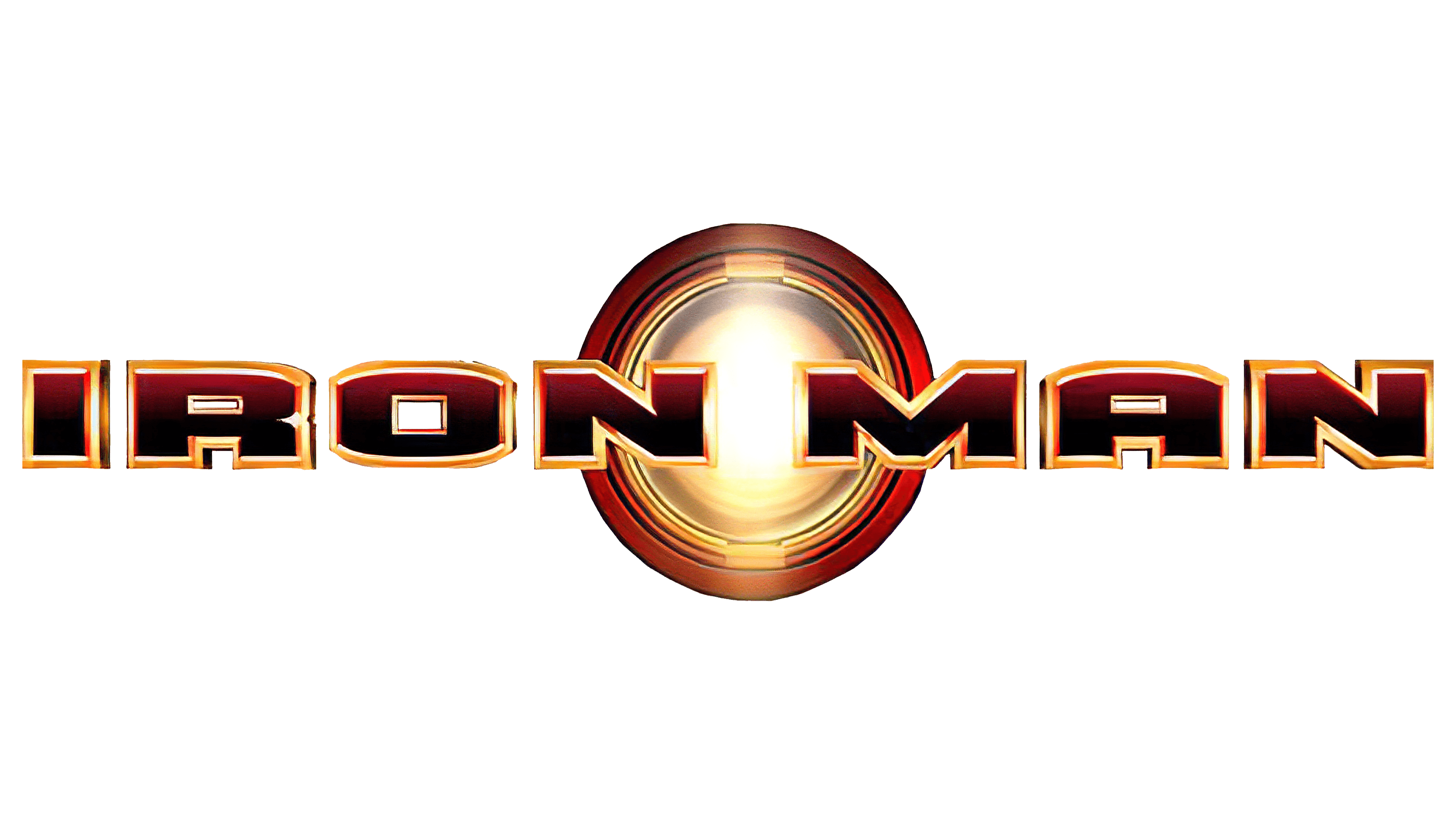
Marvel Studios and Paramount unveiled the preliminary film logo on the project’s teaser website in December 2006. The lettering retained its metallic appearance, with lighting, highlights, and layered outlines giving it depth. The two words formed a single wide horizontal line. The short, heavy letters had almost rectangular outlines. A dark red gradient across their surfaces, combined with red, beige, and gold facets, made the title look like a metal component.
Behind the gap between IRON and MAN sat a ring formed by several concentric rims. A bright white-yellow glow radiated from its center, illuminating the beige and red bands across the middle of the emblem. The ring, letter borders, and reflected light suggested a device with a glowing energy source. After its website debut, the logo appeared on toys and other film merchandise. Variations also appeared on production clapperboards.
2007 – 2008
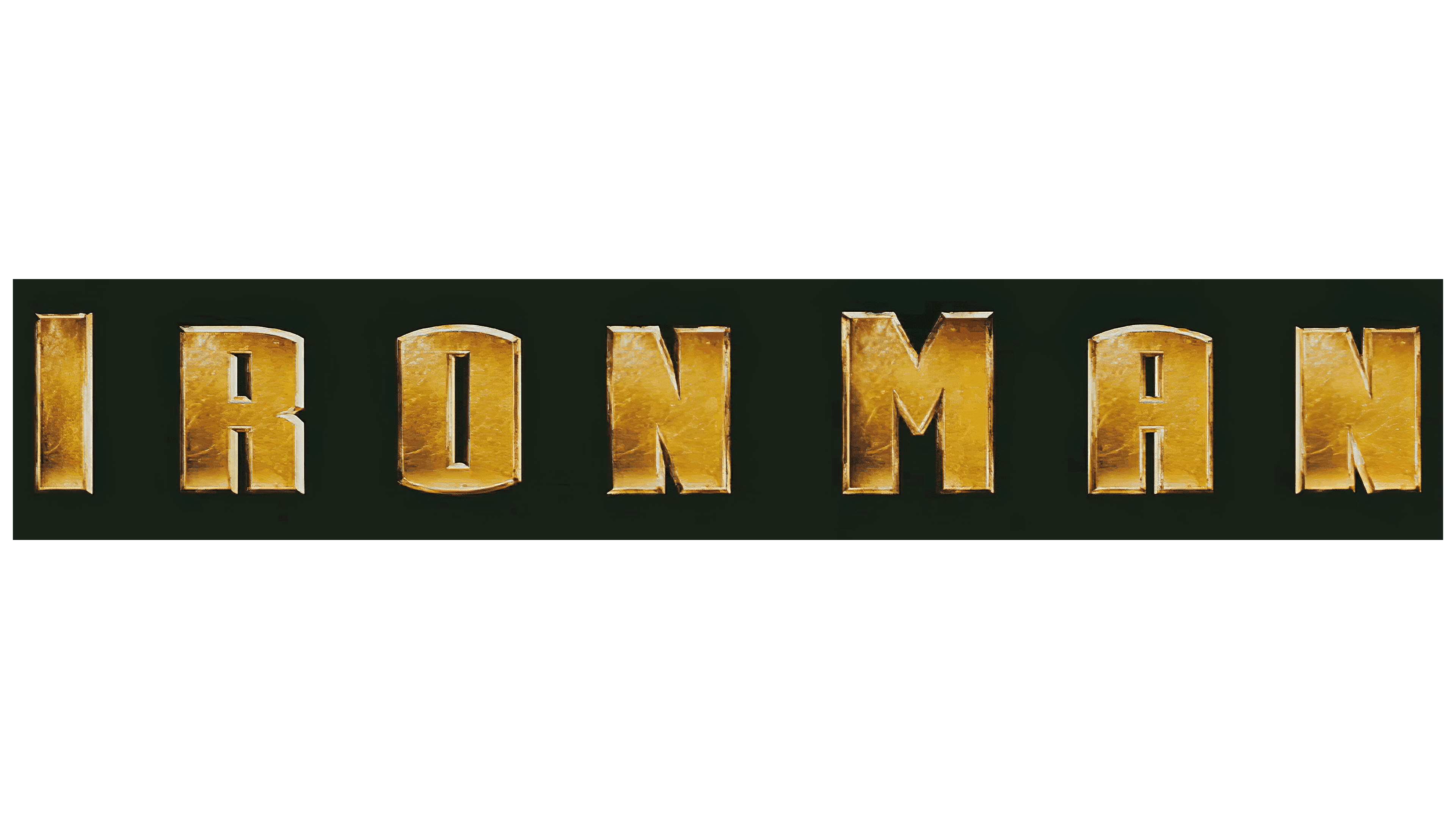
The next preliminary Iron Man logo placed greater emphasis on the film’s title. A dark rectangular background replaced the circle with its glowing center. The lettering grew taller, and the spaces between the letters widened. The words ran together in a continuous line. However, the initial “I” and “M” rose slightly above the other letters, helping divide the hero’s name into two parts. This version appeared in early teasers and other promotional materials ahead of the film’s release.
The copper-gold lettering had a rough texture marked by spots, scratches, and signs of wear. Highlights of varying intensity created relief and the impression of worked metal. Slight flares at the edges resembled the ends of metal components. The letterforms combined vertical strokes, angled cuts, and gently curved sections. The distinction between angular and rounded areas was more pronounced in the “O” and “R.” The black background highlighted the copper tones and illuminated the edges.
The title treatment connected the emblem to the hero’s toughness and technical skill. Heavy metal forms conveyed his armor’s strength and dependability. At the same time, signs of wear supported the image of a fighter prepared to battle and protect the world. The texture of this early lettering differed from the finish used in the film’s final logo.
2008
The title design was finalized for Iron Man’s 2008 release. Designer and creative director Fede Ponce, brought onto the project through Marvel’s contractors, worked on its variations. After reading the script, he connected the main title’s development to themes of redemption, destruction, and rebirth. The team reviewed numerous sketches and made several revisions before approving the final lettering.
The logo retained tall uppercase letters, a gold metallic finish, and dimensional facets. The letters became more elongated and slender, while the spacing between them tightened. A narrow gap between IRON and MAN preserved the impression of closely fitted, heavy metal parts. Consistent edge treatments, relief, and lighting united the letters.
Shadows shifted toward the top of the title, giving the surface bronze-brown tones. A golden glow illuminated the letters from below. The transition from a dark top to a bright base created an underlit effect and intensified the metal’s shine. An additional fine outline followed the outer edges and inner openings. The light border separated the title from the background, while the doubled edges added depth.
The metal finish, substantial forms, and gleaming facets connected the design to Tony Stark’s armor. The logo conveyed the strength and resilience of the genius, billionaire, and superhero. At the same time, the dimensional title treatment supported the futuristic theme of his engineered armor and its technological superiority.
2008 – today
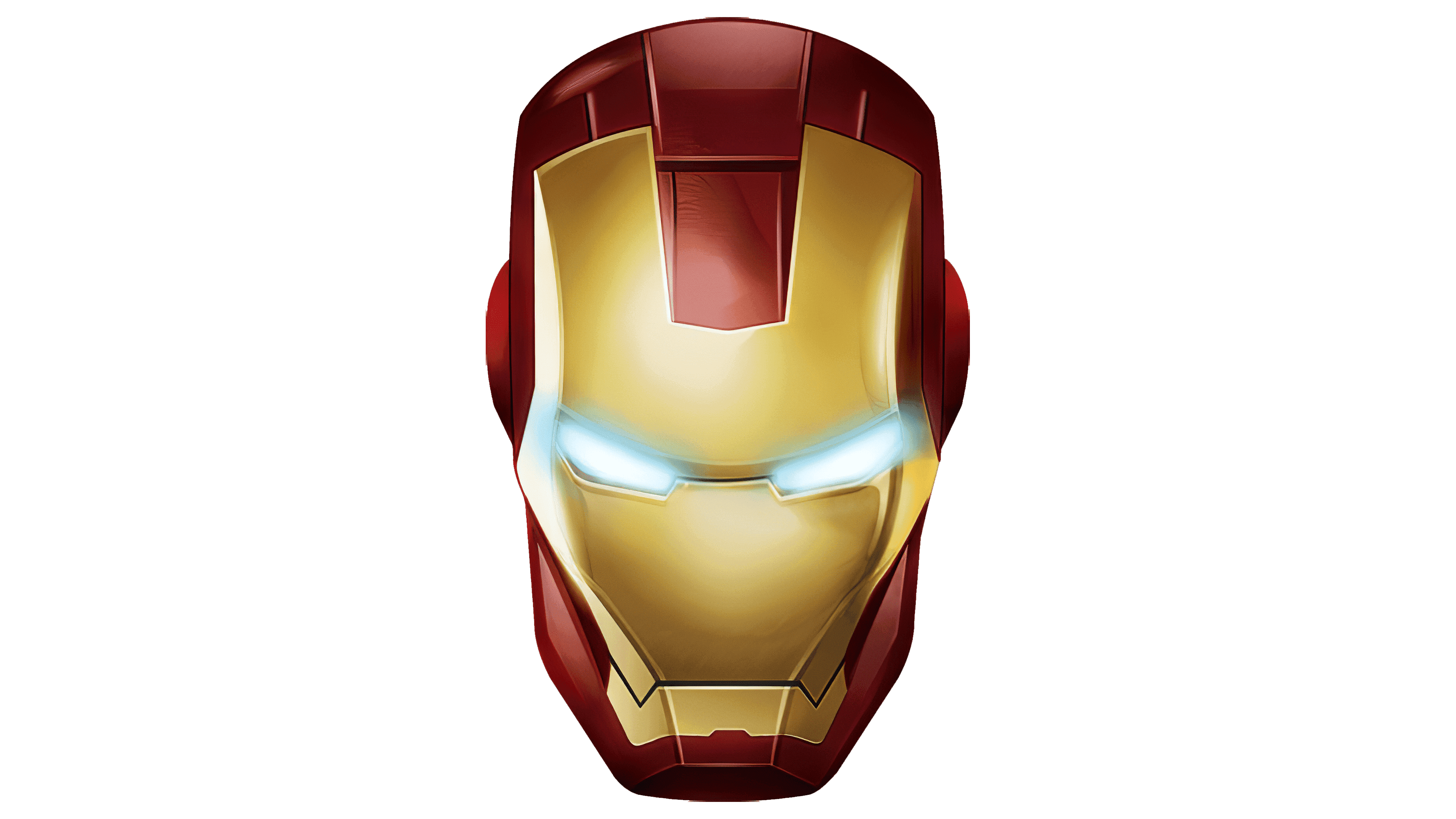
Alongside the wordmarks, Iron Man is represented by an emblem showing his helmet from the front. Its red and yellow colors come from the hero’s comic-book suit. In 1963, Steve Ditko developed the red-and-gold armor that replaced the earlier heavy suit. Red and gold became defining features of Iron Man, with yellow standing in for gold in the flat illustration.
A red shell outlines the head and frames the yellow faceplate. A red section extends from the crown to the middle of the forehead. Beneath it, narrow white eye slits angle toward the nose bridge. Angular cheek lines lead down to a rectangular chin section, forming the mask’s lower portion. The colors, faceplate contours, and eye shape identify the hero through the helmet alone.
The emblem uses solid color areas. The boundaries between the red and yellow surfaces convey the armor’s shape. At the same time, the white slits distinguish the eyes within the mask.
2010
In the 2010 Iron Man 2 logo, the sequel number became part of the metallic title. The numeral “2” appeared to the right of the name, matching the height of the elongated letters. Identically finished beveled edges united the title and number.
Compared with the first film’s logo, this version increased the contrast between dark front surfaces and illuminated edges. The faces became almost black, while gold tones remained along the borders and lower sections. Light along the facets gave the letters and numerals depth while preserving the title’s metallic appearance.
2013
The red of Tony Stark’s armor spread across the letters in the Iron Man 3 logo. It was unveiled at Comic-Con in July 2012, ahead of the film’s 2013 release. The red fill and metallic borders brought the title design closer to the hero’s armor.
Gold and silver facets added depth to the lettering. Dark recesses, scuff marks, and bright highlights covered the red front surfaces, suggesting worn metal. The numeral “3” extended the title, matching the letters in height, thickness, and finish. A small red rectangle containing the white MARVEL name appeared above it.
Font and Colors
Each logo element is executed in a restrained, strict style, with few broken or curved lines. Everything is extremely rigid and sharp, emphasizing the character’s inflexibility. Even the inscriptions have a metallic sheen and feature Iron Man’s image.
Josh Greenstein developed the wordmark for the first action movie (2008) at Paramount Studios. His colleague at the studio, Nancy Goliger, gave him the assignment. Uppercase symbols, iron textures, and reflections from metallic surfaces characterize the inscriptions.
The logo’s color matches the font: to emphasize iron, artists chose rusty shades of red, brown, and orange, paired with classic black and white.