 Juniper Networks Logo PNG
Networking technologies enable data transmission between devices, offices, and data centers, supporting digital services and corporate systems. Hardware and software solutions manage traffic, security, and access to resources. The Juniper Networks logo is associated with a company that develops networking hardware and software for corporate infrastructure.
Juniper Networks was founded in February 1996 by engineer Pradeep Sindhu, who previously worked at Xerox PARC. The main idea was to create a router that processes data flows faster than existing solutions. The venture fund Kleiner Perkins provided an initial $200,000 investment. Later, the investor New Enterprise Associates joined the project.
In 1997, the company signed cooperation agreements with IBM and Solectron. These partnerships enabled microchip development and the establishment of equipment manufacturing. In December of the same year, the company introduced its own operating system, JUNOS, designed for network equipment.
In 1998, the company released its first product, the M40. This router processed 40 million data packets per second. The innovation found a place in a market dominated by Cisco and brought the company its first $3.8 million in revenue.
By 1999, dozens of telecommunications operators used M40 routers, including Cable and Wireless and UUNET. Juniper began expanding its presence in Europe and Asia. By 2000, the company’s market share in backbone routers had reached 20 percent.
The company’s initial public offering on the NASDAQ in June 1999 was among the most successful for technology firms. Its market capitalization reached $ 4.9 billion. A year later, it exceeded $ 16 billion.
In 2004, the company acquired NetScreen Technologies for $4 billion, strengthening its position in network security. In the following years, Juniper acquired Ankeena Networks, Blackwave, and Trapeze Networks, expanding its product portfolio for the telecommunications market.
In January 2024, Hewlett Packard Enterprise announced its intention to acquire Juniper Networks. The deal was completed on July 2, 2025. After the merger, HPE and Juniper took key positions in the artificial intelligence infrastructure and hybrid cloud solutions market, marking a new stage in network technology development.
Meaning and History
What is Juniper Networks?
An American technology corporation from Sunnyvale that develops networking equipment for telecommunications operators, service providers, data centers, and government organizations. The company created the M40 router and the JUNOS operating system based on FreeBSD, becoming a competitor to Cisco. The product line includes MX, PTX, M, and T series routers, EX and QFX switches, and SRX gateways with firewall and VPN functions. After acquiring Mist Systems, it added wireless network and DDoS protection solutions. Juniper outsources manufacturing to contractors in Vietnam, Malaysia, Mexico, and Taiwan.
1996 – 1999

The name Juniper came from the founder’s family choosing it from several technical options. Pradeep Sindhu wanted the letters “IP,” representing Internet Protocol, in the name. He considered options such as IPCom and IPSwitch. He was also interested in the tree data structures behind the algorithms in the company’s earliest products. When the law firm Wilson Sonsini requested a name for the incorporation documents, Sindhu showed the list to his two children. Both chose Juniper. The English word refers to the juniper tree, while the letters “ip” within the name satisfied the original requirement.
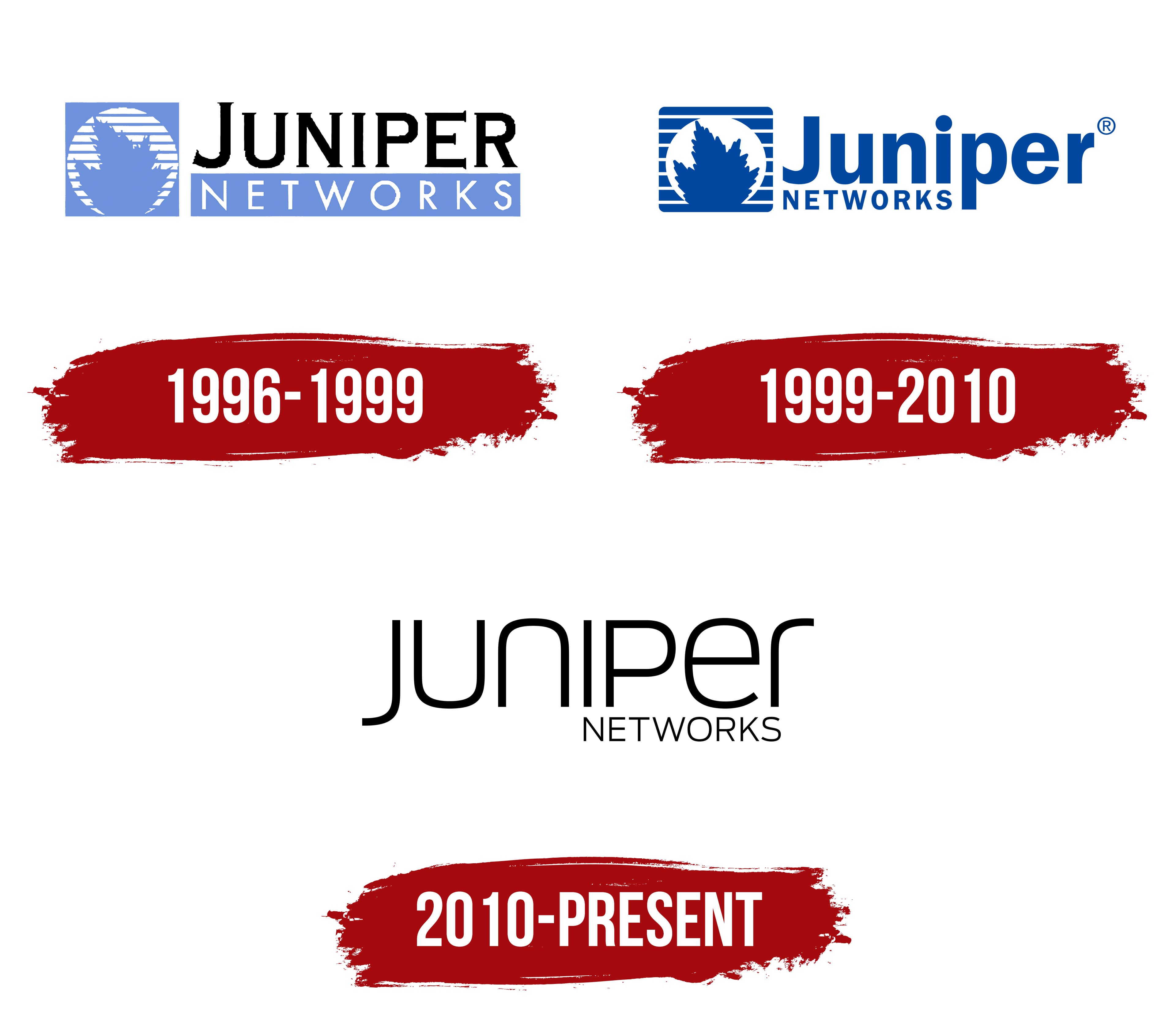
Juniper Networks began operations in February 1996. Pradeep Sindhu, an engineer from Xerox PARC, founded the company to develop high-performance routers. The equipment was designed to handle the growing volume of IP traffic. The first emblem linked the name Juniper to technology with images of a tree and a silicon wafer.
A light blue square with a subtle purple tint appeared on the left. It contained a circle made from horizontal white stripes of different lengths. The lines were interrupted in the center, leaving a blue silhouette of a juniper tree. A Juniper representative described the composition as a tree superimposed on a silicon wafer. The striped circle represented the company’s technological foundation, while the tree illustrated the origin of its name. The company said it chose the blue color for aesthetic reasons.
A two-line text block appeared on the right. The upper line featured “JUNIPER” in large black uppercase serif letters. The initial “J” was slightly elongated. Below it, “NETWORKS” appeared in white uppercase sans-serif letters. This word was placed inside a blue bar matching the square on the left. The heavy serif lettering emphasized the Juniper name, while the lower line identified the company’s industry. The logo appeared on its first routers and corporate materials.
1999 – 2010

Juniper Networks introduced its next logo around the time of its stock market debut. The company completed its IPO on NASDAQ in June 1999. By then, Juniper had already released the M40 router and the Junos operating system. The updated identity reflected the young technology company’s transition to public trading.
The emblem on the left became more compact. It featured a blue rectangle with rounded corners, crossed by white horizontal lines. The stripes formed a light circular area containing a solid blue silhouette of a juniper tree. The circle, lines, and tree connected the origin of the Juniper name with the company’s technological focus.
A two-line signature appeared on the right. The word “Juniper” began with a capital “J,” followed by lowercase letters. Its large sans-serif typeface had rounded forms and thick strokes. “NETWORKS” appeared below it, aligned with the left edge. The lower line used smaller uppercase letters with thin strokes and wider spacing.
The blue version used Pantone 293 (RGB 12, 71, 157). The emblem and lettering shared the same color, allowing the logo to be reproduced with a single ink. Corporate guidelines also provided blue, black, and white versions. The juniper silhouette and original typeface remained consistent, and the text was used alongside the emblem.
2010 – today
The 2009 global rebranding shifted Juniper Networks’ identity from the juniper tree to the company’s name. John McNeil Studio led the project, with Lippincott helping develop the identity. The program covered corporate design, brand architecture, signage, digital materials, the launch campaign, and the appearance of the company’s equipment. John McNeil Studio described the project as Juniper’s global relaunch.
The changes accompanied the company’s expansion beyond core network routers. By the late 2000s, Juniper was involved in switching, network security, software, proprietary chip development, and partner platforms. Telecommunications providers and enterprise customers used the company’s products. The new visual identity reflected this broader portfolio of technologies and services.
The presentation took place in New York on October 29, 2009, alongside the “New Network” initiative. Juniper was introduced as a provider of comprehensive networking systems with a broad product portfolio. The Junos brand, associated with the software foundation of the company’s equipment, also received an updated identity during this period.
The logo featured two lines of text. The upper line featured “juniper” in thin lowercase sans-serif letters. The initial “j” used the same lowercase style as the other letters. Rounded forms and increased spacing gave the wordmark a light, open appearance. “NETWORKS” appeared below, shifted slightly to the right. Its uppercase letters were smaller and narrower. Both lines appeared in black in most applications.
Hewlett Packard Enterprise completed its acquisition of Juniper Networks on July 2, 2025. The company became part of HPE’s networking business, and its corporate resources began using the name HPE Juniper Networking. The Juniper logo continued to appear in product division materials. Hewlett Packard Enterprise also acquired certain trademark rights.